

Soundproofing with Glass Railings: A Technical Guide
How Glass Railings Reduce Noise Transmission
Soundproofing with glass railings works because laminated glass physically interrupts sound waves before they pass through. A specialized PVB (polyvinyl butyral) interlayer bonded between two glass panes absorbs and dampens vibrations rather than letting them travel freely. The result: a significant noise reduction with acoustic laminated glass under standard conditions, which translates to hearing roughly 1/16th of the original sound volume at an STC 40 rating.
That said, glass choice alone does not determine performance. Framing, seals, and mounting hardware all contribute to the final result. A gap as small as a few millimeters around a panel can let sound bypass even the best acoustic glass entirely. The practical noise reduction range for a well-specified and properly installed glass railing system is substantial.
- Laminated glass with PVB interlayer: absorbs and slows sound waves at the interlayer
- Double glazing (IGU): adds an airspace between panes, increasing attenuation
- Glass thickness and configuration: heavier, thicker assemblies block more mid-to-high frequency noise
- Airtight seals and framing: prevent flanking sound from bypassing the glass entirely
What Types of Acoustic Glass Work Best in Railing Systems?
Not all laminated glass performs equally. The interlayer material and the overall glass configuration determine how much noise actually gets blocked.
Standard PVB Laminated Glass
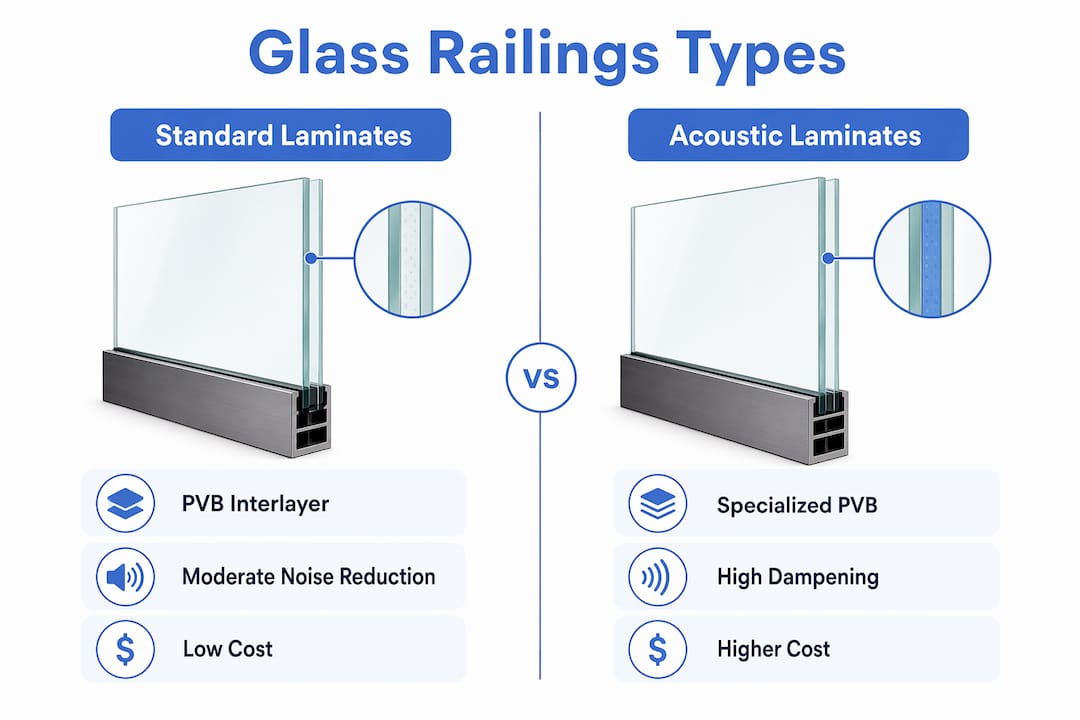
Standard laminated glass bonds two panes with a conventional PVB interlayer. It improves on monolithic glass for both safety and sound, but its acoustic performance is limited compared to specialized products. A 6.38mm standard PVB laminate typically achieves a moderate noise reduction, slightly better than 6mm monolithic toughened glass.
Acoustic PVB Laminated Glass
Specialized acoustic PVB interlayers provide meaningfully better dampening than standard laminates. The interlayer is engineered to absorb a broader range of sound frequencies, particularly the mid-range frequencies where traffic and human speech concentrate. A 6.5mm acoustic laminate reaches noticeably better noise reduction than its standard PVB counterpart of similar thickness.

Insulating Glass Units (IGUs) with Acoustic Laminate
Double glazing configurations combine the benefits of an airspace with laminated panes. An IGU with acoustic laminate inboard, such as a multi-pane configuration, can achieve high noise reduction performance. Adding argon gas fill and a low-emissivity coating improves both thermal and acoustic performance simultaneously.
Triple Glazing
Triple glazed units add a third pane and second airspace, offering the highest noise reduction available in a glazing system and suiting projects near airports, rail lines, or highways. The tradeoff is weight and cost, which matters for railing hardware selection and structural loading.
| Glass type | Typical performance | Best use case |
|---|---|---|
| 6mm monolithic toughened | Moderate sound reduction | Budget, low-noise environments |
| 6.38mm standard PVB laminate | Slightly better sound reduction | General safety and light sound reduction |
| 6.5mm acoustic PVB laminate | Improved sound reduction | Urban residential, moderate traffic |
| IGU 6/—/6.5 acoustic laminate | High sound reduction | High-traffic corridors, commercial |
| IGU 10/—/10.5 acoustic laminate | Highest sound reduction | Airports, rail, heavy industrial noise |
STC Ratings and Glass Thickness: What the Numbers Actually Mean
The Sound Transmission Class (STC) rating is the primary metric used in the United States to describe how much sound a glazing assembly blocks. An STC rating describes the approximate decibel reduction in sound transmission, with higher ratings indicating significantly better noise reduction.
For exterior glass railings, the Outdoor-Indoor Transmission Class (OITC) rating is often more relevant than STC. OITC weights low-frequency sounds like traffic and aircraft more heavily, which is exactly the noise profile most outdoor railings face. STC and OITC ratings are not linearly related, so a strong STC score does not guarantee a comparable OITC result.
Glass thickness affects which frequencies get blocked. Thicker, heavier panes resist low-frequency sound better. Thin panes have a natural resonance frequency, and sound near that frequency passes through with very little attenuation. This is called the coincidence effect, and it is why a single thick pane sometimes outperforms a thinner laminate for specific low-frequency noise sources like a slow-moving locomotive.
Pro Tip: Asymmetric glass assemblies, such as bonding a 6mm pane to a 10mm pane with an acoustic PVB interlayer, disrupt resonance frequencies and improve attenuation across a wider frequency range than symmetric assemblies of the same total thickness.
One more number worth knowing: laboratory STC and OITC ratings can overstate real-world performance by up to 6 dB due to installation variables. A 6 dB gap correlates with losing about one-third of the perceived sound reduction. Specify with that buffer in mind.
- STC 30–35: adequate for suburban residential settings with light traffic
- STC 36–40: recommended for urban balconies and commercial terraces
- STC 40+: required near highways, rail corridors, or industrial zones
Installation and System Design for Maximum Acoustic Performance
Glass selection accounts for roughly half the acoustic outcome. The other half comes from how the system is assembled and sealed. Sound leaks through gaps in framing and seals can negate the benefits of even a high-performing acoustic glass panel.
Sealing and Framing
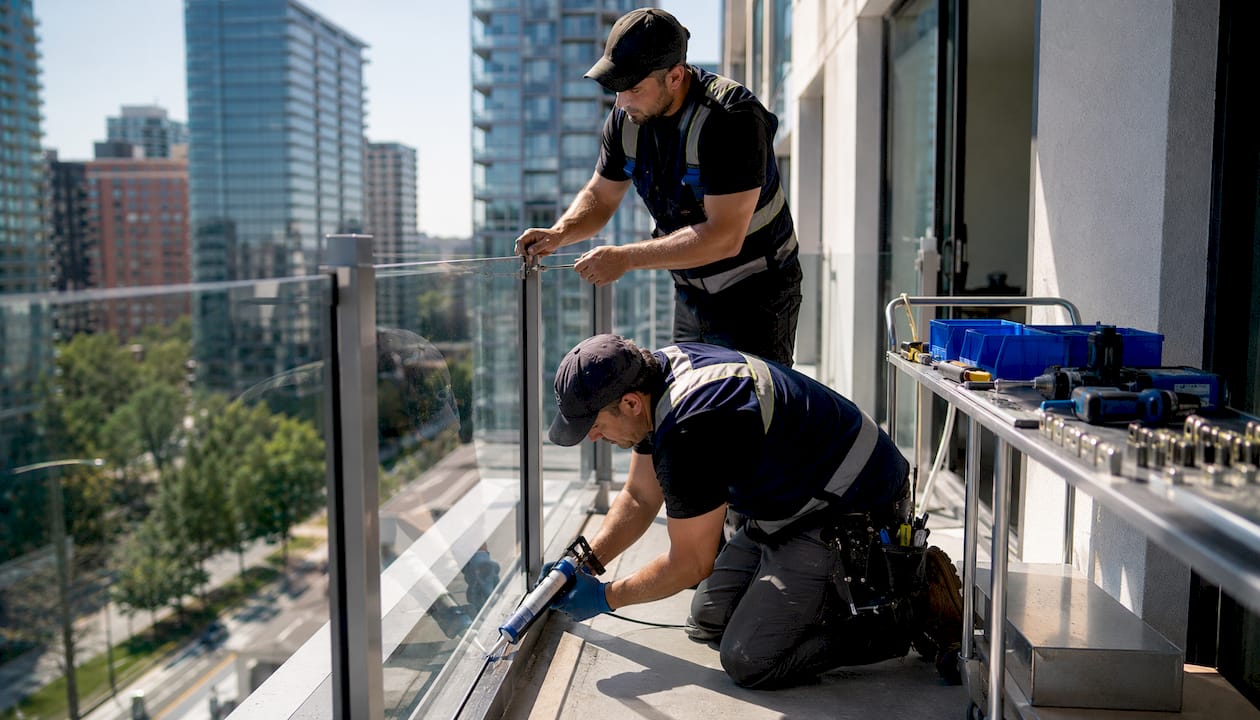
Every joint between the glass panel and its frame needs an airtight acoustic sealant. Silicone sealants rated for acoustic applications maintain flexibility over time without cracking, which matters on exterior railings exposed to thermal cycling. Even a small unsealed gap transmits sound at the same level as having no glass at all in that spot.
Frame Material and Vibration Isolation
Metal frames, particularly aluminum and stainless steel, can conduct vibration and transmit sound unless they incorporate vibration-damping gaskets or isolation pads. Frame material and design directly influence sound transmission alongside the glass itself. Rubber or EPDM setting blocks between the glass edge and the frame channel absorb vibration before it reaches the structure.
Mounting Hardware
The way glass panels attach to the structure affects both stability and acoustic integrity. Surface-mounted systems with proper isolation hardware perform differently from post-mounted or channel-mounted systems. Understanding how mounting types affect performance helps you choose the right approach before installation begins.
Maintenance and Long-Term Performance
Acoustic performance degrades when seals crack, hardware loosens, or gaskets compress over time. Routine maintenance of seals and hardware preserves the noise reduction you specified at installation. Inspect sealant joints annually, especially on exterior railings in climates with wide temperature swings.
Pro Tip: For projects where acoustic performance is a formal requirement, consult the National Council of Acoustical Consultants (NCAC) to find a qualified acoustic consultant who can verify your glass and framing specification against site-specific noise levels.
How to Choose the Right Soundproof Glass for Your Railing Project
Start with the noise source, not the product catalog. Traffic noise, aircraft, and rail all concentrate in lower frequencies, which favors thicker glass and IGU configurations. Human speech and music sit in mid-to-high frequencies, where acoustic PVB laminates perform well.
- Identify the dominant noise frequency: low-frequency sources (traffic, rail) need thicker glass or IGUs; mid-to-high sources (speech, music) respond well to acoustic PVB laminates
- Set a target STC or OITC rating: work backward from the ambient noise level outside and the acceptable interior level
- Account for the 6 dB installation gap: if you need STC 34 in practice, specify STC 40 in the glass
- Compare interlayer options: standard PVB laminates cost less; acoustic PVB interlayers deliver meaningfully better performance for a moderate price premium
- Factor in weight and hardware: thicker IGUs add load; confirm your railing hardware and structure can support the glass weight before specifying
| Glass option | Noise reduction | Relative cost | Best fit |
|---|---|---|---|
| Standard PVB laminate | Moderate | Low | Light suburban noise |
| Acoustic PVB laminate | Good | Moderate | Urban residential, commercial |
| IGU with acoustic laminate | High | Higher | High-traffic, commercial |
| Triple glazed acoustic IGU | Highest | Premium | Airports, rail, industrial |
Budget planning should treat acoustic glass as a performance specification, not an upgrade. The cost difference between standard laminated glass and acoustic laminated glass is moderate, while the performance gap is real and measurable. IGU configurations cost more and add structural complexity, but they are the right call when ambient noise levels demand STC 38 or above.
Ready to build a glass railing system that actually performs acoustically? Glassrailingstore carries the hardware and panels you need to put a properly specified system together. Start with a 46" tempered glass panel and pair it with the right connectors for your mounting configuration.

Key Takeaways
Acoustic performance in glass railings is a system property: laminated glass with a specialized PVB interlayer, airtight seals, vibration-isolating frames, and correct hardware all work together to achieve up to 40 dB noise reduction with acoustic laminated glass, and up to 35 dB noise reduction in laminated glass balcony railings using PVB and stainless steel clamps.
| Point | Details |
|---|---|
| Laminated glass with acoustic PVB | Reduces noise by up to 40 dB for acoustic laminated glass, and up to 35 dB in balcony railing assemblies with PVB and stainless steel hardware; outperforms standard PVB laminates at similar thickness. |
| STC vs OITC ratings | Use OITC for exterior railings; STC and OITC are not interchangeable and do not scale together. |
| Asymmetric glass thickness | Combining panes of different thicknesses disrupts resonance and improves attenuation across frequencies. |
| Installation gap allowance | Lab ratings overstate real-world performance by up to 6 dB; specify higher than your target. |
| Seals and framing matter | A single unsealed gap can eliminate the acoustic benefit of even a high-rated glass assembly. |
Recommended
- The Science Behind How Glass Railings Resist Impact – The Glass Railing Store
- Glass Railing Structural Integrity: Expert Guide to Safety & Durabilit – The Glass Railing Store
- Glass Railing Top Rails: Required or Optional? – The Glass Railing Store
- Glass Railing for Photography Staging: 2026 Guide – The Glass Railing Store