

Glass Railings and Their Role in Unobstructed Views
Most homeowners assume that adding a railing to a deck, balcony, or rooftop means giving up the view they paid for. That assumption made sense when railings meant solid wood planks or iron bars stacked every few inches. The role of glass railing in unobstructed views flips that entire equation. A properly installed glass system gives you the safety code requires while preserving the panorama your property sits in front of. This guide breaks down how glass railings work as a design tool, which systems suit different budgets and styles, and what real ownership looks like year to year.
Table of Contents
- Key takeaways
- The role of glass railing in unobstructed views
- Framed, frameless, and semi-frameless systems
- Practical benefits beyond the view
- Maintenance and what to realistically expect
- Safety codes, glass thickness, and installation basics
- My take on why glass railings change the conversation
- Glassrailingstore has the systems to make it happen
- FAQ
Key takeaways
| Point | Details |
|---|---|
| Glass beats every opaque material | Wood, wrought iron, and most metal railings physically block sightlines that glass keeps fully open. |
| Frameless systems maximize views | Frameless glass railings use minimal hardware, so nearly nothing interrupts your line of sight. |
| Safety codes are already solved | Continuous glass panels inherently close the 4-inch gap rule, meeting code without balusters. |
| Maintenance is manageable | Glass needs cleaning more often than cable but far less upkeep than wood staining and sealing cycles. |
| Property value follows visibility | A clear railing benefits the sale price and curb appeal of any modern home or development project. |
The role of glass railing in unobstructed views
Before comparing materials, it helps to be precise about what “unobstructed view” actually means in architectural terms. An unobstructed view railing is any system that allows your eye to travel from where you stand to the horizon without a solid object interrupting that path. That sounds simple, but most traditional railing materials fail this test badly.
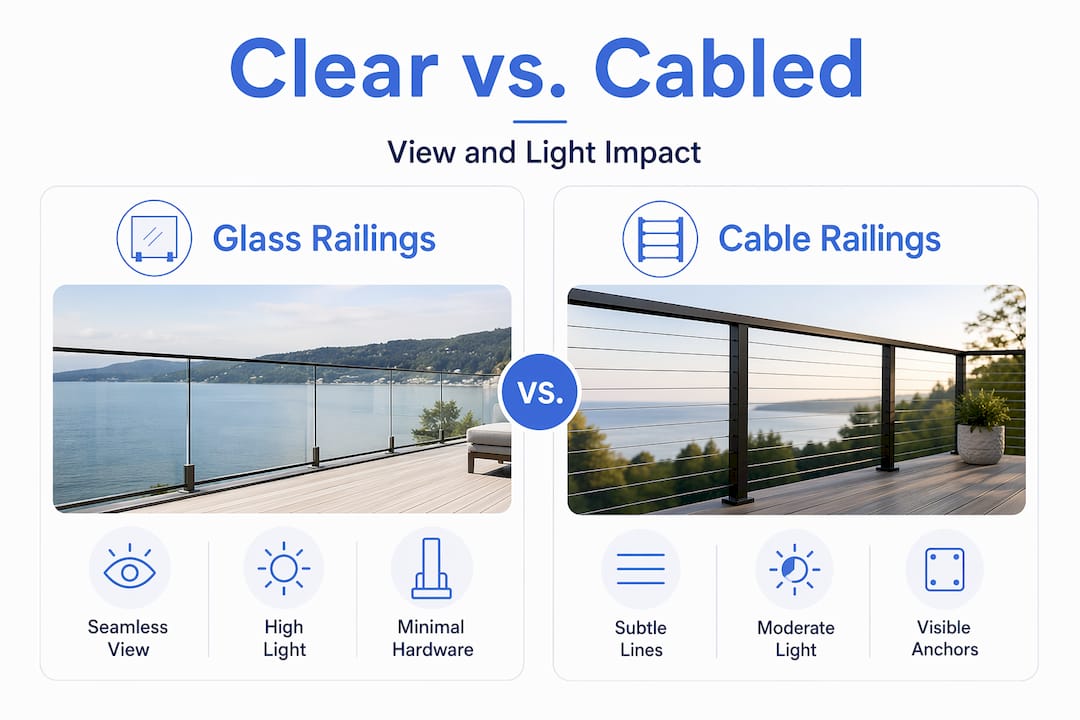
Wood balusters create a picket-fence effect. Wrought iron repeats vertical bars every few inches. Even aluminum cable systems, which are often marketed as low-profile, still require horizontal cables spaced roughly three inches apart, and those lines draw the eye in exactly the wrong direction when you are looking at a mountain range or a waterline.
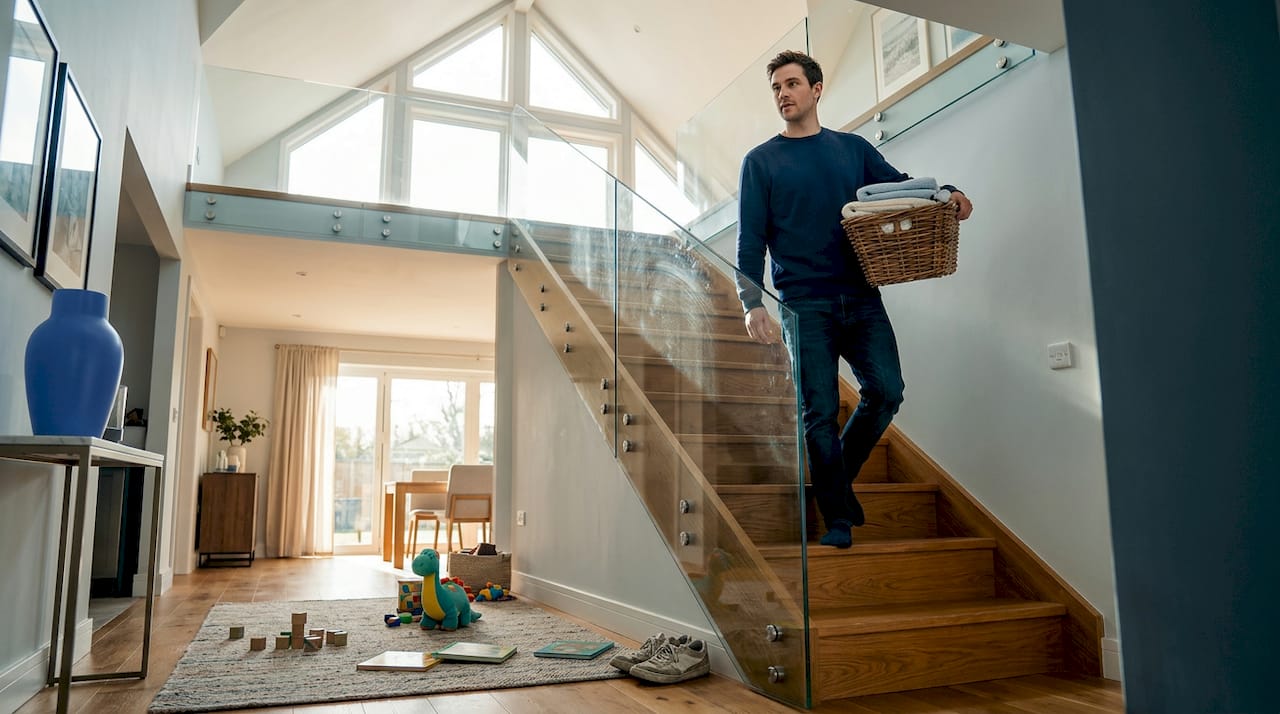
Glass railings create continuity between spaces, allowing natural light to flow and sightlines to remain intact. That is the core technical advantage. The glass panel occupies the same physical space a wood or metal barrier would, but it does not register visually the same way. Your brain processes transparent surfaces differently from opaque ones, which is why a glass wall feels like an opening rather than a barrier.
Here is a direct comparison of how common railing materials affect sightlines:
| Material | View impact | Light transmission | Maintenance level |
|---|---|---|---|
| Tempered glass | None to minimal | High | Moderate |
| Cable railing | Low (horizontal lines) | High | Low |
| Wood balusters | High (solid vertical bars) | None | High |
| Wrought iron | High (solid vertical bars) | None | Moderate to high |
| Aluminum picket | High (vertical bars) | None | Low |
Pro Tip: If your property sits on a slope, waterfront, or elevated lot, the view is part of the asset. Glass is the only railing material that lets you photograph or sell that view without the railing appearing in every shot.
Modern architecture prioritizes visual openness over physical separation, favoring glass systems to create indoor-outdoor connections that reduce artificial lighting needs. That is not a styling preference. It is a documented shift in how architects approach spatial design.
Framed, frameless, and semi-frameless systems
How glass railings enhance views depends enormously on which system you choose. The three main categories differ in hardware visibility, cost, and the quality of the sightline they deliver.
Frameless glass railings use thick tempered panels (typically 1/2 inch or 5/8 inch) secured by base shoes or standoff clamps at ground level. There is no top rail running across the glass and no vertical posts interrupting the panel face. Frameless systems are popular for luxury homes and modern architecture because of their nearly invisible appearance. They are the clearest answer to how glass railings enhance views.
Framed glass railings use aluminum or steel posts and a top rail that borders each glass panel. The hardware is visible, but framed systems offer structural support and a lower price point, balancing affordability with modern style. For a rooftop deck in a city setting, the frame can actually read as a design element rather than a visual interruption.
Semi-frameless systems split the difference. Posts appear at intervals, often every four to six feet, but the glass spans between them without a continuous top rail. You get more visual openness than a fully framed system at less cost than a fully frameless one.
Here is what each system does to your sightline:
- Frameless: near-total transparency, hardware visible only at the base
- Semi-frameless: posts visible at intervals, glass panels fully open between them
- Framed: top rail and posts clearly visible, glass panels still fully transparent
You can see real applications of these systems in modern glass deck designs to understand how each reads in a finished outdoor space before committing to one.
Pro Tip: If you have a 180-degree panoramic view, go frameless and position the base shoes toward the interior face of the deck so nothing breaks the horizon line when you are seated.
Practical benefits beyond the view
Glass barriers and visibility are the most talked-about selling points, but glass railings deliver a longer list of real-world advantages that matter once you own them.
Safety is the non-negotiable starting point. Tempered safety glass is engineered to fracture into small, blunt pieces rather than sharp shards. That matters on decks where kids run and where a break could otherwise cause serious injury. Most quality systems use glass that has passed impact and load testing.
Wind is a less obvious but significant factor.
“Glass railings provide wind resistance while maintaining clear views, making rooftop and high-elevation decks usable year-round.” (housedigest.com)
For anyone building out a rooftop space in a coastal or elevated area, that is not a minor point. A cable railing on a windy rooftop turns a dining table into a windstorm. Glass makes the space genuinely functional across more months of the year.
The property value case is equally strong. Glass railings improve property value and curb appeal by delivering a sleek, modern aesthetic that aligns with contemporary open-plan living trends. Buyers in 2026 are not looking at homes with wood balusters and thinking “premium.”
Additional practical benefits include:
- Natural light amplification: glass does not block sunlight the way opaque materials do, so adjacent interior spaces stay brighter
- Space perception: transparent barriers make decks and balconies feel larger than they are
- Year-round usability on exposed decks due to wind protection
- Pool fence compliance: continuous glass panels meet pool fence codes in most jurisdictions without additional hardware
Maintenance and what to realistically expect
Clear railing benefits come with one honest tradeoff. Glass shows water spots, fingerprints, and salt film more visibly than cable or aluminum systems. That is not a dealbreaker, but it is something to plan for.
Glass railings require cleaning to maintain transparency, though they need far less upkeep than wood, which demands annual staining or sealing cycles. A standard maintenance routine looks like this:
- Wipe down panels with a non-abrasive glass cleaner every two to four weeks in humid or coastal areas
- Inspect hardware and base shoes for corrosion quarterly, especially in salt air environments
- Check panel seating in base shoes after major storms
- For frameless systems, inspect the silicone or setting blocks that cushion the glass annually
Cable railing is often cited as a lower-maintenance alternative because the cables themselves need minimal attention. That is accurate for the cables. However, the posts and tensioners still require inspection, and the visual trade-off (those horizontal lines across your view) is significant.
A comparison of long-term maintenance demands:
| Material | Annual tasks | Cost driver | Lifespan with care |
|---|---|---|---|
| Tempered glass | Cleaning, hardware check | Replacement panels | 20+ years |
| Cable railing | Tension adjustment | Hardware replacement | 15-20 years |
| Wood | Staining, sealing, rot checks | Replacement sections | 10-15 years |
Pro Tip: In coastal environments, choose marine-grade stainless steel hardware for your glass railing system. Standard steel will surface rust within one to two years of salt air exposure, even with coatings.
Safety codes, glass thickness, and installation basics
One of the most common questions property developers ask is whether glass railings actually meet building codes, or whether the open panel face creates a compliance problem. The answer is the opposite of what most people expect.
Building codes require that railing openings be smaller than 4 inches to prevent safety hazards. Continuous glass panels eliminate gaps entirely, surpassing the baluster spacing rule that governs picket and cable systems. Glass railings are not harder to make code-compliant. They are structurally better positioned to comply.
Here is a simple process for approaching installation with safety and code in mind:
- Confirm your local jurisdiction’s railing height requirement (typically 36 inches for decks under 30 inches high, 42 inches for elevated decks).
- Select the appropriate glass thickness for railings based on your system type and local load requirements (3/8 inch for framed systems, 1/2 inch to 5/8 inch for frameless).
- Verify that your glass is tempered and labeled as safety glazing per ANSI Z97.1 or CPSC 16 CFR 1201 standards.
- Review glass railing building codes for your specific application, including deck, stair, balcony, or pool fence.
- Engage a certified installer for structural connections, especially on elevated or post-tension concrete decks.
Professional installation matters most at the connection point between the base shoe or post anchor and the structural substrate. That single connection handles the lateral load from someone leaning into the railing. Getting it wrong is not a cosmetic problem.
My take on why glass railings change the conversation
I’ve worked around glass railing projects long enough to notice a consistent pattern. Homeowners come in skeptical. They have seen cheap glass pool fences that looked fine for two years and then turned hazy and scratched. They assume that is the category.
What I’ve found is that the gap between budget-grade glass railing products and professional-grade tempered systems with marine-grade hardware is enormous, and most people don’t know to ask about it. The impact of glass on scenery is real and lasting when the system is specified correctly. The disappointment happens when someone chooses hardware based on price alone and then lives with the result.
My honest advice: do not compromise on the hardware. The glass itself is commodity-priced now. The base shoes, standoffs, and connectors are where quality actually lives. I’ve seen frameless systems installed 15 years ago that still look factory-new because the hardware was specified right the first time.
The other thing I’ve observed is that most people underestimate how much the view matters to daily quality of life once you have it. A homeowner who fights the glass railing decision for months usually becomes the person telling everyone they know to stop hesitating.
— Fuanne
Glassrailingstore has the systems to make it happen

Glassrailingstore carries the full range of professional-grade glass railing systems built for exactly this: preserving your view without cutting corners on safety or durability. From frameless deck panels to pool fence systems, every product is built from tempered safety glass paired with marine-grade stainless steel hardware that holds up in real outdoor conditions.
If you need confidence that your system will pass inspection, the glass railing engineering testing service provides the documentation your project requires. For installation, the certified installer network connects you with professionals who know code requirements in your region. And if you need a tailored solution, the custom glass railing option lets you specify dimensions, hardware finish, and system type to match your exact design intent. Free shipping applies on orders over $3,000.
FAQ
1. What is an unobstructed view railing?
An unobstructed view railing is any railing system that allows an uninterrupted sightline from the railing’s position to the surrounding scenery. Glass railings are the most effective type because the panels are fully transparent, unlike wood, metal, or even cable systems, which all introduce visible lines or solid surfaces.
2. How do glass railings enhance views compared to cable railings?
Cable railings reduce obstruction compared to wood or metal balusters, but the horizontal cable lines still draw the eye and segment the view. Glass panels are fully transparent, so the view reads as a single continuous image with no lines crossing it.
3. Do glass railings meet building safety codes?
Yes. Code-compliant glass railings use continuous panels that close all gaps, which actually exceeds the baluster spacing requirements that govern other railing types. Tempered safety glass also meets standard impact and load requirements when specified correctly.
4. How often do glass railings need to be cleaned?
In most residential settings, a cleaning every two to four weeks keeps panels clear. Glass decks need less maintenance than wood but are more susceptible to water spots and fingerprints, so frequency depends on weather exposure and use.
5. Does a glass railing increase my property value?
Glass railings align with contemporary architectural trends favoring open-plan living and natural light, and buyers actively seek that aesthetic. The combination of visual openness and modern design consistently supports higher perceived property value.
Recommended
- Glass Railings & Deck Railing Systems – The Glass Railing Store
- How glass railings boost property value and appeal – The Glass Railing Store
- Tempered glass advantages: enhance safety and design outdoors – The Glass Railing Store
- Examples of deck railings: modern glass designs – The Glass Railing Store