

Choosing safe and stylish glass thickness for railings
Most homeowners and developers assume there’s a single approved thickness for glass railings, the way there’s a standard size for light switch covers. That assumption can lead to costly mistakes, failed inspections, or worse, a railing that looks stunning but fails under pressure. Glass thickness for railings isn’t governed by a universal number. It’s governed by performance, and understanding that distinction will save you time, money, and risk on your next project.
Table of Contents
- Why glass thickness matters for railings
- How building codes and engineering standards impact your choice
- Common glass thickness options: Uses, pros, and cons
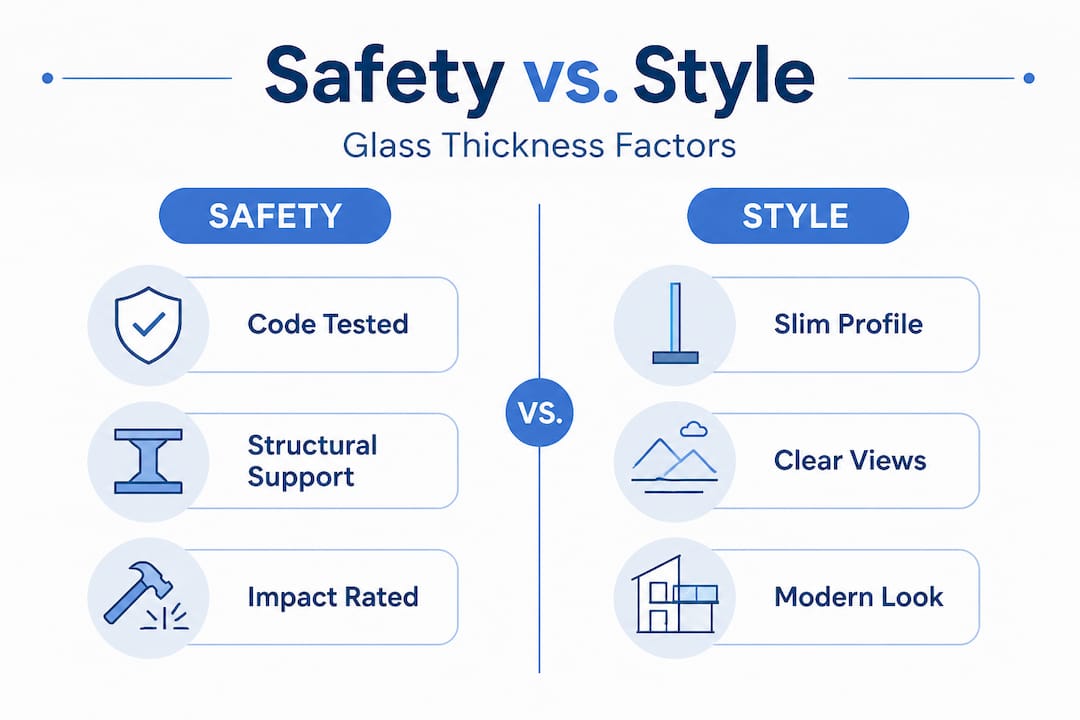
- Style vs. safety: Balancing elegance with engineering
- What to ask your supplier or installer before you buy
- Why there’s no “one-size-fits-all” for glass thickness
- How to ensure your project gets safe and compliant glass railings
- Frequently asked questions
Key Takeaways
| Point | Details |
|---|---|
| No universal standard | Glass thickness should always be justified through code-driven engineering tests, not generic rules. |
| System performance over specs | Both the glass and mounting system must pass actual load and impact tests for safety. |
| Balance style and safety | The best design meets legal requirements and delivers the look you want. |
| Ask for test results | Always demand engineering test evidence and certifications from your supplier or installer. |
Why glass thickness matters for railings
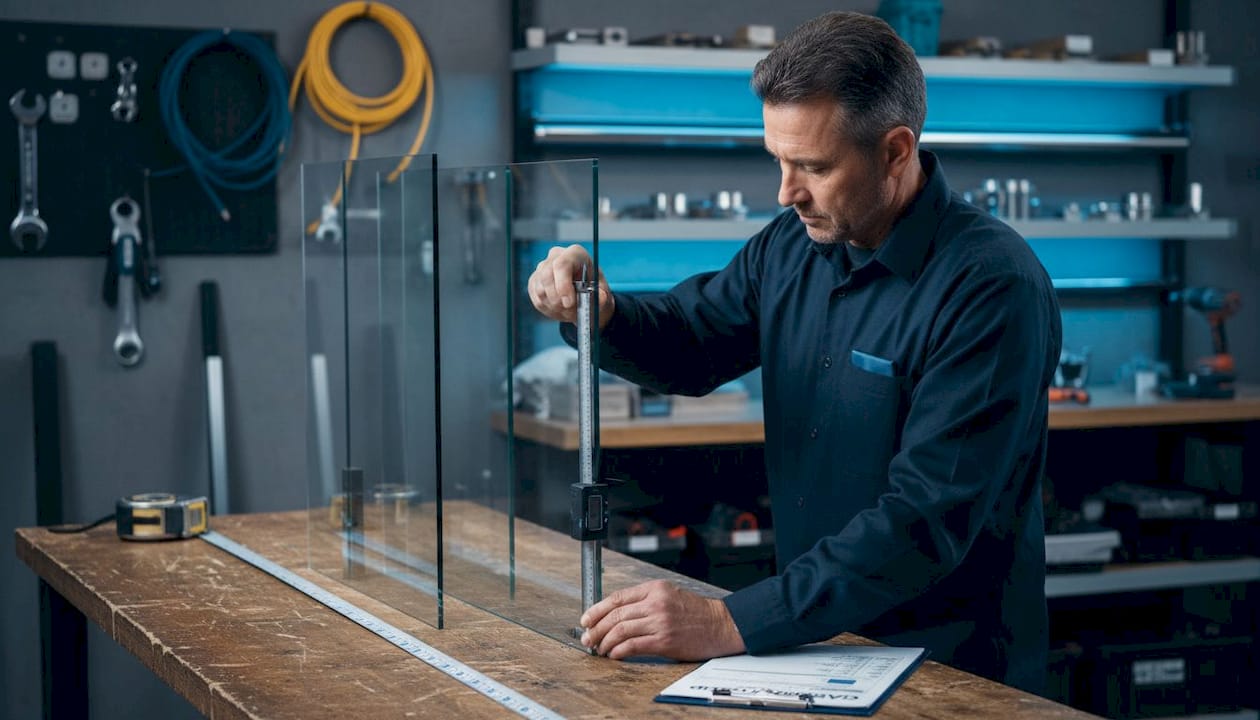
Glass thickness isn’t just a number on a spec sheet. It’s the foundation of how a railing panel responds to force, weather, impact, and long-term wear. Choose too thin, and a panel can deflect dangerously under load. Choose without checking the engineering, and you may pass visual inspection but fail a load test.
Here’s what thickness actually determines:
- Force resistance: Thicker panels resist lateral pressure, like someone leaning against the railing or wind loading on a high-rise balcony, more effectively than thinner ones.
- Deflection under load: A panel that flexes too far under force may not break, but it can dislodge from its mounting hardware, creating a fall hazard.
- Post-breakage behavior: This matters enormously. Tempered glass shatters into small, relatively safe pebbles. Laminated glass holds together even when cracked. The right thickness, combined with the right glass type, determines how a failure unfolds and how survivable it is.
- Aesthetics: Thinner glass (3/8 inch) has a sleek, almost invisible quality that homeowners love for modern decks. Thicker glass (3/4 inch) carries visual weight and a sense of permanence, which suits commercial spaces and grand staircases.
“Thickness should be justified through system design and performance evaluation, not as a standalone rule.”
Function must come before form, always. That said, the right system design can absolutely give you both. Glass railing testing covers exactly how panels are evaluated for real-world conditions, including static strength, impact performance, and post-breakage behavior, all of which factor into which thickness is appropriate for your specific installation.
Pro Tip: Before selecting a glass panel, ask the manufacturer for the product’s test certification. This tells you what load the panel has actually been proven to handle, not just what the spec sheet claims.
Engineering and test standards for glass railing design focus on performance criteria, specifically static strength, impact performance, and post-breakage characteristics, rather than prescribing a single thickness for all situations.
How building codes and engineering standards impact your choice
Understanding the “why” behind glass thickness, it’s time to see how codes and engineering realities set the rules for every project.
No single national code tells you to use exactly 1/2 inch glass everywhere. What codes like the International Building Code (IBC) and International Residential Code (IRC) do is require that your railing system withstand specific loads and pass certain impact tests. The glass thickness that satisfies those requirements depends on the span between supports, the height of the railing, the mounting system used, and whether the application is residential or commercial.
Here’s a simplified look at how occupancy type influences common thickness ranges:
| Occupancy type | Typical glass thickness | Performance basis |
|---|---|---|
| Single-family residential | 3/8 inch to 1/2 inch | IRC load and impact requirements |
| Multi-family residential | 1/2 inch | IBC performance evaluation |
| Commercial (restaurants, retail) | 1/2 inch to 5/8 inch | IBC load, wind, and impact criteria |
| High-rise or exposed exterior | 5/8 inch to 3/4 inch | Structural engineering and wind load analysis |
| Pool fencing | 3/8 inch to 1/2 inch | Safety glazing and impact standards |
These ranges are not universal guarantees. They reflect common outcomes when panels are engineered and tested appropriately for each context. Glass railing code basics explains how these code frameworks apply to typical residential and commercial projects.
How to check your local requirements before you buy:
- Identify your jurisdiction. Building codes vary by state and sometimes by county or city. Some states adopt the IBC directly; others have amendments.
- Contact your local building department. Ask specifically about glazing standards for guardrails and handrails, including any state amendments.
- Review the referenced standards. Codes often point to ASTM or other technical standards for testing requirements. Understanding that standards check performance under load, not just glass thickness, helps you ask better questions.
- Work with a qualified engineer or certified supplier. If your project involves unusual spans, high exposure, or commercial occupancy, get a stamped engineering review.
State-specific resources can be invaluable here. For example, if you’re building in the Midwest, the Ohio building code page walks through local requirements that affect glass selection in that state. Your state may have similar resources.
Common glass thickness options: Uses, pros, and cons
With the basics down, let’s see how the most popular thicknesses stack up for different needs.
The four thicknesses you’ll encounter most often are 3/8 inch, 1/2 inch, 5/8 inch, and 3/4 inch. Each has a legitimate role in the right application. The key is matching thickness to the engineering requirements of your specific project, not just picking what looks good or what costs less.
| Glass thickness | Best for | Pros | Cons |
|---|---|---|---|
| 3/8 inch | Interior railings, low-span residential decks | Lightweight, sleek appearance, lower cost | Limited to shorter spans and lighter loads |
| 1/2 inch | Residential decks, balconies, pool fencing | Versatile, most common, good strength | Heavier than 3/8, slightly higher cost |
| 5/8 inch | Commercial spaces, larger spans, exposed outdoor | Strong, handles wider spans and wind load | Heavier to install, more expensive |
| 3/4 inch | High-rise, commercial, custom high-load applications | Maximum rigidity, impressive visual weight | Heavy, expensive, requires robust hardware |
A few specifics worth knowing:
- 3/8 inch glass is popular for interior stair railings and low-traffic residential decks where spans are short and loads are light. It provides that almost invisible look many modern designers prefer. However, it’s not appropriate for all outdoor applications.
- 1/2 inch glass is the most widely used thickness for residential outdoor railings. It strikes the balance between strength, weight, and cost that most homeowners and contractors need.
- 5/8 inch glass becomes relevant when spans exceed 36 to 42 inches between mounting points, or when wind exposure is significant. Commercial restaurants with open-air patios, for instance, often specify this thickness.
- 3/4 inch glass is reserved for demanding applications: high-rise terraces, heavy-traffic commercial environments, or custom projects where visual impact is part of the design intent.
As a general rule, thickness must be justified through system design rather than applied as a rule of thumb. If your supplier can’t explain why a particular thickness was selected, that’s a red flag.
State codes add another layer. If you’re working in the western U.S., reviewing California requirements is essential, as California’s Title 24 and other regulations include specific glazing performance standards that affect thickness selection.
Style vs. safety: Balancing elegance with engineering
Now that you know the range of options, how do you make a choice when looks and code aren’t always in sync?
This tension is real. A homeowner building a beach house deck may fall in love with the barely-there look of 3/8 inch glass. An architect designing a rooftop lounge may want floor-to-ceiling panels with minimal visual interruption. Both are valid aesthetic goals. But neither can override the engineering requirements that keep people safe.
Here’s where most projects go sideways: someone selects a glass thickness based on appearance or budget, then tries to justify it after the fact. That backward approach creates real risk. A panel that looks fine can still flex, deflect, or fail under lateral force if it hasn’t been tested in the configuration it’s being used in.
The mounting system matters as much as the glass itself. A 1/2 inch panel in a properly engineered base shoe system may outperform a 5/8 inch panel in a poorly designed standoff mount. Heavier glass is not automatically safer glass. The system as a whole, glass, hardware, attachment points, and substrate, determines performance.
Real-world example: A contractor installs 3/8 inch glass on a second-story deck because the homeowner prefers the slim profile. The spans between base shoe sections are 48 inches, which exceeds what 3/8 inch glass is typically rated for at that height. The installation passes a visual inspection but fails when a load test is applied during the permit process. The result is a complete reinstallation at significant cost, plus a project delay. Choosing the right glass from the start, guided by engineering rather than aesthetics, would have prevented both problems.
Pro Tip: Don’t rely on appearance to verify safety. Ask your supplier to provide the load test results and impact certification for the exact glass and mounting combination you’re purchasing. That documentation is what protects you during inspections and after installation.
In states like Georgia, where outdoor living spaces are common year-round, the Georgia code for railings spells out the performance criteria that apply to both residential and commercial glass railing systems. Knowing your local requirements before selecting glass thickness is always the smarter path.
Thickness should be justified through system design and performance evaluation, not chosen on looks alone or as a rule of thumb applied across different project types.
What to ask your supplier or installer before you buy
Armed with knowledge, you’ll want to make sure your supplier or installer is equally rigorous about safety and code.
Many suppliers can sell you glass. Fewer can verify that the glass they’re selling has been tested for your specific application. These questions will help you tell the difference fast:
- What test certifications do these panels carry? Look for documented testing to ASTM standards or equivalent, covering static load, impact, and post-breakage performance.
- How was this thickness evaluated for my specific installation? Span, height, exposure, and mounting type all affect what thickness is appropriate. If the answer is “this is what we always use,” that’s not sufficient.
- Is the mounting hardware rated for this glass thickness and load? Glass and hardware must be evaluated together. Mismatched components undermine the entire system.
- What post-breakage behavior can I expect? Tempered glass shatters safely but completely. Laminated glass holds in place. Know what happens if impact occurs.
- What warranty or performance guarantee comes with the system? Reputable suppliers stand behind both the glass and the hardware.
“Testing, not guesswork, should determine what’s safe.”
This applies equally to your supplier’s knowledge. If they can’t answer these questions with documentation, engineering and performance testing standards exist precisely to give you a baseline for evaluating what you’re being sold. Engineering/test standards for glass railing design are performance-based, so your supplier should be able to confirm which standard applies to your project and how their product meets it.
Why there’s no “one-size-fits-all” for glass thickness
Here’s the opinion most articles in this space avoid giving: the common belief that thicker glass equals safer railings is not just an oversimplification. In some cases, it’s genuinely backwards.
We’ve seen projects where contractors specified 3/4 inch glass because it “feels more solid” only to install it in a base shoe system that wasn’t engineered to handle the added weight and rigidity. The result is stress concentration at the mounting points, micro-cracking over time, and a railing that is actually more likely to fail catastrophically than a properly engineered 1/2 inch system would be.
Modern building codes and experienced engineers prioritize system-level performance precisely because regulations are based on verified performance, not glass thickness alone. The test results matter. The engineering drawings matter. The matching of glass to hardware to substrate matters. The thickness number on the spec sheet is just one variable in a much larger equation.
The practical takeaway: if someone tells you a project is safe because the glass is thick, ask them to back that claim up with test documentation. Safety that can’t be verified on paper isn’t safety you can count on. Every well-designed system, from balcony railings to stair guards, gets its credibility from engineering testing that proves the whole assembly performs under real conditions.
True safety means asking the right questions before you buy, not after you install.
How to ensure your project gets safe and compliant glass railings
Choosing glass thickness isn’t the last decision you’ll make. It’s the first in a series of choices that determine whether your railing looks great for years and holds up under inspection, weather, and daily use.

At Glass Railing Store, every system we offer is built around engineering-tested systems that go through rigorous performance evaluation. We don’t just sell glass panels. We provide the documentation, hardware compatibility guidance, and building code guidance that help you make the right call for your specific project from day one. Whether you’re building a single-family deck or a multi-story commercial terrace, our team connects you with certified installers who understand both the engineering and the aesthetics of glass railing systems. Reach out for a free consultation and let’s make sure your project gets done right.
FAQs
1. What is the minimum glass thickness for a residential railing?
There is no single minimum thickness that applies universally. Minimum thickness depends on verified performance testing and local code requirements, but most residential railings use 3/8 to 1/2 inch tempered glass when tested and engineered correctly.
2. Can I use thinner glass for interior railings?
Sometimes yes, but only when the full system, including mounting hardware and span distances, passes the required safety tests for that specific application. Thickness must be justified through performance testing and system design, regardless of whether the railing is inside or outside.
3. Does using thicker glass make my railing safer?
Not automatically. Both the glass and the mounting system must meet code-tested performance requirements together. Thick glass in an under-engineered mount can be more dangerous than properly tested thinner glass in a rated system.
4. What is the most popular glass thickness for outdoor decks?
Most outdoor residential decks use 1/2 inch tempered glass, but the final selection should always be confirmed against your local code and engineering standards. Common choices are 1/2 inch but must still be justified by the system design and load requirements for your specific installation.
5. What type of glass is best for railing safety?
Tempered and laminated glass that has been certified and tested specifically for railing use are the most reliable options. Tempered glass is the standard for most applications, while laminated glass is preferred where post-breakage integrity is a priority, such as overhead or high-traffic commercial railings.
Recommended
- Ohio Glass Building Code for Glass Railings – The Glass Railing Store
- How to calculate safe baluster spacing for glass railings – The Glass Railing Store
- Building Codes for Glass Railings – The Glass Railing Store
- Top Glazing Tape Solutions for Secure Glass Railings – The Glass Railing Store
- Films de sécurité pour vitrages : types et critères clés