

Specifiers: 8 Glass Railing Clamp Families and When to Use Each
Glass railing clamps fall into eight main families: D-shaped, square, round, Z-shaped, glass-to-glass, adjustable, floor/spigot, and wall-mounted. D-shaped and square clamps handle standard post-mounted balconies and decks; round clamps suit curved runs; Z-shaped clamps fix flush-mount offsets; glass-to-glass connectors join corner panels without posts; adjustable connector clamps correct uneven substrates on stairs; floor clamps carry frameless pool and terrace railings; wall-mounted clamps work in tight shower and interior spaces. Match every choice to your glass thickness and stainless grade before ordering.
TL;DR:
- Compatibility requires matching glass thickness with clamp family, with load-heavy applications demanding thicker or laminated glass for safety.
- Stainless steel grade selection depends on location, with 316 or duplex alloys essential for coastal or poolside settings to prevent corrosion.
- Proper substrate preparation and precise installation torque are critical to prevent failure, especially in high-wind or high-traffic areas.
- Frameless systems support larger glass thicknesses, but demanding careful planning for structural reinforcement and environment considerations.
- Shape choices like round, square, or D-shaped clamps are primarily aesthetic, while core factors include gasket contact, screw engagement, and alloy grade.
Table of Contents
- Types of Glass Railing Clamps: What Each Family Does
- How Do Glass Thickness and Material Grade Affect Clamp Choice?
- How Do You Choose the Right Clamp for Your Project?
- Where to Find Compatible Clamps and Panels
- What Actually Matters When You’re Choosing a Clamp
- Get Matched Glass and Hardware From One Supplier
- Sources
- FAQ
Types of Glass Railing Clamps: What Each Family Does
Shape and mounting method drive most clamp decisions, and the complete guide to clamp types from Aleader Machinery breaks the category into three useful layers: shape (D, square, round), mount (glass-to-wall, glass-to-glass, glass-to-floor), and function (adjustable or heavy-duty). Once you understand those layers, picking a family for your project gets a lot faster.
- D-shaped clamps. The workhorse of post-mounted balcony and deck railings. The rounded profile hides fastener heads and reads as understated rather than industrial. Most accept 6mm to 12mm glass and mount to a top rail, post, or wall.
- Square clamps. Same job as D-shaped clamps but with crisp, geometric lines that pair naturally with square posts and contemporary architecture. AODSON’s breakdown of clamp families notes that square versus round is largely an aesthetic call. Structural performance depends on gasket contact area and screw engagement, not the outer shape.
- Round (circular) clamps. Best suited to curved railing runs, cylindrical posts, and traditional or nautical-style designs. The rounded body wraps cleaner around a radius than a squared-off clamp ever will.
- Z-shaped clamps. Built for flush-mount and offset conditions, where the glass needs to sit forward or back from its mounting surface rather than directly against it. Common on staircases where a post placement forces an offset.
- Glass-to-glass and corner clamps. These connect panels directly at 90°, 135°, or 180° angles without an intermediate post, which is what gives frameless corner runs their unbroken sightline. Glazing edge quality matters here more than in post-mounted setups, since the connector grips glass on two sides instead of one.
- Adjustable (angle) clamps. Pivot ranges, often 0° to 42° depending on the model, let installers compensate for uneven stringers on stair runs or out-of-level substrates. That flexibility is valuable on renovations, though it adds a mechanical joint that needs checking during inspection for retained clamping force.
- Floor-mounted (spigot) clamps. Support glass from underneath rather than through a top rail or post, which is what makes fully frameless railings possible. Bohle’s floor glass clamp line covers glass from 10mm to 17.52mm and includes height-adjustable and angle-adjustable variants for terraces, pool enclosures, and staircases.
- Heavy-duty clamps. Deeper screw engagement, thicker wall sections, and higher-grade stainless steel for code-critical guardrails, commercial installations, and high-traffic public spaces where failure isn’t an option.
- Wall-mounted and shower clamps. Space-saving anchors that eliminate the need for a floor spigot or post entirely. Common in bathrooms and tight interior corridors where floor space is scarce. Wall clamp hardware for glass interior doors follows a similar logic, anchoring panels directly to a vertical surface instead of a base.
Frameless and base-mounted systems keep sightlines the cleanest, but they generally demand thicker glass and more substrate reinforcement than a standard post-mounted railing.
How Do Glass Thickness and Material Grade Affect Clamp Choice?
Every clamp family carries a published thickness range, and mismatching glass to clamp is the single fastest way to fail an inspection. Metraxion’s guide to glass clamps notes that light-duty clamps commonly accept 6mm to 12mm glass, while floor and base clamps often cover 10mm to 17.52mm. That gap exists because floor-mounted systems carry more of the structural load without a top rail to help.
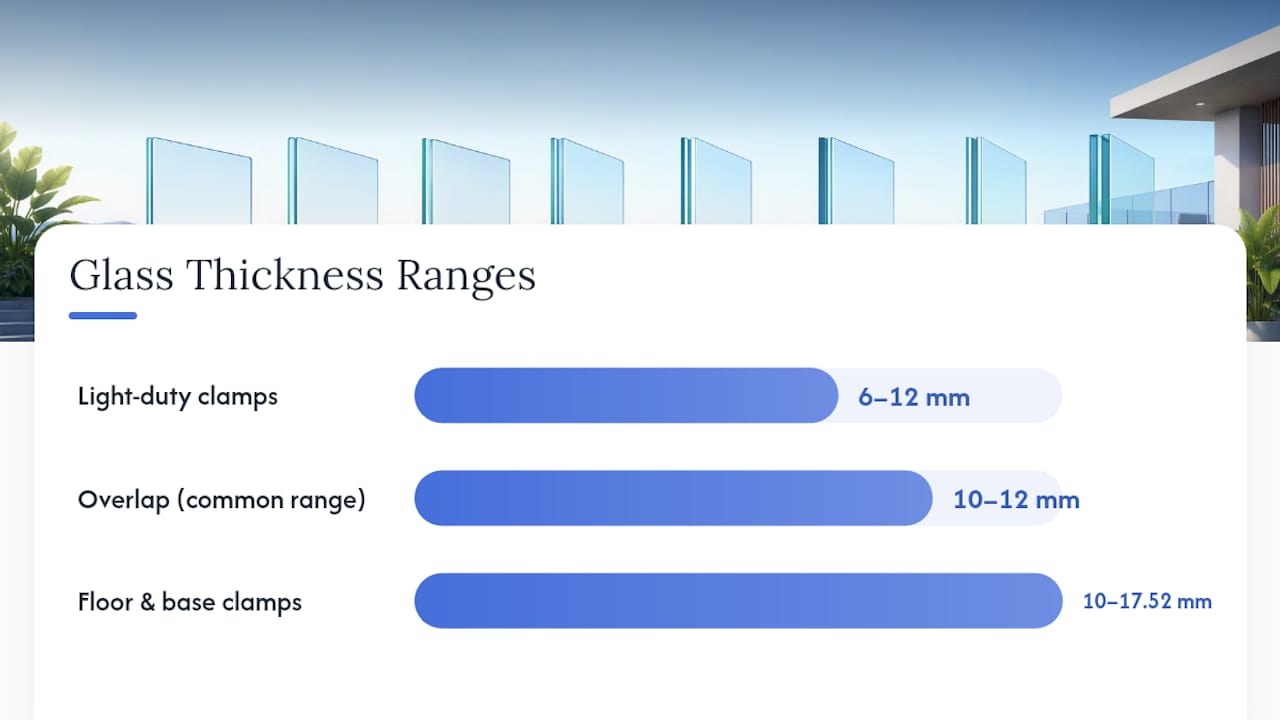
Statistic Callout: Bohle’s floor clamp line handles glass thicknesses between 10mm and 17.52mm, with angle-adjustable models covering a 0° to 42° range. That range alone explains why floor clamps dominate pool fence and terrace specifications where post-mounted options fall short on load capacity.
Quick compatibility notes worth keeping on hand:
- Laminated glass or thicker tempered panels are typically required for guardrail-height balcony and deck railings under most residential codes.
- 304 stainless steel works fine indoors or in dry, sheltered exterior locations.
- 316 stainless steel or duplex 2205 alloys resist corrosion far better in coastal, poolside, or high-humidity settings.
- Satin finishes hide fingerprints and water spots better than mirror polish, which shows every smudge in a pool enclosure.
- Powder coat and PVD finishes trade a bit of shine for lower long-term maintenance.
For pool decks and coastal properties specifically, run through a short corrosion checklist before ordering: confirm the alloy is 316 or duplex 2205, verify the gasket material tolerates chlorine and salt exposure, and ask whether the finish is rated for continuous moisture contact. Skipping that check is how a clamp that looks fine in the showroom starts pitting within a season.
How Do You Choose the Right Clamp for Your Project?
Run through this sequence before you place an order:
- Identify the application. Balcony, staircase, pool fence, shower panel, and interior room divider each favor a different clamp family.
- Confirm glass specs. Nail down thickness and whether laminated glass is required before you shop clamps, not after.
- Assess the environment. Coastal or poolside settings push you toward 316 or duplex 2205 stainless, regardless of which shape you prefer.
- Check load and code requirements. Guardrail-height railings on decks and balconies usually carry stricter load rules than a shower panel.
- Decide if you need adjustability. Uneven stringers or out-of-level substrates make adjustable clamps worth the extra mechanical complexity.
- Match the finish to the rest of the hardware. Mixing satin and mirror finishes on the same run looks like an installation error even when it isn’t.
Substrate prep varies by mounting type. Post-mounted clamps need a solid, level post face. Floor and spigot clamps need a reinforced concrete or structural substrate with proper anchoring and drainage so water doesn’t pool around the base plate. Wall-mounted clamps need blocking or masonry anchors rated for the glass load, not just drywall anchors.
During installation, seat the gasket fully before tightening, and tighten fasteners progressively in a cross pattern rather than cranking one screw down first. Follow the manufacturer’s torque specification exactly. Over-tightening cracks glass edges; under-tightening leaves the panel loose. Use threadlocker or locking fasteners on any clamp exposed to vibration or wind load.
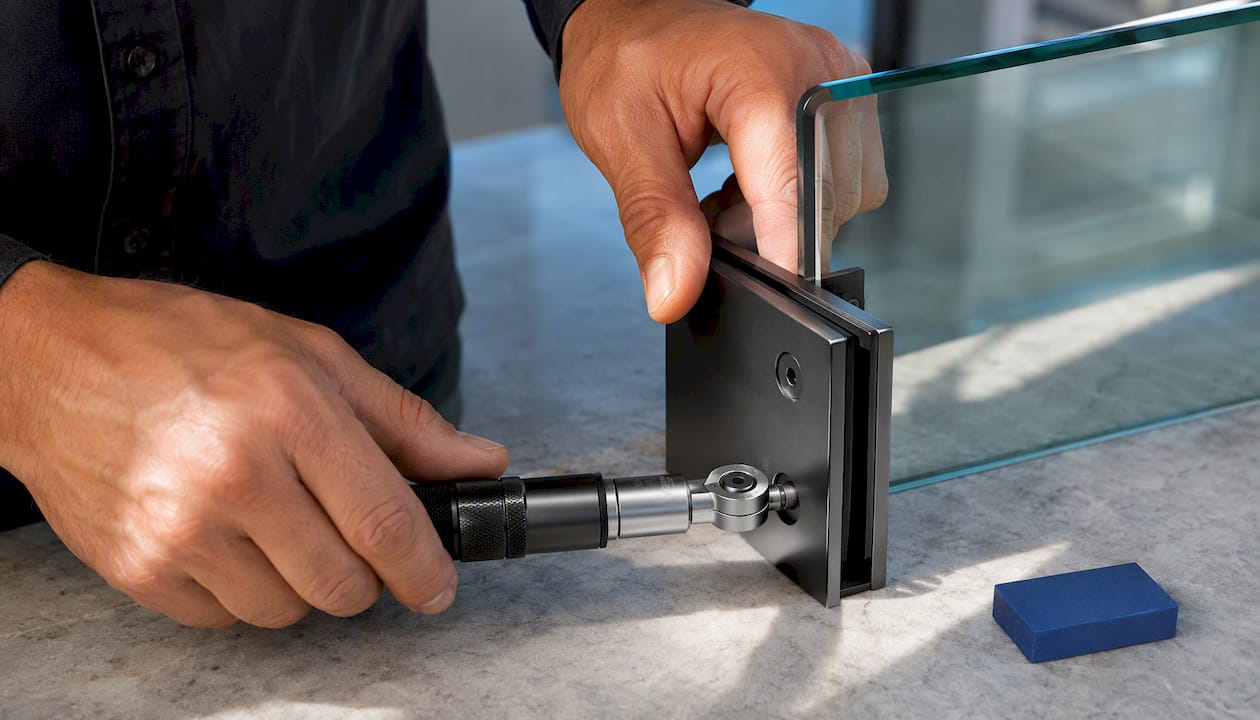
Pro Tip: Keep the manufacturer’s torque spec sheet on the job site. A clamp tightened to “feel right” instead of to spec is the most common callback we hear about, and it’s entirely preventable.
Watch for these red flags: a gasket that doesn’t fully seat against the glass edge, a clamp stamped 304 going into a poolside installation, screws that spin freely past the torque point, and glass edges without adequate support depth inside the clamp body. For deck and balcony guardrails, unusual spans, or high-wind locations, bring in a structural engineer before finalizing the glass railing’s structural specifications.
Where to Find Compatible Clamps and Panels
Glassrailingstore stocks tempered glass panels and the connector hardware that pairs with them, so you can match thickness, alloy, and finish in one order instead of chasing parts across multiple suppliers. A few practical next steps once you know your clamp family:
- Measure your panel run and check it against a glass thickness selection guide before finalizing dimensions.
- Review whether your application needs laminated glass using this safety-focused thickness guide.
- Browse 46-inch tempered glass panels sized for standard guardrail heights.
- Request a quote or shop drawing before ordering hardware for a code-critical run.
What Actually Matters When You’re Choosing a Clamp
Most guides treat clamp selection as an aesthetic decision first, structural second. That order is backwards. Square versus round versus D-shaped is genuinely a style call, and nobody should agonize over it. What deserves the agonizing is gasket contact area, screw engagement depth, and alloy grade, because those three variables determine whether the railing survives ten years of weather or starts corroding in two.
The overrated variable is clamp shape. The underrated one is substrate prep. A beautifully specified 316 stainless floor clamp bolted into an under-reinforced concrete slab will fail before a plain 304 D-clamp on a properly blocked post ever does. Contractors chase the visible decision and skip the invisible one.
If you take one thing from this guide, take this: decide your environment and load requirements first, alloy and thickness second, and shape last. Frameless aesthetics look fantastic in photos, but they demand more planning upfront than a simple post-mounted rail. Plan for that reality instead of discovering it mid-installation.
— Fuanne
Get Matched Glass and Hardware From One Supplier
Glassrailingstore cuts out the guesswork of sourcing tempered glass panels and clamp-compatible hardware from separate vendors who don’t coordinate specs with each other. Every panel listed is sized for standard clamp families, and the connector catalog covers the corner, wall, and caprail hardware that pairs with the clamp types covered above.

If your project calls for corner joins without posts, the 90-degree connector for glass railing and 180-degree connector both match the glass-to-glass clamp category discussed earlier. Homeowners running a square caprail system will find matching straight and corner connectors built for the same profile. For wall-mounted runs like shower enclosures or interior dividers, the wall connector for glass railing fits the mounting method covered in the types section above.
Start by measuring your panel dimensions and confirming your thickness requirement, then request a quote to get hardware and glass specified together instead of pieced together after the fact.
Sources
- Floor glass clamps
- Stainless Steel Glass Clamps: Types, Materials & Uses | AODSON
- Glass Clamps: The Complete Guide to Types, Sizes, and Installation - Aleader Machinery
- What Is a Glass Clamp? Ultimate Guide for Railings & Balustrades
FAQ
1. What Are the Three Main Types of Glass Clamps?
A common three-way split is shape (D-shaped, square, round), mount (glass-to-wall, glass-to-glass, glass-to-floor), and function (adjustable or heavy-duty), according to the classification used by Aleader Machinery. In practice, most projects choose a mounting method first, then a shape that fits the design.
2. What Are the Different Types of Glass Railing Systems?
Glass railing systems generally break into post-mounted, floor/spigot-mounted, and glass-to-glass frameless systems, each using a different clamp family suited to that mounting style. Post-mounted systems handle most decks and balconies; floor-mounted spigots support pool fences and frameless terraces; glass-to-glass systems skip posts entirely for the cleanest sightline.
3. What Glass Thickness Do Floor Clamps Support?
Floor clamps typically support glass from 10mm to 17.52mm, which is thicker than most post-mounted clamp ranges of 6mm to 12mm. The extra thickness compensates for the lack of a top rail carrying part of the load.
4. Should I Use 304 or 316 Stainless Steel for My Clamps?
Use 316 stainless steel or duplex 2205 alloy for coastal, poolside, or high-humidity installations, and reserve 304 stainless for interior or sheltered exterior use. Manufacturers including Bohle recommend duplex 2205 specifically where corrosion resistance is a priority.
5. Do Adjustable Clamps Weaken the Railing?
Adjustable clamps don’t weaken a properly installed railing, but the pivoting mechanism adds a joint that needs periodic inspection to confirm it still holds full clamping force. They’re most valuable on renovations and long stair runs where the substrate isn’t perfectly level.