

What is wholesale glass railing: A complete guide
Wholesale glass railing is one of those terms that sounds straightforward until you realize most people picture it wrong. The assumption is that it simply means buying consumer glass panels in bulk at a discount, like ordering extra tiles for a bathroom floor. The reality is more specific and considerably more useful. What is wholesale glass railing actually refers to a supply model where tempered or laminated glass panels are fabricated to project drawings, pre-drilled, edge-finished, and delivered to the jobsite as installation-ready units. For homeowners, developers, and contractors managing outdoor deck, balcony, stair, or pool fence projects, understanding this distinction changes how you plan, budget, and execute your railing installation.
Table of Contents
- Defining wholesale glass railing and its core components
- Tempered vs. laminated glass: Safety and performance considerations
- Fabrication precision and engineering alignment in wholesale glass railing
- Building codes, safety standards, and common regulations for glass railings
- Practical steps and considerations when ordering wholesale glass railing
- Why choosing wholesale glass railing is smarter for modern projects
- Get started with wholesale glass railing from trusted industry experts
- Frequently asked questions
Key Takeaways
| Point | Details |
|---|---|
| Wholesale definition | Wholesale glass railing means bulk, project-specific panels fabricated for installation, not just consumer retail glass. |
| Glass types | Tempered glass offers impact strength, laminated glass provides post-breakage safety by holding shards together. |
| Fabrication precision | Panels are custom fabricated to exact project specs including holes, edges, and mounting interfaces for guaranteed fit. |
| Code compliance | Glass railings must meet building codes including height, load, and openings safety standards, vital for permitting. |
| Ordering process | Confirm measurements, drawings, and permits before ordering to ensure fit, safety, and avoid costly mistakes. |
Defining wholesale glass railing and its core components
Wholesale glass railing generally means glass railing components supplied in bulk as installation-ready units, rather than consumer retail packaging. That single sentence carries a lot of weight. It means your panels show up with holes already drilled for standoff hardware, edges already polished or beveled to spec, and dimensions already cut to match your approved drawings. Nothing left to figure out in the field.
A typical wholesale glass railing order includes several coordinated components working together:
- Tempered or laminated glass panels cut and fabricated to exact project dimensions
- Pre-drilled holes placed according to hardware layouts (standoffs, spigots, or channel mounts)
- Edge finishing such as polished, seamed, or beveled edges for durability and appearance
- Mounting hardware coordination so the glass integrates directly with channel systems, base spigots, or embedded posts
- Bulk panel consistency across all units so every piece installs identically without field adjustment
The difference between this and walking into a glass retailer is significant. Retail glass is a raw material. Wholesale glass railing is an engineered component. You are not buying glass and then figuring out what to do with it. You are receiving a finished part that fits into a pre-defined system.
Wholesale fabrication treats every panel as a functional safety element rather than a decorative surface. Dimensions, hole placement, and edge work are locked in before production, not guessed during installation.
One thing many first-time buyers miss is that local building codes for glass railings govern what those fabrication details must be. Panel thickness, hole size, edge-to-hole distances, and temper requirements all exist because these panels carry structural loads and protect people from falls. A supplier who fabricates to spec with this in mind is a completely different category of vendor than a glass cutter filling a retail order.
Tempered vs. laminated glass: Safety and performance considerations

Once you understand what wholesale glass railing is, the next question is almost always about glass type. Two options dominate the market, and the choice between them affects safety performance, cost, and what your local code will accept.
Tempered glass is a single sheet of annealed glass that has been heat-treated to increase its strength. When it breaks, it shatters into small, relatively blunt pieces rather than sharp shards. That behavior makes it significantly safer than standard glass for guard applications. It is favored for impact strength prior to failure, which is why it is the most common choice for residential decks and exterior balconies.
Laminated glass is two or more glass layers bonded with a plastic interlayer (usually PVB or SentryGlas). When it breaks, the interlayer holds the fragments together. The panel stays mostly intact instead of falling away. It is specified when improved retention is required after breakage, which matters in elevated or high-traffic locations where a failed panel falling is as dangerous as the break itself.
| Feature | Tempered glass | Laminated glass |
|---|---|---|
| Breakage pattern | Small blunt pieces | Fragments held by interlayer |
| Post-breakage integrity | Panel collapses | Panel stays in place |
| Best application | Residential decks, standard guards | Overhead, elevated, or high-security |
| Sound reduction | Minimal | Moderate to significant |
| Relative cost | Lower | Higher |
| Code acceptance | Widely accepted | Required for specific locations |
Pro Tip: If your project is on a second-story deck over a pedestrian area or a commercial property with high foot traffic, specify laminated glass even if your code only requires tempered. The retained-fragment behavior eliminates the risk of a failed panel injuring someone below.
Consider glass safety requirements in your jurisdiction before locking in your glass type. Some municipalities go beyond baseline code and require laminated glass in specific applications regardless of height.
Fabrication precision and engineering alignment in wholesale glass railing
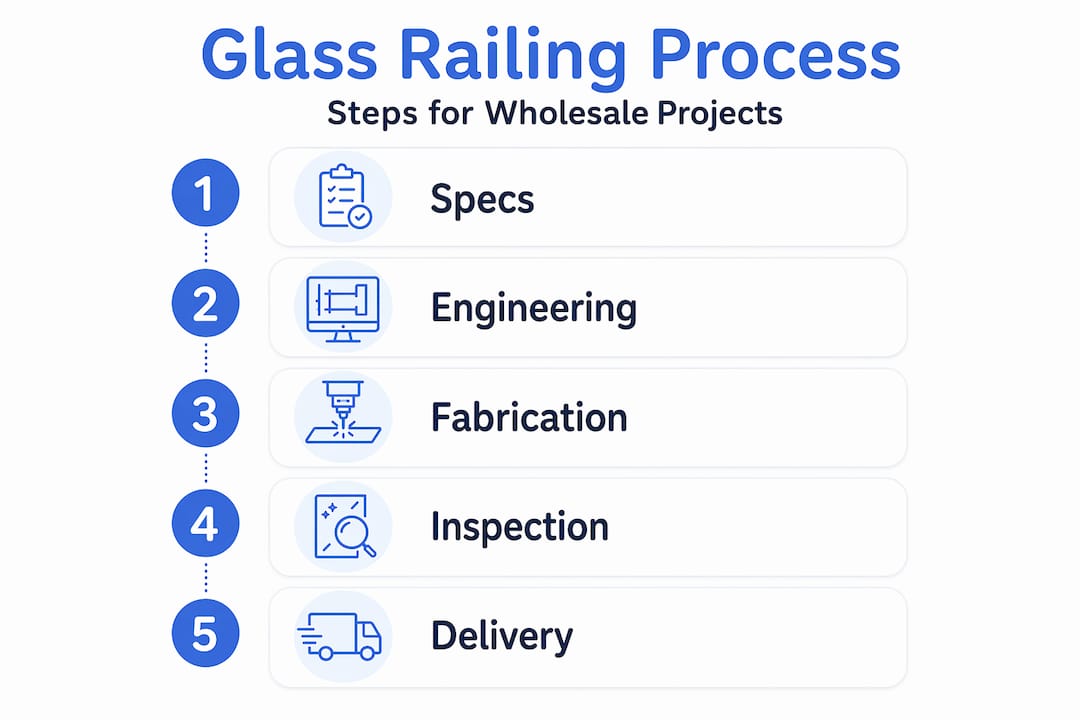
This is where wholesale glass railing separates itself most clearly from anything you could source at a local glass shop. Fabrication in a wholesale context is a manufacturing process driven by engineering documents, not a custom cutting job driven by rough measurements.
Here is what a proper wholesale fabrication spec looks like in practice:
- Approved drawings submitted by the contractor or engineer showing panel dimensions, post locations, and mounting system details
- Glass type and thickness confirmed based on structural load requirements and code compliance
- Hole patterns specified indicating exact center locations, diameters, and edge distances for standoff hardware
- Edge work detailed including polish grade, chamfer spec, or bevel for exposed edges
- Mounting system coordinated so channel bases, spigots, or core-drilled anchors are sized to match the glass spec
Wholesale orders coordinate layouts, mounting systems, edge detailing, and hole placement so panels arrive jobsite-ready, aligning perfectly with drawings. That coordination is the value you are paying for, and it prevents the single most common expensive mistake in glass railing installation: receiving panels that do not match your hardware.
The reason this cannot be improvised is straightforward. The complete spec package includes glass type, thickness, hole patterns, edge work, and load transfer to mounting systems, because installers cannot field-engineer after fabrication. A tempered glass panel cannot be cut or re-drilled after heat treatment. If the holes are wrong, the panel is scrap.
Pro Tip: Before submitting your fabrication order, have your installer or engineer sign off on the hole location layout. A five-minute review at the drawing stage eliminates the possibility of receiving panels that cannot be installed. See how glass railing engineering testing validates the full spec package for structural compliance.
Building codes, safety standards, and common regulations for glass railings
Glass railing sits in an interesting regulatory category. It is both an architectural finish and a life safety product, which means the rules are non-negotiable and enforced through permit inspections. Understanding these rules before you order saves you from redesigning after fabrication.
The key deck railing code requirements vary by jurisdiction but consistently cover these parameters:
| Code requirement | Common standard |
|---|---|
| Minimum guard height (residential) | 36 inches |
| Minimum guard height (commercial or elevated) | 42 inches |
| Top rail concentrated load | 200 lbs at any point |
| Infill horizontal load | 50 lbs per square foot |
| Maximum opening size | 4-inch sphere must not pass |
| Glass specification | Safety glazing required (tempered or laminated) |
- Guard height starts at 36 inches for most residential applications but increases to 42 inches for commercial buildings and decks more than 30 inches above grade in many jurisdictions
- Opening restrictions require that no opening in the infill allows a 4-inch sphere to pass through, a rule specifically designed to prevent child entrapment
- Load requirements mean your mounting system and glass panels must be tested and rated, not just estimated
- Safety glazing mandates that all glass used in guards be either tempered or laminated, standard annealed glass is prohibited
Many codes require openings to prevent a 4-inch sphere from passing through guard systems, which directly affects panel spacing and any framing details. This is not optional for inspection.
Glass railing code treats glass as a life safety product, requiring safety glazing and engineered design to meet height, load, and safety rules.
Check your glass railing building codes early in design, and verify against your local California glass railing code if your project is in that state, since California has additional requirements beyond the IBC baseline.
Practical steps and considerations when ordering wholesale glass railing
With codes understood and fabrication specs clear, the actual ordering process follows a logical sequence. Skipping steps here is how projects get delayed or panels get scrapped.
- Create accurate layout drawings showing the full railing run with mounting surface locations, panel widths, and post or spigot spacing
- Select your glass type and thickness based on structural requirements and code for your specific location and height
- Specify edge finishing for all exposed edges that will be visible or touched
- Confirm code compliance and permit approval before placing a fabrication order, since custom panels made to order cannot be changed after production
- Choose a supplier that fabricates to your drawings with documented quality control across the full panel run
- Schedule delivery to align with installation allowing for the typical 3-4 week fabrication lead time for custom panels
Additional considerations that affect your order:
- Coating options such as hydrophobic treatments reduce ongoing maintenance and keep glass clear longer in exterior applications
- Panel labeling on wholesale orders helps installers identify which panel goes where in a complex run
- Packaging and delivery coordination matters for large projects where multiple panels arrive at once and staging space is limited
- Contingency panels are worth ordering for large runs, since a single broken panel during installation can stall a project for weeks if replacements are not on hand
Pro Tip: Before your panels ship, request a fabrication report from your supplier confirming dimensions and hole placements match your drawings. Most quality wholesalers provide this automatically. If yours does not, ask for it. Get a frameless glass railing quote early to lock in pricing before lead times extend on larger orders.
Why choosing wholesale glass railing is smarter for modern projects
Here is something the industry does not say loudly enough: the real cost risk in glass railing is not the glass itself. It is the labor and delay that comes from panels that do not fit, hardware that does not align, or installations that fail inspection. Wholesale glass railing, done properly, eliminates all three of those risks at the source.
We see this play out repeatedly on mid-size residential projects where a developer tries to save money by sourcing glass panels from a local glass cutter rather than a wholesale fabricator. The panels arrive in the right dimensions but without holes, because the cutter does not drill tempered glass. The installer then has to source a different hardware system last-minute, which pushes the schedule, increases labor, and sometimes triggers a re-inspection. The savings from the cheaper glass evaporated two days into installation.
Wholesale suppliers who specialize in glass railing components understand the full system: glass, hardware, mounting, code. The engineering testing for glass railings that backs up a quality wholesale supply chain is not theater. It is documentation that your installer, inspector, and insurance company can rely on.
For multi-unit residential or commercial projects, the bulk fabrication consistency that wholesale suppliers deliver is genuinely irreplaceable. When 40 panels need to install identically, you need 40 panels that were fabricated on the same program, from the same glass lot, to the same spec. Retail sourcing cannot deliver that. Onsite fabrication definitely cannot.
The uncomfortable truth for some contractors is that wholesale glass railing requires more upfront coordination than they are used to. Drawings finalized, permits approved, specs locked before ordering. That discipline feels like extra work until you compare it to the alternative: field problems with no good solutions and a client watching the schedule slip.
Get started with wholesale glass railing from trusted industry experts
If you are ready to move from planning to ordering, the foundation is the right supplier relationship. At Glass Railing Store, panels are fabricated to your exact specifications, pre-drilled, edge-finished, and delivered with the documentation your inspector expects.

Start with our glass railing engineering testing resources to confirm your spec meets structural and code requirements before fabrication begins. Review our building codes for glass railings guide to verify your local requirements. When you are ready to price a project, connect with our certified glass railing installers network for professional installation support. Free shipping applies on orders over $3,000, and our team provides custom quotes with full engineering and design guidance for projects of any scale.
FAQs
1. What exactly does wholesale glass railing include?
Wholesale glass railing includes bulk quantities of tempered or laminated glass panels fabricated to project specifications, with details like hole placements and edge finishes delivered ready for installation. It is not raw glass but a finished, installation-ready building component.
2. When should I choose laminated glass over tempered glass for railing?
Laminated glass retains fragments upon breakage and is preferred for elevated locations, overhead applications, or anywhere a falling panel would pose a serious hazard. It also provides better sound insulation than tempered glass.
3. How do building codes affect glass railing design and ordering?
Codes dictate panel height, load capacity, safety glazing type, and restrict openings to prevent child passage, so your glass railing must be specified and fabricated to those standards for permit approval and inspection. Codes require safety glazing and prevent openings allowing a 4-inch sphere to pass through guard systems.
4. What are the typical lead times for wholesale glass railing panels?
Custom glass panels typically have lead times of around 3-4 weeks from order confirmation, with variations depending on coatings, laminate options, and overall order volume. Finalize your drawings and permits before placing the order to avoid adding weeks to your project timeline.
5. Can I get wholesale glass railing panels customized to my project’s drawings?
Yes. Wholesale suppliers fabricate glass to align with your approved drawings and project specifications, including hole patterns, edge detailing, and mounting system requirements. That custom fabrication to drawings is precisely what defines the wholesale glass railing model.