

Glass Railing for Modular Construction: A Pro Guide
Glass railing for modular construction is defined as a prefabrication-compatible barrier system that integrates tempered or laminated glass panels with engineered hardware into modular building assemblies. These systems serve dual roles: meeting guard and handrail safety requirements under the International Building Code (IBC) while delivering unobstructed sightlines across balconies, corridors, and rooftop decks. Large-scale residential projects have installed approximately 16,500 linear feet of glass railing in a single development, which shows the scale at which modular projects now specify these systems. Glassrailingstore supplies panels, connectors, and hardware tested for exactly these applications.
What are the primary installation methods for glass railing in modular construction?
Two bracket systems dominate professional glass railing installations: top-fix and side-mounted (fascia) brackets. Each suits different substrate conditions and modular assembly sequences.
Top-fix brackets mount directly to the top surface of a slab or deck. They work well on poured concrete and thick timber platforms where the structural depth supports the post load. The trade-off is that they consume floor space at the perimeter, which conflicts with tight balcony dimensions common in multifamily and student housing projects.
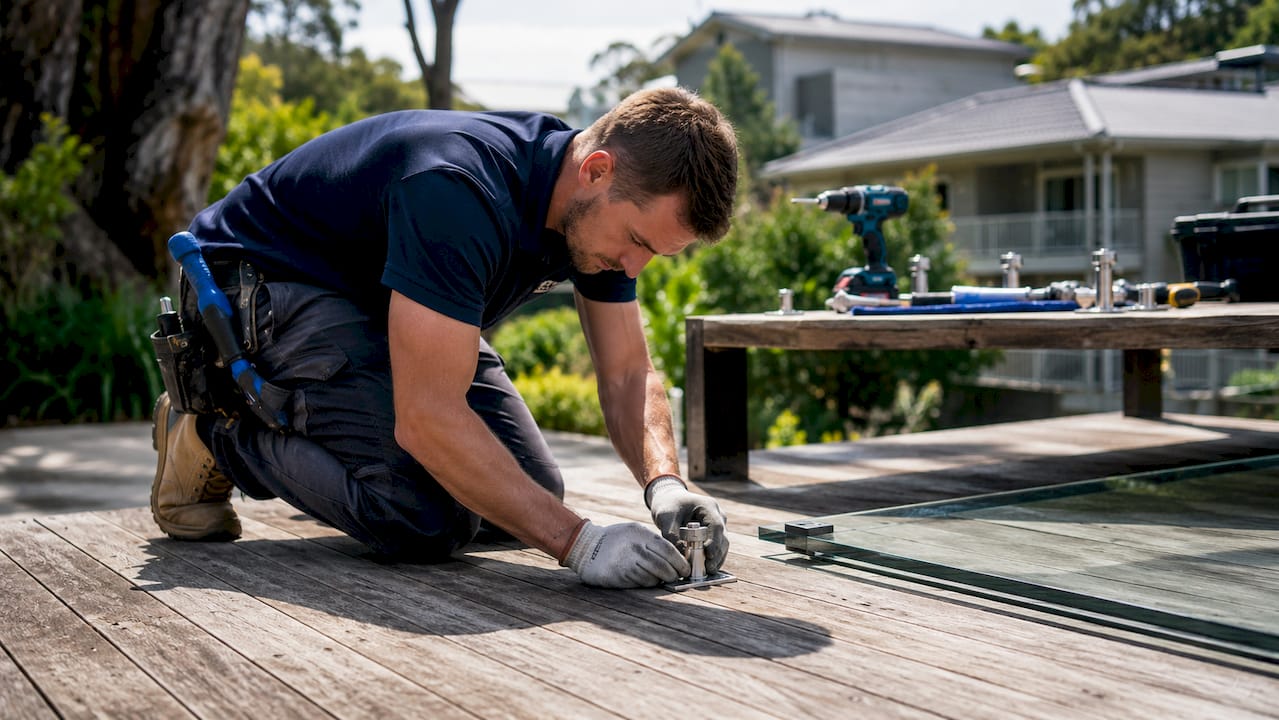
Side-mounted brackets attach to the vertical face of the floor structure. Side-mounting keeps floor surfaces clear, a design priority in multi-unit developments where every square inch of usable balcony space counts. This method also simplifies waterproofing because the bracket does not penetrate the deck membrane.
Substrate compatibility matters as much as bracket type. Concrete, timber, and steel stringers each require different anchor specifications. Hardware with marine-grade stainless steel construction handles the corrosion demands of exterior modular balconies across all three substrates.
One of the most labor-saving approaches in modular construction is integrating railings into patio door frames or balcony units during factory assembly. This allows interior installation before the module ships to site, eliminating external scaffolding entirely. Early design coordination between the railing supplier and the modular manufacturer is the single biggest factor in whether this works.
- Confirm substrate type and anchor pull-out values before specifying bracket models.
- Coordinate railing integration with the module manufacturer at the design development stage, not during shop drawings.
- Specify side-mounted systems on balconies under 60 inches deep to preserve usable floor area.
- Verify that bracket placement does not conflict with waterproofing membrane terminations.
Pro Tip: Request ICC-ES evaluation reports from your hardware supplier before finalizing the bracket specification. Inspectors on modular projects often require substrate-specific load documentation that generic product sheets do not cover.
How to select glass and hardware for safety and design flexibility
Glass type is the first decision, and it carries both safety and aesthetic consequences. Tempered glass is the standard safety glazing choice: it fractures into small, blunt pieces rather than sharp shards. Laminated glass adds a polyvinyl butyral (PVB) interlayer that holds broken pieces together, making it the preferred choice for overhead applications and projects where post-breakage containment is critical, such as glass railing for luxury condos or senior living communities.
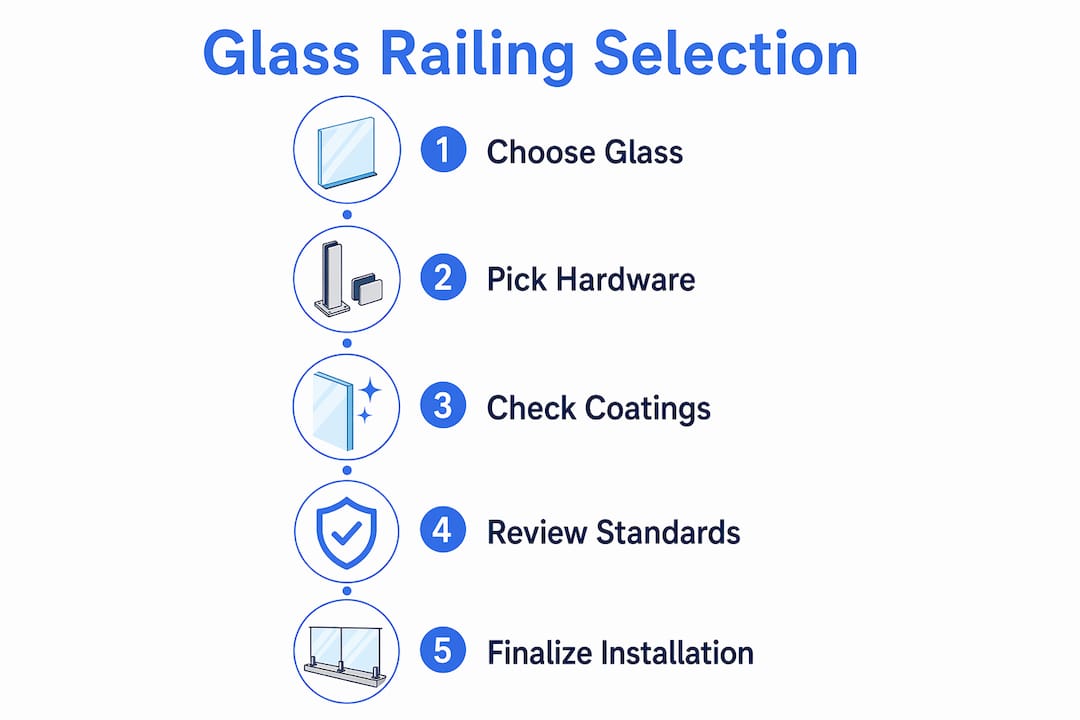
Architects prioritize low-iron glass in mixed-use and hospitality projects to eliminate the green tint present in standard float glass. The visual difference is most apparent on long continuous runs where standard glass reads as distinctly green at the edges. Low-iron glass reads as water-clear, which matters for glass railing for historic redevelopment and adaptive reuse projects where the building’s original character must not be obscured.
Hydrophobic coatings reduce maintenance by causing water and mineral deposits to bead and run off the surface. This is a practical benefit on vacation rentals and co-living spaces where cleaning schedules are irregular and salt air or urban pollution accelerates glass soiling.
| Glass type | Best application | Key advantage |
|---|---|---|
| Tempered | Balconies, stairs, guards | Safety fracture pattern, cost-effective |
| Laminated | Overhead, high-traffic areas | Post-breakage containment |
| Low-iron tempered | Luxury condos, hospitality | Water-clear appearance, no green tint |
| Low-iron laminated | Historic redevelopment | Premium clarity plus containment |
Hardware finish selection follows the same logic. Marine-grade 316 stainless steel resists chloride corrosion in coastal modular projects. Brushed finishes hide fingerprints better than mirror-polished surfaces, which matters on high-touch balcony rails in townhouse developments and student housing.
Pro Tip: Specify glass thickness and base shoe type together. A 1/2-inch tempered panel in a top-fix shoe behaves differently under lateral load than the same panel in a side-mounted clamp. Your structural engineer needs both dimensions to confirm compliance.
What safety standards and code considerations affect glass railing in modular construction?
Building codes set the non-negotiable floor for every glass railing specification. IBC Sections 1014 and 1015 define handrail and guard requirements, including minimum heights, load resistance, and opening limitations. These sections apply directly to glass railing for multifamily projects, mixed-use buildings, and any modular structure classified as an occupancy requiring guards.
The key compliance points architects and contractors must address are:
- Guard height: 42 inches minimum above the walking surface for occupied floors above 30 inches in elevation, per IBC Section 1015.
- Lateral load resistance: Guards must resist a 200-pound concentrated load applied at any point in any direction along the top rail.
- Infill panel testing: Glass infill panels must be tested to resist a 50-pound-per-linear-foot load without failure.
- Safety glazing: All glass used as a structural infill in a guard system must meet ANSI Z97.1 or CPSC 16 CFR Part 1201 safety glazing standards.
- ICC-ES evaluation reports: Engineering testing and ICC-ES reports provide substrate-specific installation guidance that inspectors use to confirm structural performance on modular assemblies.
Modular construction adds a compliance wrinkle that site-built projects do not face. Modules are inspected at the factory under a third-party inspection program, then re-inspected at the site after assembly. Glass railing systems installed in the factory must carry documentation that travels with the module and satisfies both the factory inspector and the local building department. This means engineering documentation is not optional. It is a project delivery requirement.
Building codes for glass railings vary by jurisdiction, and some states have adopted local amendments to the IBC that affect glass thickness minimums or post spacing. Confirm the applicable code edition and any local amendments before finalizing the specification.
Design and aesthetic adaptations for modular building types
Glass railing design in modular construction is not one-size-fits-all. The building type, unit density, and visual goals from the street all shape the right approach.
-
Coordinate with sliding door assemblies. Balcony railings that terminate at a sliding door frame create a natural integration point. Specifying the railing base shoe to align with the door threshold eliminates a visible gap and reduces weatherproofing complexity. This is especially relevant for glass railing for vacation rentals and luxury condos where the indoor-outdoor connection is a selling feature.
-
Choose continuous runs over segmented panels where possible. A continuous glass run reads as a single plane from the street, which strengthens the building’s facade composition. Segmented panels with visible posts interrupt that plane. Glass panel railings combine wind protection and safety with high transparency, and a continuous run maximizes both effects on rooftop decks and upper-floor balconies.
-
Coordinate divider structures and Juliette balconies. In multifamily and co-living projects, privacy dividers between unit balconies often use the same glass panel system as the guard rail. Specifying matching glass type and hardware finish across both elements creates visual coherence. Juliette balconies, which are fixed guards at French door openings, use the same IBC guard requirements but require wall-mounted hardware rather than floor-mounted base shoes.
-
Select caprail profiles and connectors to match the building’s architectural language. Square caprail profiles read as contemporary and work well on modular buildings with flat rooflines. Round profiles suit transitional and traditional aesthetics. Straight connectors and 90-degree connectors allow continuous rail runs around corners without visible breaks, which matters on wrap-around balconies common in townhouse developments.
-
Consider the rooftop perspective. Amenity decks on modular buildings are viewed from above by upper-floor residents. A frameless glass system with minimal hardware reads as clean from that angle. A post-and-rail system with visible hardware reads as industrial. The choice affects perceived unit value for floors above the amenity level.
Key takeaways
Glass railing for modular construction succeeds when installation method, glass specification, code documentation, and design intent are coordinated from the earliest design phase.
| Point | Details |
|---|---|
| Side-mounting preserves floor space | Fascia-mounted brackets keep balcony decks clear, critical in multifamily and student housing projects. |
| Low-iron glass improves aesthetics | Water-clear panels eliminate the green tint on long runs, essential for luxury and historic projects. |
| ICC-ES documentation is mandatory | Engineering reports must travel with the module to satisfy both factory and local inspectors. |
| Early design coordination saves labor | Integrating railings into balcony frames at the factory eliminates external scaffolding on site. |
| Caprail and connector selection shapes facade | Matching profiles and finishes across all railing elements creates visual coherence from street level. |
What I’ve learned from watching modular glass railing projects go wrong
The most consistent mistake I see on modular glass railing projects is treating the railing as a finish item rather than a structural component. Teams specify the glass and hardware late in design development, then discover the bracket anchor pattern conflicts with the module’s structural frame. That conflict costs time and money to resolve in the field, and it often forces a switch from the preferred side-mounted system to a top-fix system that eats into balcony depth.
The second mistake is underestimating documentation. Modular projects move through two inspection regimes. A railing system without an ICC-ES evaluation report or a project-specific engineering letter will stop a factory inspection cold. I’ve seen delivery schedules slip by weeks because the railing supplier could not produce the right paperwork on short notice.
The trend I find genuinely interesting is the move toward factory-integrated railing assemblies. When the railing ships as part of the balcony module rather than as a separate site-installed item, quality control improves and site labor drops. The early design coordination required to make that work is front-loaded, but the schedule and cost savings on a 200-unit project are substantial.
My honest recommendation: bring your glass railing supplier into the design process at schematic design, not at permit submission. The decisions made in those early meetings, bracket type, glass thickness, hardware finish, caprail profile, determine whether the system installs cleanly or becomes a field problem.
— Fuanne
Glassrailingstore’s solutions for modular construction projects
Glassrailingstore supplies tempered glass panels, marine-grade stainless steel hardware, and connector systems built for the load and documentation demands of modular construction.
The engineering testing documentation covers substrate-specific installation guidance for concrete, timber, and steel, giving your inspectors and structural engineers the reports they need at both factory and site review stages. Panels are available in multiple thicknesses, and hardware ships in brushed and mirror-polished finishes to match any architectural specification. Bulk ordering with free shipping over $3,000 makes Glassrailingstore practical for large modular projects. The 46-inch tempered glass panel is a proven choice for balcony guard applications across multifamily and mixed-use modular buildings.
FAQ
What glass thickness is standard for modular balcony railings?
Most modular balcony guard applications use 1/2-inch (12mm) tempered glass as the baseline. Projects with higher lateral load requirements or overhead exposure may specify 9/16-inch or 5/8-inch laminated glass.
Does IBC Section 1015 apply to modular buildings?
Yes. IBC Section 1015 guard requirements apply to modular buildings in the same way they apply to site-built construction. The key difference is that compliance documentation must satisfy both the factory third-party inspector and the local building department.
Can glass railings be installed inside the factory module?
Glass railings can be integrated into balcony frames during factory assembly when the railing system is designed for interior installation. This approach eliminates external scaffolding on site and improves quality control.
What hardware finish works best for coastal modular projects?
Marine-grade 316 stainless steel in a brushed finish is the standard choice for coastal environments. It resists chloride corrosion and hides surface wear better than mirror-polished hardware.
How does low-iron glass differ from standard tempered glass?
Low-iron glass removes the iron content that gives standard float glass its green tint. The result is a water-clear panel that reads as more transparent, which is the preferred specification for premium glass railing systems in luxury and historic redevelopment projects.