

Structure Reinforcement for Glass Railings: 2026 Guide
Structural reinforcement for glass railings is the engineered combination of high-strength laminated tempered glass, precision-grade mounting hardware, and verified load-bearing connections that keeps a glass railing system safe under real-world forces. Glass railing systems must resist horizontal line loads of 0.5 to 1.0 kN/m per current building codes, which means every component from the base anchor to the top clamp carries a structural role. Builders who treat hardware as a cosmetic detail rather than a load path create systems that fail under wind, crowd pressure, or impact. The right approach starts with material selection, runs through hardware specification, and ends with verified installation.
What Materials Are Best for Structure Reinforcement for Glass Railings?
Laminated tempered glass is the non-negotiable starting point for any structurally sound glass railing. It delivers 4 to 5 times the strength of standard annealed glass and, critically, holds together as a bonded unit after breakage rather than collapsing into a gap in the barrier. That post-breakage integrity is what separates a compliant railing from a liability.
Glass thickness directly controls bending resistance and load capacity. For most residential deck and balcony applications, 12 mm laminated tempered glass is the practical minimum. Commercial or high-traffic installations typically require 15 mm or 17.52 mm panels. Thicker glass reduces deflection under lateral load, which protects both the glass and the hardware connections at the base.
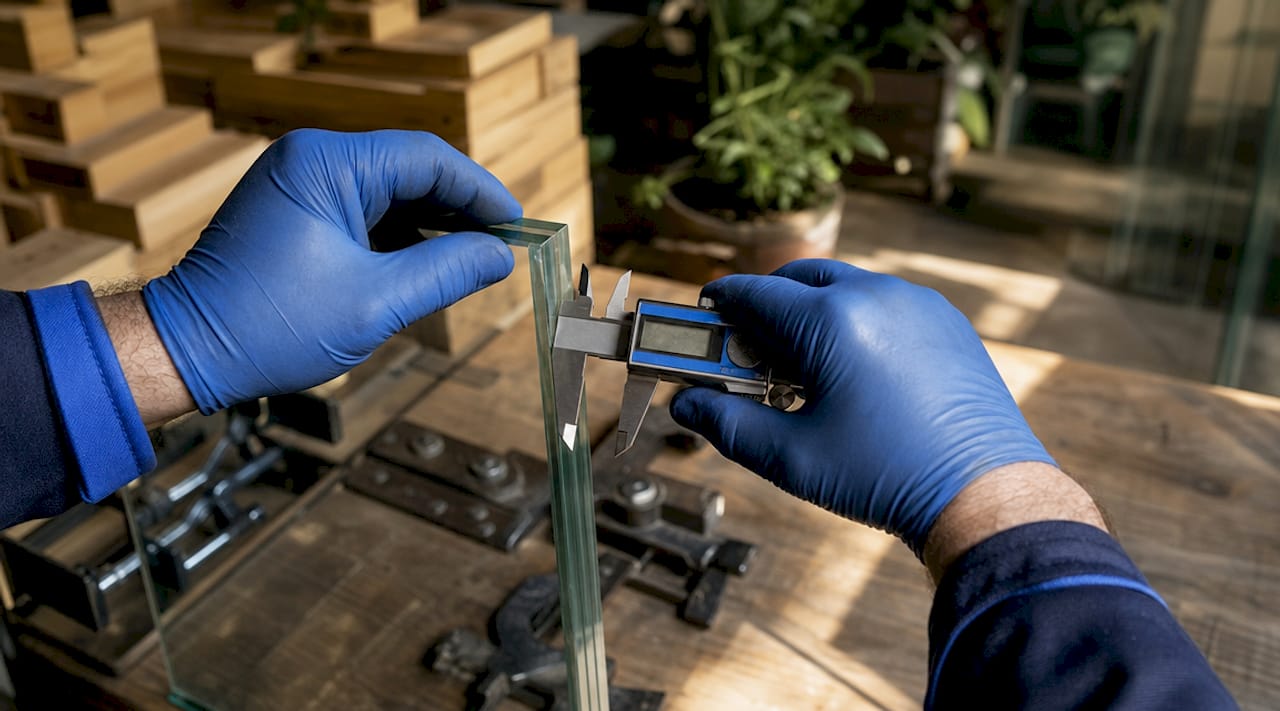
The interlayer bonding the two glass plies together is where many specifications fall short. Ionomer and structural PVB interlayers provide shear coupling between the plies, meaning both layers act as a composite section rather than two independent sheets. Standard PVB interlayers do not provide the same shear transfer, so they reduce the effective structural thickness of the panel. For any balustrade application, specify structural-grade interlayers by name in your material schedule.
For hardware, the alloy choice matters as much as the glass specification. Duplex 2205 stainless steel delivers more than twice the yield strength of standard 316L stainless steel and resists chloride corrosion in coastal and pool environments. Spigots, base channels, and clamps fabricated from Duplex 2205 maintain their clamping force and dimensional stability over decades of service, where 304-grade hardware begins to show stress corrosion within a few years in exposed conditions.
- Use 12 mm laminated tempered glass as the minimum for residential applications; specify 15 mm or thicker for commercial loads.
- Select ionomer or structural PVB interlayers, not standard PVB, for composite shear action between glass plies.
- Specify Duplex 2205 stainless steel for spigots, clamps, and base channels in coastal, pool, or high-wind environments.
- Confirm glass edge treatment: polished or seamed edges reduce stress concentrations at clamp contact points.
Pro Tip: Request mill certificates for stainless steel hardware before accepting delivery. Grade markings on hardware can be inconsistent, and a Duplex 2205 certificate confirms yield strength and alloy composition before the hardware goes into a structural connection.
The three primary mounting systems for glass railings are base channels, point-fixed spigots, and surface-mounted clamps. Each distributes load differently, and choosing the wrong system for the application is the most common structural error on site.
| Mounting system | Load path | Best application | Key limitation |
|---|---|---|---|
| Base channel | Continuous support along glass bottom edge | Frameless systems, high-wind zones | Requires deep embedment (100 to 150 mm) |
| Point-fixed spigots | Concentrated loads at discrete base points | Frameless decks, clean aesthetic | Spacing and embedment depth are critical |
| Surface-mounted clamps | Shear transfer through post-to-glass connection | Semi-frameless systems | Clamp quality and gasket condition determine performance |
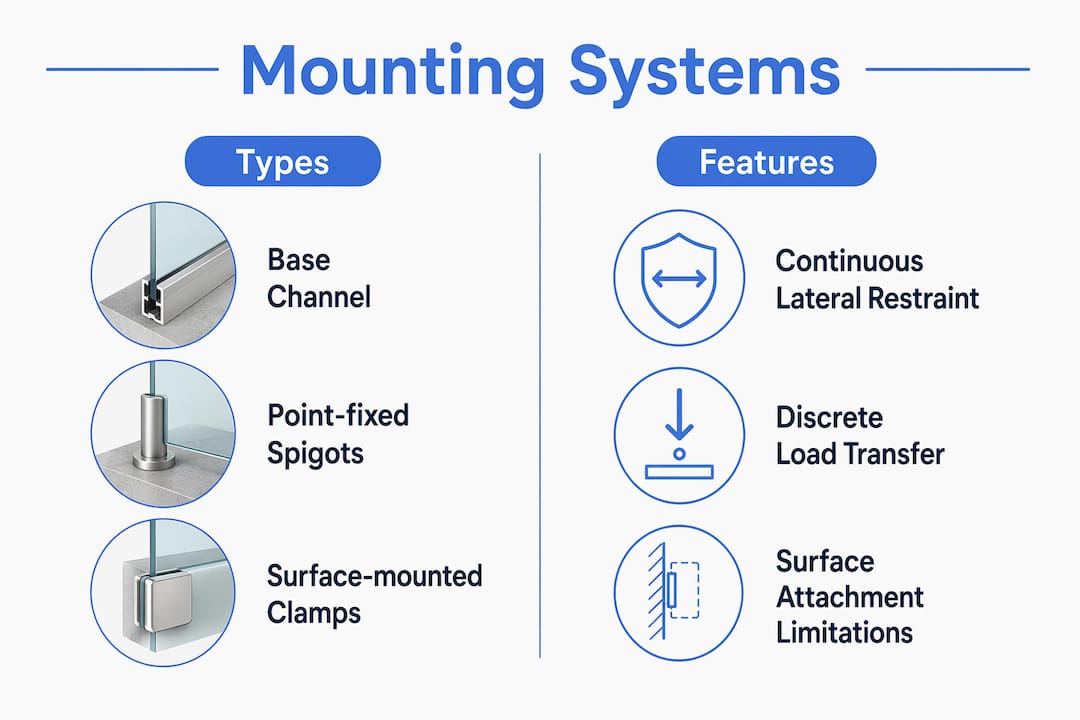
Base channels provide continuous lateral restraint along the full bottom edge of the glass panel. Frameless systems require channels 100 to 150 mm deep to resist the bending moment generated when a horizontal load is applied at the top of the panel. Undersized channels allow the glass to rotate at the base, which concentrates stress at the channel lip and leads to cracking or panel ejection under load.
Point-fixed spigots transfer load at discrete locations, so their spacing and embedment depth are the governing design variables. For 1000 to 1200 mm wide glass panels, clamp and spigot spacing of 600 to 800 mm with clamps positioned 150 to 250 mm from panel edges maximizes shear load transfer and prevents panel deflection between support points. Tighter spacing is required for taller panels or higher design loads.
Gasket material inside clamps and channels is a detail that directly affects long-term performance. UV-stabilized EPDM or silicone gaskets act as friction grips and vibration dampers, preventing glass movement and rattling under cyclic wind loads. Gaskets that degrade under UV exposure lose their compression set, which reduces clamping force and allows the glass to shift within the fitting. Specify UV-stabilized compounds for any exterior installation.
Standard surface-mount baseplates are often inadequate in high-wind or high-rise applications without structural backing or knee braces. Knee braces transfer overturning moments from the post base into the substrate rather than relying solely on anchor bolt tension. On concrete substrates, this means specifying the correct anchor bolt diameter, embedment depth, and edge distance to match the design load. On timber framing, blocking and through-bolting are standard requirements.
Pro Tip: Always verify baseplate anchor capacity against the combined wind and live load before finalizing the hardware schedule. Treating the baseplate as a standard detail rather than a calculated connection is the single most common cause of railing failures in high-wind zones.
What Are the Best Reinforcement Methods for Different Railing System Types?
The right reinforcement method depends on whether the system is frameless, semi-frameless, or post-supported. Each type distributes structural loads through a different primary member, and the reinforcement strategy follows that load path.
Frameless Systems
In a frameless glass railing, the glass panel itself is the primary structural component. The glass carries the full lateral load from the top of the panel down to the base channel or spigots. This places maximum demand on glass thickness, interlayer specification, and base connection depth. Frameless systems deliver the cleanest visual result but require the most rigorous structural specification. Thicker laminated panels, deep base channels, and high-quality spigots with verified embedment are all non-negotiable in this configuration.
Semi-frameless systems use metal posts to carry vertical loads while clamps transfer lateral forces from the glass panels into the posts. This hybrid structural approach reduces the structural demand on the glass itself, allowing thinner panels and shallower base connections compared to frameless designs. The trade-off is that clamp quality and placement become the critical variables.
Positioning clamps near the top and bottom edges of each panel maximizes shear transfer into the stiffest portions of the post. Clamps act as shear connectors that move lateral load from the glass face into the post cross-section. A clamp placed at mid-panel height transfers load less efficiently and increases bending demand on the glass between support points.
The practical advantages of semi-frameless systems for most commercial projects include:
- Lower glass thickness requirements reduce material cost per linear meter.
- Post spacing can be adjusted to accommodate irregular plan geometry without custom glass sizes.
- Adjustable clamps with internal pivoting accommodate stair rake angles without custom hardware.
- Post-based systems allow glass panel replacement without disturbing the structural base connections.
- Knee braces can be added to posts in high-wind zones without modifying the glass specification.
For high-rise or high-wind structures, both system types require structural backing at the base. Knee braces and strong base anchors are the standard solution, and the American building code requirements for glass railings define the minimum load cases that these connections must satisfy.
How to Install and Verify Structural Reinforcement for Glass Railings
A correctly reinforced glass railing starts before the first anchor goes into the substrate. Pre-installation preparation determines whether the finished system meets its design loads or simply looks like it does.
- Assess the substrate. Confirm concrete compressive strength, timber species and grade, or steel section size before selecting anchor types. A substrate that cannot develop the required anchor capacity makes every other specification irrelevant.
- Select and inspect hardware. Verify that clamps, spigots, and base channels match the specified alloy grade and dimensional tolerances. Check gasket condition before installation. Compressed or cracked gaskets from storage must be replaced.
- Set out spacing. Mark clamp and spigot positions to the specified 600 to 800 mm spacing for standard panel widths, with the first and last support 150 to 250 mm from panel edges. Use a laser level to confirm alignment across the full run before drilling.
- Install base connections. Torque anchor bolts to the specified value using a calibrated torque wrench. Do not estimate by feel. Under-torqued anchors allow baseplate rotation under load; over-torqued anchors can split concrete edge zones.
- Place glass panels. Use setting blocks at the base to maintain the specified glass-to-channel clearance. Lower panels into channels or onto spigots without lateral impact. Confirm plumb before tightening clamps.
- Compress gaskets and torque clamps. Apply clamp torque in stages, alternating sides to achieve even gasket compression. Final torque values should match the hardware manufacturer’s specification for the glass thickness in use.
- Verify load compliance. Cross-check the installed configuration against the building code load requirements for horizontal line loads. Document anchor embedment depths and clamp torque values for the project record.
The most common installation failure is not a wrong product choice. It is a correct product installed without verifying the substrate capacity or anchor torque. A Duplex 2205 spigot in an under-drilled hole performs no better than a 304-grade spigot in the same hole.
Key Takeaways
Structural integrity in glass railings depends on the combined performance of laminated tempered glass, correctly specified hardware, and verified base connections, not on any single component in isolation.
| Point | Details |
|---|---|
| Glass specification | Use laminated tempered glass with ionomer or structural PVB interlayers for composite shear action. |
| Hardware alloy | Specify Duplex 2205 stainless steel for spigots and clamps in exterior or high-stress applications. |
| Clamp placement | Position clamps 150 to 250 mm from panel edges with 600 to 800 mm spacing for standard panel widths. |
| Base connection | Supplement surface-mount baseplates with knee braces or structural backing in high-wind or high-rise conditions. |
| Installation verification | Document anchor torque and embedment depth to confirm compliance with 0.5 to 1.0 kN/m horizontal load requirements. |
What I've Learned Specifying Glass Railing Reinforcement on Real Projects
The gap between a compliant glass railing drawing and a compliant glass railing installation is wider than most project managers expect. I have reviewed enough post-installation reports to say with confidence that the failure point is almost never the glass. It is the base connection, and specifically the assumption that a standard baseplate detail from a previous project transfers directly to the current one.
Wind load calculations change with building height, exposure category, and local topographic effects. A baseplate that worked on a ground-floor terrace in a sheltered suburban setting will not automatically satisfy the overturning demand on a 15th-floor balcony in a coastal city. Coordinating with a structural engineer to calculate actual base reactions for each project is not a premium service. It is the minimum standard of care.
Gasket specification is the other detail I see undervalued consistently. Contractors often substitute whatever EPDM strip is available on site for the UV-stabilized compound the hardware manufacturer specifies. Within two to three years in a sun-exposed installation, that substitution shows up as glass rattle, visible panel movement, and eventually loosened clamps. The cost difference between standard and UV-stabilized EPDM is negligible. The callback cost is not.
Semi-frameless systems remain my preferred recommendation for most commercial projects where the client wants a clean aesthetic without the full structural demand of a frameless design. The posts carry the vertical load, the clamps handle the lateral transfer, and the glass does what glass does best: provide an unobstructed view. When the hardware is specified correctly and the base connections are verified, these systems perform reliably for decades.
— Fuanne
How Glassrailingstore Supports Builders with Engineered Glass Railing Products
Glassrailingstore supplies the full hardware stack that structural reinforcement requires, from Duplex-grade spigots and UV-stabilized clamp assemblies to tempered glass panels sized for standard railing heights. Every product in the catalog is selected for exterior performance and code compliance, not just appearance. For projects where load verification is part of the contract deliverable, Glassrailingstore offers engineering testing services that confirm your installed system meets 2026 building code requirements for horizontal line loads and impact resistance. The technical support team works directly with contractors to match hardware specifications to project-specific substrate conditions, panel sizes, and wind exposure categories. Free shipping applies on orders over $3,000, which covers most commercial hardware packages.
FAQs
1. What glass thickness is required for structural glass railings?
Most residential applications require a minimum of 12 mm laminated tempered glass, while commercial and high-traffic installations typically specify 15 mm or 17.52 mm panels. Thickness selection is governed by panel height, design load, and the mounting system in use.
2. How far apart should glass railing clamps be spaced?
For panels 1000 to 1200 mm wide, clamps should be spaced 600 to 800 mm apart, with each clamp positioned 150 to 250 mm from the panel edge. This spacing maximizes shear load transfer and prevents deflection between support points.
3. When are knee braces required for glass railing posts?
Knee braces are required when surface-mount baseplates cannot resist the overturning moment generated by design wind or live loads, which is common in high-rise and coastal applications. A structural engineer should calculate base reactions for each project to determine whether standard baseplates suffice.
4. What is the difference between frameless and semi-frameless reinforcement?
In frameless systems, the glass panel is the primary structural member and requires thicker laminated glass with deep base channels. In semi-frameless systems, metal posts carry vertical loads and clamps transfer lateral forces, reducing the structural demand on the glass itself.
5. What horizontal load must glass railings resist under 2026 building codes?
Glass railing systems must resist horizontal line loads of 0.5 to 1.0 kN/m depending on occupancy and application. Builders should verify the specific load requirement against the applicable state code for each project location.
Recommended
- Building Codes for Glass Railings – The Glass Railing Store
- Weatherproof Glass Railing Features: A Homeowner’s Guide – The Glass Railing Store
- Glass railing durability: Build it right, build it to last – The Glass Railing Store
- Glass Railing Support Systems: What You Need to Know – The Glass Railing Store