

Glass Pricing Guide: What Custom Panels Really Cost
Custom-cut tempered glass runs roughly from low to moderate prices per square foot, but that number tells only part of the story. The figure that actually matters for your budget is the total project cost, and shipping, crating, and site handling regularly add a significant portion on top of the material line. Three quick benchmarks to anchor your planning:
- A small custom tabletop panel in 1/4" annealed glass: roughly moderate cost for the piece itself, plus shop minimum fees if it’s under a square foot.
- A 1/4" tempered shower panel (approximately 24" × 76"): typically moderate cost depending on edge finish and whether holes are drilled.
- A 46" tempered railing panel: pricing varies by width and finish; expect to factor in hardware connectors and freight on top of the glass cost.
Pro Tip: All holes, notches, and cutouts must be specified and completed before the glass enters the tempering oven. Tempered glass cannot be re-cut or drilled after the fact — any measurement error means a lost panel, not a rework.
The International Building Code (IBC) and ASTM C1048 govern tempering standards for safety-critical applications like railings and doors. Knowing those standards before you order is what separates a smooth project from an expensive do-over.
Table of Contents
- How glass pricing breaks down by type and thickness
- Add-ons and customizations that raise your quote
- Why shipping and installation often cost more than the glass
- How to get an accurate, itemized quote
- What lead times actually look like
- Why total project costs consistently exceed material budgets
- Key Takeaways
- The pricing mistakes fabricators see most often
- Glassrailingstore makes tempered glass railing pricing straightforward
- The pricing mistake most buyers don’t see coming
- Useful sources
How Glass Pricing Breaks Down by Type and Thickness
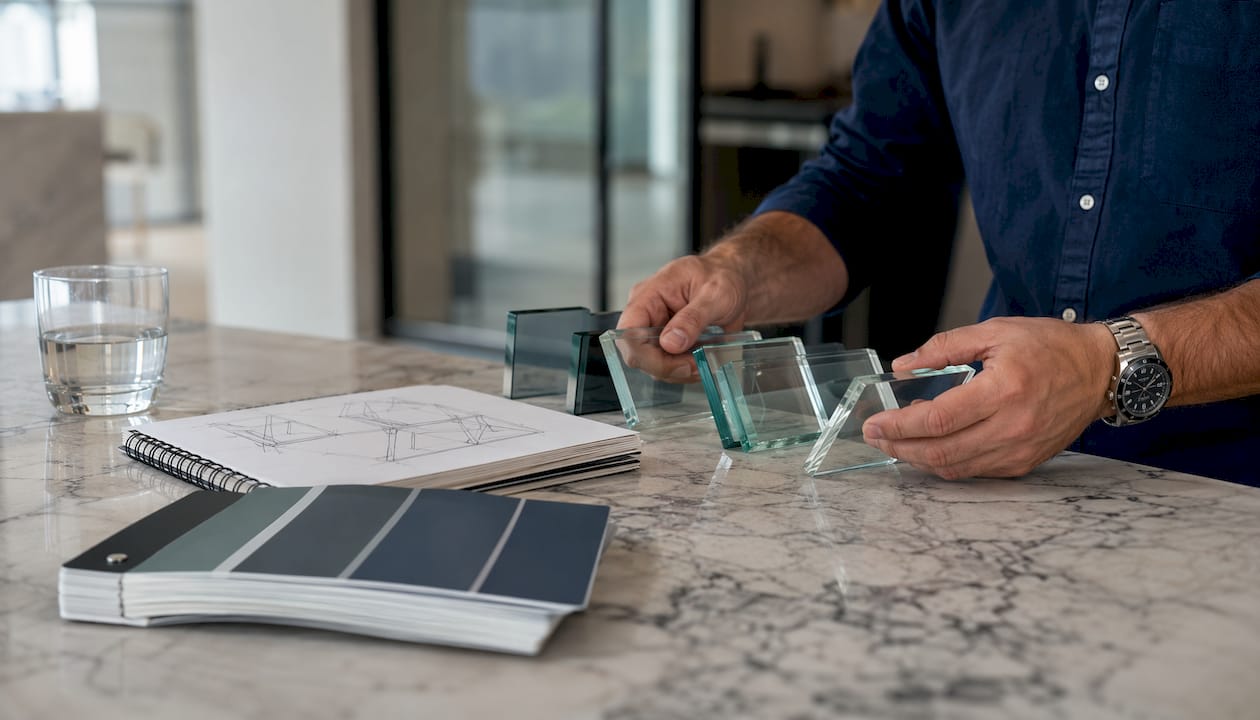
Glass type and thickness are the two levers that move a quote from the low end to the high end faster than anything else. Clear float (annealed) glass starts around low cost per square foot for standard sizes, while custom-cut tempered pieces typically open at moderate cost per square foot for simple shapes and climb from there.
| Glass Type | Typical Price/Sq Ft | Common Thicknesses | Typical Applications |
|---|---|---|---|
| Clear annealed (float) | low cost range | 1/8", 3/16", 1/4" | Tabletops, shelves, interior windows |
| Standard tempered | moderate cost range | 1/4", 3/8", 1/2" | Shower enclosures, doors, railings |
| Custom-cut tempered | moderate to higher cost range | 3/8", 1/2", 5/8" | Frameless railings, pool fences, commercial |
| Laminated | moderate cost range | 3/8", 1/2", 5/8" | Overhead glazing, impact zones, skylights |
| Low-iron (ultra-clear) | higher cost range | 1/4", 3/8", 1/2" | High-visibility railings, display cases |
| Fire/impact-rated | high cost range | Varies | Commercial, code-mandated fire separations |
Thickness affects price significantly. Moving from 1/4" to 3/8" tempered increases the material cost noticeably; stepping up to 1/2" raises the per-square-foot figure further. The reason is weight and furnace time: thicker glass requires longer tempering cycles and heavier handling throughout fabrication.
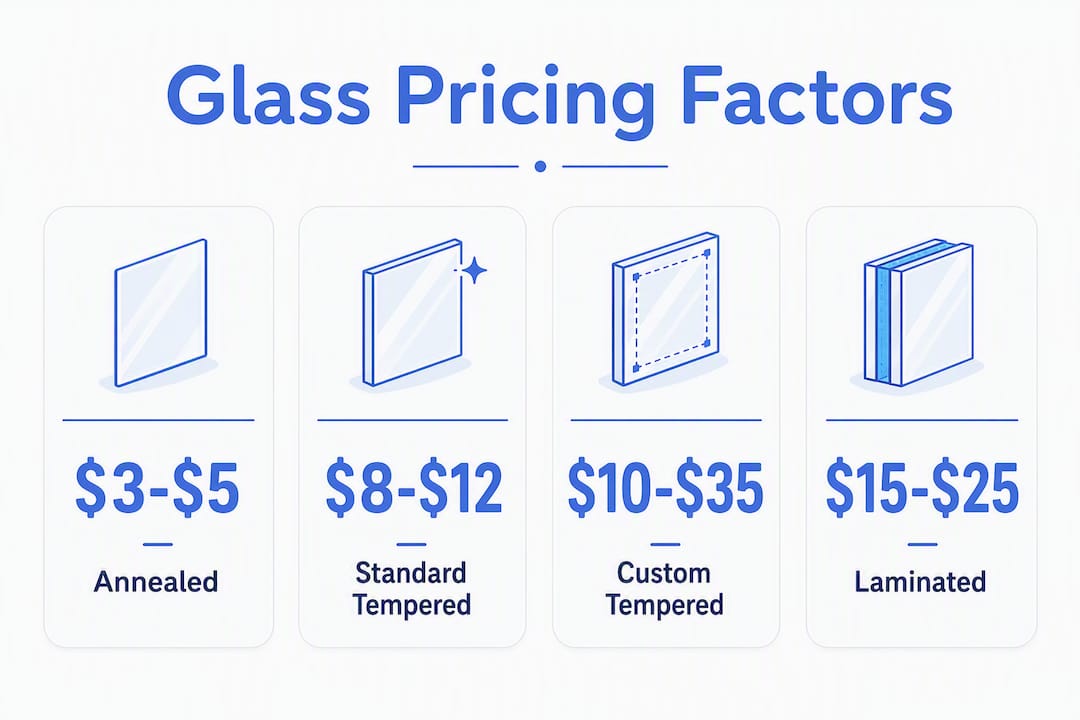
Laminated glass sits in the $15–$25 per square foot range because of the PVB or SGP interlayer bonding process. It’s the right call for overhead applications or anywhere a shattered panel could fall on someone, but it’s overkill for a standard deck railing where tempered alone satisfies code.
Regional variation is real. Coastal markets (California, Florida, the Pacific Northwest) tend to run 10–20% higher than inland markets, partly due to freight costs and partly because local demand for frameless glass systems keeps fabricator capacity tight. Small cuts also trigger shop minimums: expect a modest minimum charge even when the raw material cost of a tiny piece is only a few dollars.
Add-Ons and Customizations That Raise Your Quote
The base glass price is just the starting point. Fabrication extras stack up quickly, and knowing the typical per-unit surcharges lets you evaluate a quote line by line rather than accept a lump sum.
- Edge finishing: Flat or pencil polish adds $2–$5 per linear foot; beveled edges run $5–$8 per linear foot. A standard 36" × 76" panel has roughly 19 linear feet of perimeter, so a full bevel can add $95–$150 to a single panel.
- Drilled holes: Each hole typically costs $15–$40 depending on diameter and glass thickness. Panels with four or more holes for point-fix mounting can add $60–$160 in drilling charges alone.
- Notches and cutouts: L-shaped cuts or post-clearance notches are priced per cutout, often $25–$75 each, and require precise templates.
- Specialty shapes: Non-rectangular cuts (arched tops, angled cuts for stair railings) carry a premium because they require CNC programming and additional handling time.
- Coatings: Low-E coatings add $3–$8 per square foot; tinted or reflective glass adds $4–$10 per square foot depending on the film or integral tint.
Here’s a concrete example of how extras compound. Start with a 3/8" tempered panel at $18/sq ft for a 10 sq ft piece: that’s $180 in glass. Add a full pencil polish on all four edges ($2.50/lf × 19 lf = $47.50), two drilled holes for hardware ($30 each = $60), and a low-E coating ($5/sq ft = $50). The panel that quoted at raw glass cost now has significantly higher total cost before freight.
The critical constraint: because tempered glass cannot be re-cut after the tempering process, every hole location, cutout dimension, and edge profile must be locked in before the order goes to the furnace. A template error doesn’t mean a rework fee. It means a full replacement.
Why Shipping and Installation Often Cost More Than the Glass
Freight is the budget line most buyers underestimate. Shipping, crating, and site handling can represent a substantial portion of the final project quote for custom tempered panels, and the math doesn’t scale as expected.

Shipping five panels often costs nearly the same as shipping one. The reason is that crating and handling overhead dominate the freight bill. A custom wooden crate, foam padding, corner protection, and a white-glove freight carrier represent fixed costs per shipment regardless of panel count. That’s why ordering your full panel set, plus all hardware connectors, in a single shipment is almost always cheaper per unit than splitting the order.
Pro Tip: Bundle your glass panels with all hardware (connectors, caprail, posts) in one order. The freight savings on a consolidated shipment frequently offset the cost of ordering hardware you might have sourced separately.
Typical glass railing installation cost drivers beyond freight:
- Site access: Narrow stairwells, upper-floor balconies, or rooftop decks require specialized rigging and add labor hours.
- Substrate prep: Concrete core drilling for post bases or sistering deck joists to meet load requirements can add $200–$600 before a single panel goes in.
- Old railing removal: Demo and disposal of an existing wood or metal railing typically runs $150–$400 depending on linear footage.
- Permit and inspection time: Some jurisdictions require a framing inspection before glass installation; scheduling delays can extend a project by days.
- Labor rates: Installer labor for glass railings runs $50–$120 per hour in most U.S. markets, with frameless systems requiring more precision and therefore more time.
For frameless vs. framed glass railing systems, the installation cost gap is significant. Frameless systems demand tighter tolerances, heavier glass, and more precise hardware alignment. On a small-to-medium project, hardware and precision mounting can actually exceed the glass cost when you factor in stainless steel point-fix fittings, base shoes, and caprail connectors.
How to Get an Accurate, Itemized Quote
A vague quote is a liability. Here’s exactly what to provide and what to demand.
What to send your supplier:
- Exact panel dimensions for every piece (width × height in inches, to 1/16" tolerance).
- Glass type and thickness required (confirm with your mounting system specs).
- Edge finish specification (flat, pencil polish, beveled, seamed).
- All hole and cutout locations with a dimensioned template or CAD drawing.
- Mounting system type: framed, semi-framed, or frameless.
- Hardware preferences or part numbers if you’re sourcing connectors separately.
- Site photos and access notes (freight elevator, stairs, rooftop, etc.).
- Delivery address and whether liftgate service is needed.
Questions to ask every supplier:
- Do you temper in-house, or do you outsource to a third-party furnace?
- Will you itemize the quote: raw glass, fabrication, edge work, drilling, shipping, crating, and installation separately?
- What are your shop minimums for small cuts?
- What ASTM or ANSI standard does your tempered glass meet?
- What is your damage-in-transit policy, and is the shipment insured?
- What warranty applies to the glass and to fabrication work?
Red flags on any quote:
- A single lump-sum line with no breakdown.
- No mention of tempering standard (ASTM C1048 or ANSI Z97.1).
- Vague lead times (“a few weeks”).
- No crating or insurance detail.
A fully itemized quote that separates materials, fabrication, shipping, and installation is the only way to compare two bids fairly. Without line-item separation, you can’t tell whether one supplier is cheaper on glass but more expensive on freight, or vice versa.
Pro Tip: For complex shapes or panels with multiple cutouts, send a physical cardboard template to the fabricator. It eliminates ambiguity and reduces the risk of a costly panel loss.
For accurate project cost estimates across the full build, treat glass as one line item in a broader materials-plus-labor budget, not the whole budget.
How to Get an Accurate, Itemized Quote
Annealed glass cuts can be ready same-day or next-day at most local glass shops. Custom-cut tempered panels are a different story: standard production runs 7–10 business days from order confirmation. That window assumes the glass is in stock, the shape is straightforward, and no specialty coatings are involved.
Add time for:
- Low-iron glass: Often requires a special order from the float plant, adding 5–10 business days.
- Laminated panels: Autoclave processing adds 3–7 days on top of the base fabrication time.
- Specialty coatings (low-E, reflective, tinted): Depending on the coating type, add 5–15 business days.
- Peak season: Spring and summer renovation season can stretch standard tempered lead times to 3–4 weeks at busy fabricators.
- Permit-driven holds: If your jurisdiction requires a permit before installation, build in 1–3 weeks for approval before scheduling delivery.
Rush tempering is available from some fabricators, typically at a 20–40% surcharge on the fabrication cost. It’s worth paying when a project timeline is fixed and a delay would cost more in contractor standby time than the rush fee itself.
Why Total Project Costs Consistently Exceed Material Budgets
Three research-backed patterns explain most budget overruns on glass projects.
| Cost Driver | Finding | Implication |
|---|---|---|
| Logistics share | Shipping, crating, and handling: 20–40% of final quote | Always get a delivered price, not just a material price |
| Mounting method | Frameless systems require thicker glass and precision hardware; hardware can exceed glass cost on small projects | Decide frameless vs. framed before specifying glass thickness |
| Code compliance | IBC and local codes mandate tempered glass for railings, doors, and pool fences | Non-compliant glass means full replacement, not a waiver |
The building codes for glass railings in most U.S. jurisdictions require tempered or laminated safety glass for any railing application. Using annealed glass to save money on a deck railing isn’t a gray area: it fails inspection, and the replacement cost of re-ordering, re-shipping, and re-installing the correct panels can easily double the original material spend.
Mounting method is the decision that most directly drives glass specification. A framed system can use thinner, less expensive glass because the frame carries load. A frameless system transfers load directly to the glass and its hardware, requiring 3/8" or 1/2" tempered panels and precision point-fix fittings. On a 20-linear-foot deck railing with frameless hardware, the stainless steel connectors, base shoes, and caprail can represent 40–60% of the total material cost.
Key Takeaways
Custom glass pricing is most accurately understood as a total-project number: material cost plus fabrication, freight, hardware, and installation routinely runs 60–100% above the raw per-square-foot glass price alone.
| Point | Details |
|---|---|
| Per-sq-ft ranges | Annealed: $3–$5; standard tempered: $8–$12; custom tempered: $10–$35; laminated: $15–$25. |
| Freight is a major line item | Shipping and crating add 20–40% to the final quote; consolidate panels and hardware in one order. |
| Fabrication locks in before tempering | All holes, cutouts, and edge work must be specified before the glass is tempered — errors mean full panel replacement. |
| Demand itemized quotes | Separate material, fabrication, shipping, and installation lines are the only way to compare bids fairly. |
| Glassrailingstore for railing projects | Glassrailingstore offers tempered glass panels, matching connectors, and bundled shipping for U.S. railing builds. |
The Pricing Mistakes Fabricators See Most Often
Most budget overruns on glass railing projects stem from timing and specification decisions during the process, rather than supplier issues.
The four most common mistakes:
- Inaccurate templates: Hole locations off by 1/8" or panel dimensions measured to the nearest 1/4" instead of 1/16" result in panels that don’t fit. Since tempered glass can’t be adjusted, the panel is scrap.
- Split orders: Ordering glass first and hardware later means two freight bills, two crating charges, and often a mismatch between panel thickness and hardware tolerance.
- Skipping the code check: Ordering annealed glass for a railing application because it’s cheaper, then failing inspection, is the most expensive mistake on this list.
- Late change orders: Changing a panel dimension or adding a cutout after the order is placed often means restarting the panel from scratch, including a new tempering cycle.
The right sequence: confirm your mounting system and hardware first, then specify glass thickness and dimensions, then order panels and hardware together in a single shipment. Document every measurement with a photo and a dimensioned sketch. For complex cutouts, send a physical cardboard template.
Suppliers that provide itemized pricing and insured freight aren’t just being thorough. They’re giving you the paper trail you need if a panel arrives damaged or a dimension is disputed.
Glassrailingstore Makes Tempered Glass Railing Pricing Straightforward
Pricing tempered glass for a railing project gets complicated fast, but it doesn’t have to be a guessing game. Glassrailingstore offers U.S.-fabricated tempered glass panels, matching stainless steel hardware, and itemized online quotes that break out glass, connectors, and shipping as separate line items so you know exactly what you’re paying for.
For a standard deck or balcony build, the 46" tempered glass railing panel is the workhorse product, sized for code-compliant residential railings and available with the matching 90-degree connectors, wall connectors, and 180-degree connectors for continuous runs. Ordering panels and hardware together through Glassrailingstore consolidates freight into a single shipment, which is the most direct way to reduce the logistics share of your total project cost. Orders over $3,000 qualify for free shipping.
Ready to get a real number for your project? Start with the frameless glass railing quote page, where you can submit your panel dimensions, hardware preferences, and site details to receive a fully itemized quote.
The Pricing Mistake Most Buyers Don’t See Coming
Most articles on glass pricing focus on the per-square-foot number. That’s the wrong place to anchor your budget.
The real risk is the gap between what a material quote says and what a project actually costs. A supplier who quotes $12/sq ft on tempered glass but buries freight, crating, and a shop minimum in a lump-sum total is not cheaper than one who quotes $16/sq ft with a transparent freight line. The second quote is easier to manage, easier to compare, and far less likely to produce a surprise invoice.
There’s also a sequencing problem that catches a lot of buyers: they choose a glass type based on price before they’ve confirmed the mounting system. A frameless system that looks affordable at 3/8" tempered glass pricing can become significantly more expensive once you add the precision hardware it requires. The hardware decision should come first, always. Glass thickness follows from the mounting spec, not the other way around.
The other thing worth saying plainly: code compliance is not optional, and it’s not a line item you can cut. Tempered glass for railings is a legal requirement in virtually every U.S. jurisdiction. The cost of replacing non-compliant glass after a failed inspection, including re-fabrication, re-shipping, re-installation, and potential contractor standby time, is almost always higher than the cost of getting it right the first time. Confirm your local IBC requirements before the order goes in, not after.
Useful Sources
- Tempered Glass Panel Cost: Price Ranges and What Affects the Bill — Verify logistics cost share (20–40%), the one-way nature of tempering, and frameless hardware cost dynamics.
- Glass Railing Building Codes: Complete 2025 Compliance Guide — Verify IBC and local code requirements for tempered glass in railing and door applications before ordering.
- How to Create Accurate Project Cost Estimates — Use this to structure a full project budget that treats glass, hardware, freight, and labor as separate line items.
Recommended
- Choosing Outdoor Glass Panels: A 2026 Homeowner’s Guide – The Glass Railing Store
- How to Negotiate Prices with Glass Railing Contractors Like a Pro – The Glass Railing Store
- How to Negotiate Prices with Glass Railing Contractors Like a Pro – The Glass Railing Store
- Glass Panels for Value Enhancement: A Smart Investor’s Guide – The Glass Railing Store