

Cost of Glass Railing Systems for Homeowners and Contractors
Expect to pay between $4,000 and $16,000 for a complete tempered glass railing system, with $150 to $600 per linear foot installed being the working number contractors actually quote from. That per-foot range covers the tempered glass panels, stainless or aluminum hardware, and labor together, not just materials. Angi’s national data puts the average installed cost around $7,000, with most homeowners landing between $4,000 and $10,000.
Linear foot is the metric that matters because railing quotes rarely match unless you convert them. A 30-foot deck run and a 30-foot balcony with three corners cost differently even at the same glass type, since post count, hardware, and cutting complexity shift the math. Glass Railing Store structures its own per-linear-foot budgeting guidance around this exact comparison problem.
- Budget framed systems: roughly $150 to $250 per linear foot
- Mid-range semi-frameless: roughly $250 to $400 per linear foot
- Premium frameless: $400 to $600+ per linear foot, per current pricing data
Key Takeaways
Complete tempered glass railing systems typically cost $150 to $600 per linear foot installed, with total project costs commonly running $4,000 to $16,000 depending on length and system style.
| Point | Details |
|---|---|
| Use per-linear-foot pricing | Convert every quote to $/linear foot so you can compare framed, semi-frameless, and frameless bids fairly. |
| Budget by system tier | Framed runs $150–$250/ft, mid-range $250–$400/ft, premium frameless $400–$600+/ft installed. |
| Factor in labor and permits | Labor typically runs 20% to 50% of total cost, plus $150 to $2,000 in permit fees depending on jurisdiction. |
| Add contingency for complexity | Stairs, curves, and tall railings justify a 15% to 20% buffer above your base estimate. |
| Get a project-specific quote | Glassrailingstore’s frameless quote page and product pages let you price panels, hardware, and connectors against your exact linear footage. |
Table of Contents
- How Much Does Glass Railing Cost by Project Length?
- What Drives the Price of Glass Railing Materials and Hardware?
- How Do You Estimate the Cost of a Glass Railing Project?
- How Much of the Cost Is Labor, and What Do Permits Add?
- Is Glass Railing Worth the Cost Long-Term?
- What Do We See Homeowners Get Wrong on Glass Railing Budgets?
- Get a Straight Answer on Your Glass Railing Quote
- Frequently Asked Questions
- Sources
How Much Does Glass Railing Cost by Project Length?
A 10-foot stair rail and a 50-foot deck perimeter aren’t the same purchase, obviously, but the per-foot math still applies once you factor in the fixed costs every job carries regardless of size (delivery, minimum labor calls, one or two corner posts). Here’s how typical installed pricing breaks down across common project lengths, using the $150 to $600 per-foot band as the baseline.
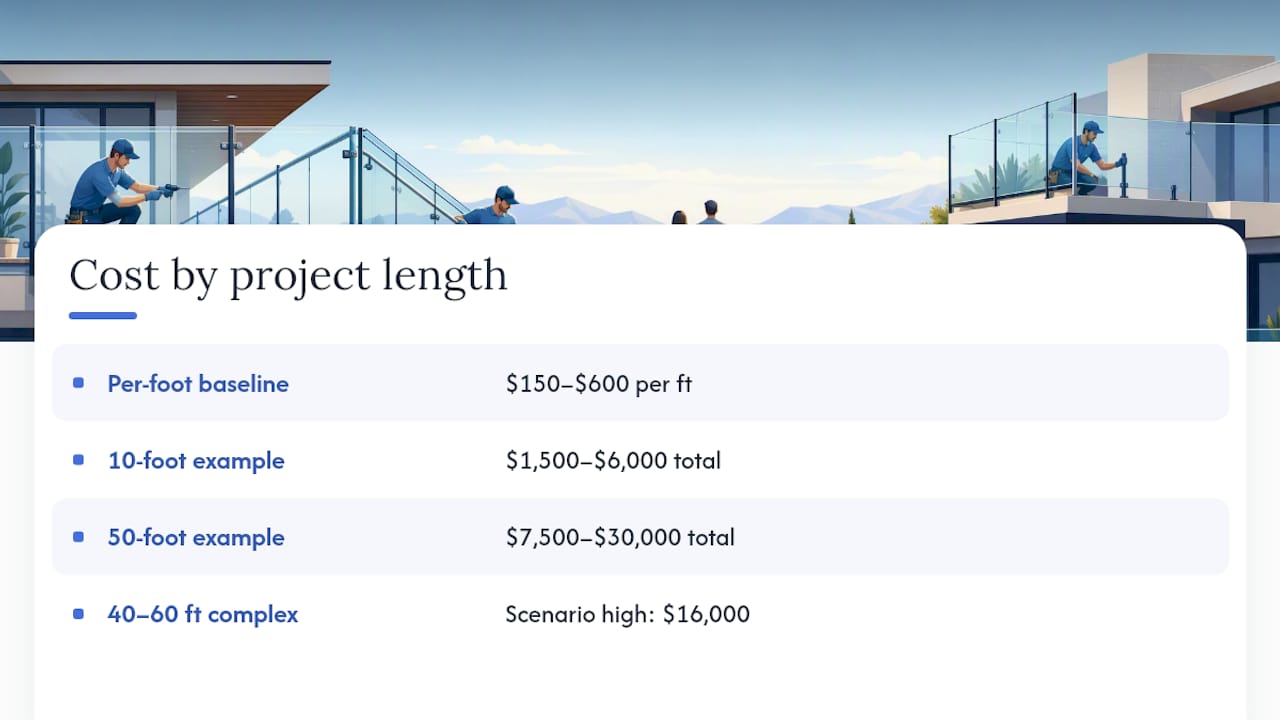
Longer runs don’t scale in a straight line. Stair sections, curves, and railings taller than the standard 36 to 42 inches all add labor hours and sometimes require custom panel sizes, which pushes a 40 to 60 foot project as high as $16,000 in scenario-based estimates. These figures assume standard access. A second-story balcony with no direct crane or lift access will run above the high end shown here.
What Drives the Price of Glass Railing Materials and Hardware?
System style is the biggest lever you control; learn about the luxury of glass interior doors for insights on glass options and finishes that complement your railing choices. Framed systems sit at the bottom of the per-foot range because the frame does structural work the glass doesn’t have to. Frameless systems flip that: the glass itself bears the load, which means thicker tempered panels, deeper base shoes, and tighter installation tolerances. That combination commonly raises frameless pricing to 2 to 3 times a framed job, both in materials and labor hours.
Glass type matters almost as much as system style:
- Tempered glass (residential standard): the baseline cost included in most $150 to $600 per-foot quotes
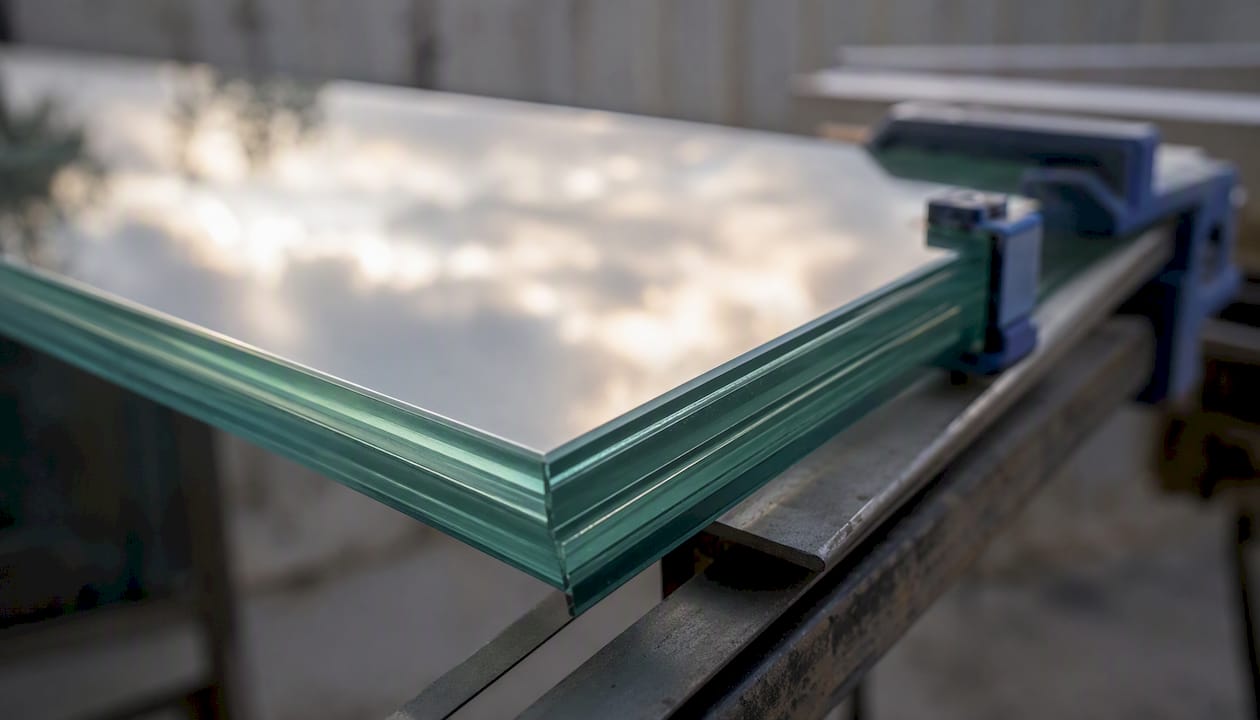
- Laminated glass: typically a step up in material cost, but it stays intact if it breaks rather than needing an emergency swap
- Low-iron or clear ultra-transparent glass: a finish upgrade that adds cost without changing the structural math
- Frosted, tinted, or styled panels: custom fabrication that can add 10% to 15% on top of standard panel pricing, per DIY-focused industry pricing
Hardware is where a lot of homeowners underestimate the bill. Posts, clamps, base shoes, and top rail hardware together can add $20 to $200 or more per linear foot depending on finish (brushed stainless costs more than mill-finish aluminum) and whether the hardware is exposed or hidden.
Pro Tip: If your deck sits within splash range of a pool or faces coastal salt air, laminated glass is worth the upcharge even though tempered is the code minimum in most areas. Laminated holds together when cracked, which means no emergency board-up and no gap in your railing while you wait on a replacement panel. Compare the trade-offs in this laminated vs. tempered breakdown.
How Do You Estimate the Cost of a Glass Railing Project?
You don’t need a contractor’s bid to get a realistic number. Run this five-step process before you request quotes so you can sanity-check what comes back.
- Measure your linear footage. Walk the actual railing line, including any returns at corners or stair transitions, not just the straight-line distance.
- Choose your system style and glass type. Decide between framed, semi-frameless, or frameless, and whether tempered, laminated, or a styled finish fits the application.
- Select hardware finish and top rail. Exposed stainless clamps, hidden base shoes, and a code-required top rail each shift the per-foot rate. Browse custom panel and finish pricing to see how these add up.
- Multiply linear feet by your per-foot rate. Use $150 to $250 for budget framed, $250 to $400 for mid-range, or $400 to $600+ for premium frameless.
- Add labor, permits, site prep, and contingency. Layer in the extras below before you call it a final number.
Example: 20-foot deck run
- Mid-range semi-frameless at $325/ft: 20 × $325 = $6,500
- Add a $250 permit fee and $400 in site prep (removing an old wood rail): $7,150
- Add 10% contingency for unforeseen post spacing issues: roughly $7,865
- Premium frameless at $500/ft on the same 20 feet: $10,000, before permits and prep
Add 10% to 15% contingency on straightforward straight runs, and closer to 20% on jobs with stairs, curves, or custom cut panels. That buffer covers the surprises most homeowners don’t see coming, like hidden costs tied to old decking removal or unlevel framing that needs shimming before posts go in.
How Much of the Cost Is Labor, and What Do Permits Add?
Labor typically runs 20% to 50% of total project cost, with the low end applying to simple straight runs on ground-level decks and the high end showing up on stair rails, curved layouts, or anything above standard railing height. Frameless systems push labor toward that upper band because precision fitting takes longer than dropping panels into a frame.
- Permit fees commonly vary widely depending on jurisdiction and railing classification
- Skipping a required permit risks failed resale inspections and forced rework later
- Simple straight-run installs often wrap in a single day; stair sections or curved runs can take two to three days
- Lead time from order to install typically runs several weeks once custom panels are cut to size
Site access changes the timeline too. A ground-floor deck with a clear path is straightforward. A second-story balcony that needs scaffolding or a lift adds both labor days and cost that a flat per-foot number won’t capture. Details on how access and site prep affect a quote are covered in this installation cost breakdown.
Is Glass Railing Worth the Cost Long-Term?
Glass railings ask for less upkeep than wood or iron over time. There’s no annual staining, no rust treatment, and no repainting cycle. Routine care is mostly glass cleaner and a soft cloth, with occasional professional polishing if a panel picks up hairline scratches from patio furniture or pets.
- Expect glass panels themselves to last decades with minimal wear
- Watch warranty language closely: long-term maintenance plans should specify what’s covered on hardware corrosion versus glass defects
- Unobstructed views are the resale argument real estate agents lean on for view lots and pool properties, and that low-maintenance profile is part of why buyers pay a premium for it
The upfront cost sits higher than a basic wood or cable rail, but the durability payoff shows up over the following ten to fifteen years in avoided repainting and repair bills.
What Do We See Homeowners Get Wrong on Glass Railing Budgets?
The most common mistake is comparing a per-panel quote from one contractor against a per-linear-foot quote from another, without converting either one to the same unit. That mismatch makes an apples-to-oranges comparison look like a huge price gap when it isn’t. Our recommendation for most residential decks and balconies is a mid-range semi-frameless system: it holds the clean sightlines people want without the full frameless premium in labor and glass thickness. If you’re not sure where your project lands, our planning team can run the linear-foot math against your specific layout and flag anything, like a stair run or tight corner, that will push cost above a straight-run estimate.
Get a Straight Answer on Your Glass Railing Quote
Once you know your per-linear-foot target, the next step is getting a real number against your actual layout, not a generic estimate. Glassrailingstore prices its panels, connectors, and hardware transparently by product, so you can build your own line-item budget instead of waiting on a contractor callback.
Every product page lists specs and pricing up front, and connector options like the 90-degree connector or 180-degree connector let you price out corners and straight runs separately instead of guessing at a blended rate. Installation guides and documented hardware specs also reduce the risk of a mismatched order or a failed inspection down the line. If your project involves a stair run, curve, or anything beyond a straight deck perimeter, request a frameless glass railing quote and get your linear footage priced against real system options before you commit to a contractor bid.
FAQs
1. What is a fair price per linear foot for glass railing?
A fair installed price falls between $150 and $600 per linear foot, with $250 to $400 covering most mid-range semi-frameless systems homeowners choose.
2. Is frameless glass railing worth the extra cost?
Frameless costs 2 to 3 times more than framed systems because of thicker glass and precision installation, but it delivers the cleanest sightline and highest resale appeal for view-focused decks and pools.
3. Does the cost of glass railing include installation?
Most quoted per-linear-foot ranges, including the $150 to $600 figure used throughout this guide, bundle materials, hardware, and labor into one installed price.
4. How much does a permit add to glass railing cost?
Permit fees typically vary by jurisdiction and railing type, affecting overall costs accordingly.
5. Can I lower the cost of replacement glass without sacrificing safety?
Yes. Sticking with standard tempered panels instead of laminated or styled finishes, and choosing a semi-frameless system over full frameless, keeps costs down while still meeting residential safety codes.
Sources
- How Much Does a Glass Railing Cost to Install? 2025 Data
- Glass Railing Systems Prices: How Much for Frameless Balustrades in the U.S. 2026 – Current Cost