

Custom Table Glass for Railings: Code-Ready Buying Checklist
Specify laminated, fully tempered or heat-strengthened laminated safety glass with a minimum nominal thickness of 1/4 inch, sized to your system, and pair it with hardware tested to ASTM E2358 and ASTM E2353 where the glass panel is the primary guard element. That is the short answer. Every purchase order for railing glass should reference IBC §2407, ASTM E2358, ASTM E2353, ASTM C1172, ASTM C1048, ANSI Z97.1, and CPSC 16 CFR 1201, and the panel must carry a manufacturer identification mark. Get an engineered quote from a supplier who provides test reports and, when your jurisdiction requires it, a stamped engineering sign-off.
The 2024 IBC sets maximum allowable stresses of 3,000 psi for heat-strengthened glass and 6,000 psi for fully tempered glass, with a required safety factor of 4.
Table of Contents
- Key takeaways for ordering custom railing glass
- What installers see go wrong — and how to specify around it
- Glassrailingstore makes ordering code-compliant railing glass straightforward
- Standards and code references worth bookmarking
- Key Takeaways
- The spec decision most buyers get wrong
Key Takeaways for Ordering Custom Railing Glass
Laminated tempered or laminated heat-strengthened glass is the code-required default for guards under IBC §2407. Monolithic tempered is only permitted where no walking surface exists below or where that surface is permanently protected from falling glass fragments — and some jurisdictions eliminate that exception entirely.
- Glass type: — Laminated fully tempered or laminated heat-strengthened per ASTM C1172 (laminated) and ASTM C1048 (heat-strengthened); monolithic tempered only under the narrow IBC exception.
Pro Tip: Photograph your existing base shoe or clamp hardware before ordering. Fabricators need the exact slot width, glass bite depth, and hole centerline dimensions to cut panels that fit without field modification.
What Installers See Go Wrong—and How to Specify Around It
The most expensive mistakes happen before fabrication starts. Measurement errors account for the majority of panel remakes: buyers submit overall opening dimensions without accounting for the required glass bite (the depth the panel must sit inside the base shoe or clamp), the edge reveal on each side, or the precise centerline locations of any holes for standoffs or bolts. Embedding guidance recommends a minimum glass bite of h/10 (not less than 3 inches) at the bottom edge and a minimum clearance of 3/8 inch between the base shoe and the glass unit, with a silicone top-finish depth of 1/4–3/8 inch. Submit those numbers in writing, not verbally.
Over-stressing at clamp points is the second common failure mode. Point-load clamps concentrate stress at the glass edge; if the panel is cut even slightly oversize or the hole is off-center, the clamp bears unevenly and the glass is at risk. Confirm fabrication tolerances in your purchase order.
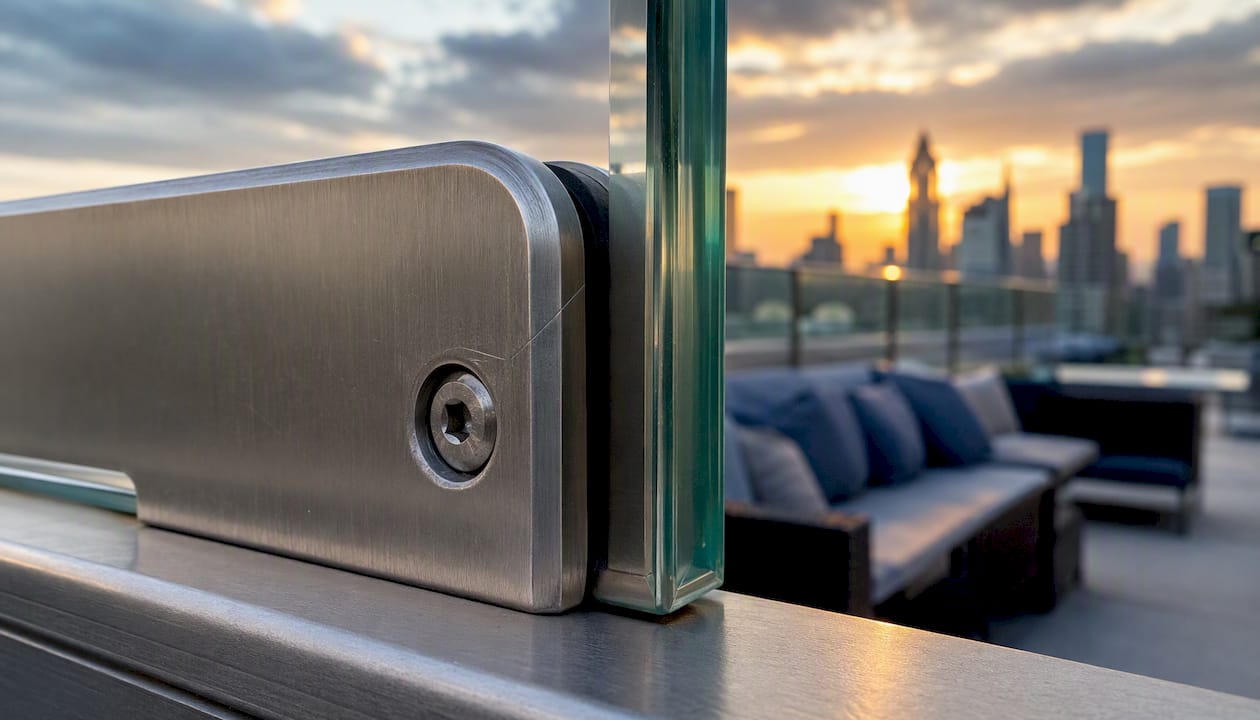
Sealant compatibility with laminated interlayers is a problem that shows up months after installation, not during it. Some silicones and wet-glaze compounds attack PVB or ionoplast interlayers, causing delamination at the edge. NGA/GANA guidance specifically flags this: verify sealant compatibility with your interlayer material before specifying, and request a mock-up or test panel for any exposed-edge laminated assembly. Get the edge-alignment tolerances confirmed in writing before fabrication begins.
The IBC’s narrow exception for monolithic tempered glass is another trap. Designers sometimes specify it to save cost, only to find the local AHJ (Authority Having Jurisdiction) has adopted an amendment that eliminates it. Check local amendments before finalizing your glass type.
Glassrailingstore Makes Ordering Code-Compliant Railing Glass Straightforward
Skip the back-and-forth with multiple vendors. Glassrailingstore stocks tempered glass panels, laminated options, base shoes, clamps, and a full caprail connector family — including the 46" tempered glass panel for standard guard heights, plus 90° connectors, square caprail straight connectors, wall connectors, corner connectors, and 180° connectors — all sized to work together.
Every product ships with compliance documentation, and the store’s measurement templates and installation guides reduce the spec errors described above. Upload your drawings or submit dimensions directly for a quote, and you receive manufacturer ID marks, test-report availability, and installation guidance with your order. Free shipping applies on orders over $3,000.
Standards and Code References Worth Bookmarking
The list below covers what to cite on permit submittals and purchase orders.
- IBC §2407 / Chapter 24: — Baseline glazing and guard requirements; governs glass type, thickness, markings, and the monolithic-tempered exception.
| Glass type | Construction | Typical thickness | Common support | Key standard |
|---|---|---|---|---|
| Laminated tempered | Two tempered lites + interlayer | varies by system and code | Base shoe, clamp, post | ASTM C1172, E2358 |
| Laminated heat-strengthened | Two heat-strengthened lites + interlayer | varies by system and code | Base shoe, post | ASTM C1172, C1048 |
| Monolithic tempered | Single tempered lite | varies by code exception | Clamp, standoff | ASTM C1048, IBC exception only |
For glass railing engineering testing details and system report guidance, Glassrailingstore’s technical pages walk through what each standard requires and what documentation to request. Architects and contractors specifying custom glass for stairs should also review handrail height requirements alongside panel specs. For interior glass inspiration, One Day Doors & Closets covers architectural uses of custom glass that complement railing glass aesthetics.
Key Takeaways
Laminated, fully tempered, or heat-strengthened laminated safety glass at a minimum 1/4 inch nominal thickness, tested to ASTM E2358 and E2353, is the correct specification for IBC-compliant glass railing guards in the United States.
| Point | Details |
|---|---|
| Glass type requirement | Laminated tempered or laminated heat-strengthened is the IBC §2407 default; monolithic tempered applies only under a narrow exception. |
| Minimum thickness | 1/4 inch nominal per IBC; confirm span and load with your fabricator. |
| Allowable stress limits | IBC sets 3,000 psi for heat-strengthened and 6,000 psi for fully tempered glass, with a safety factor of 4. |
| System test matching | ASTM E2358/E2353 reports must match your actual edge-support method — base shoe, clamp, or standoff. |
| Glassrailingstore | Stocks tempered panels, laminated options, and a full caprail connector family with compliance documentation and measurement templates. |
The Spec Decision Most Buyers Get Wrong
The conventional wisdom says “just order tempered glass” — it is cheaper per square foot and faster to source. The problem is that monolithic tempered glass, once broken, offers nothing between a falling person and a pile of glass cubes on the deck below. The interlayer in laminated glass is not a marketing feature; it is the retention mechanism the code is built around.
What surprises most buyers is how narrow the monolithic exception actually is. “No walking surface beneath” sounds simple until you realize a covered patio, a lower deck, or even a permanently installed planter box may not qualify as “permanently protected” in your AHJ’s interpretation. The safer and more defensible specification is laminated every time, regardless of what the exception technically permits.
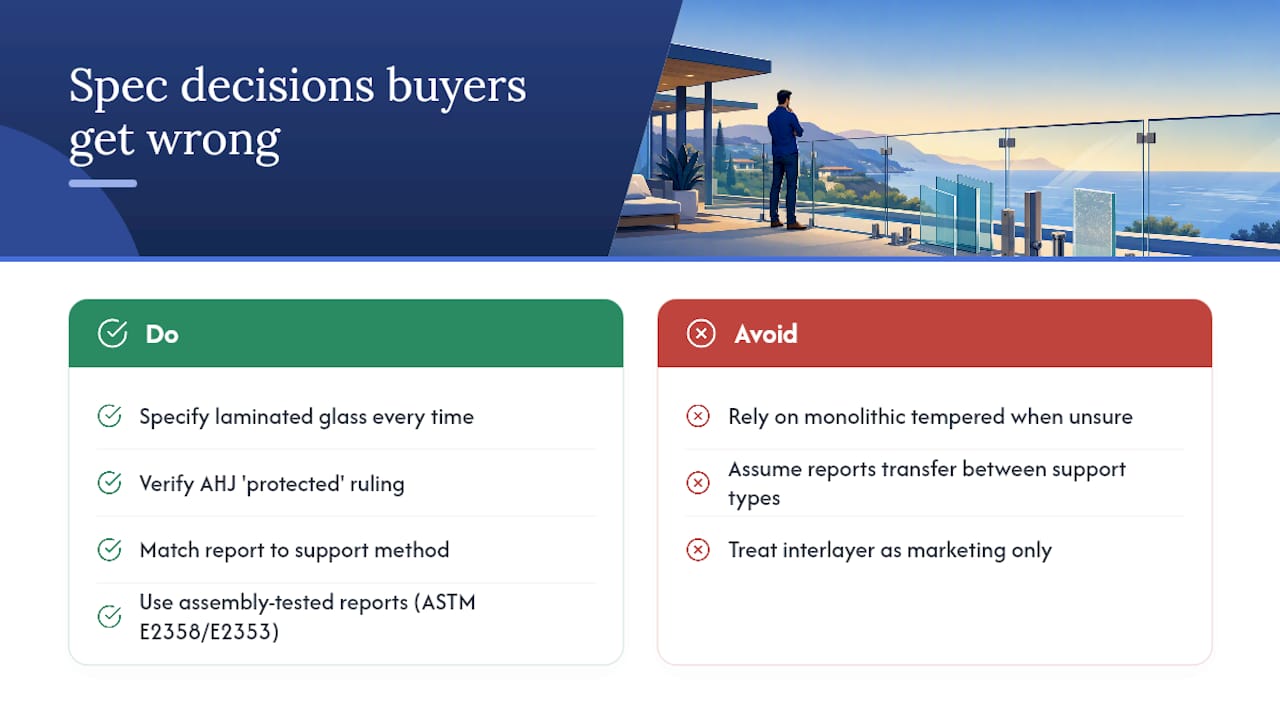
The second thing people underestimate is the system-level nature of the test standards. ASTM E2358 and E2353 test a complete assembly in its actual support condition. A test report for a base-shoe system does not transfer to a clamp system, even if the glass is identical. Matching the report to the support method is not a paperwork formality — it is the only way to know the assembly actually performs as the code intends.
Recommended
- High Quality Glass for Railings: Specify with Confidence – The Glass Railing Store
- Building Codes for Glass Railings – The Glass Railing Store
- How to Ensure Your Glass Railings Meet Local Safety Standards – The Glass Railing Store
- Glass Railing Top Rails: Required or Optional? – The Glass Railing Store