

High Quality Glass for Railings: Specify with Confidence
For railing systems, high quality glass means tempered safety glass, preferably tempered-laminated, ordered as a tested assembly (glass plus hardware) that satisfies ASTM E2353 and the applicable IBC or IRC guard provisions. Before you purchase a single panel, confirm the system has been tested as a complete assembly, or get an engineering review. Buying panels and hardware separately from different vendors, then hoping they add up to code compliance, is the single most common and expensive mistake on railing projects.
Table of Contents
- What makes glass “high quality” for railing systems?
- Tempered vs. tempered-laminated: which one do you actually need?
- Which U.S. codes and standards do you need to verify?
- Why does hardware and whole-assembly testing matter so much?
- How to specify and order high-quality glass panels and hardware
- What do glass railings actually cost, and how long do they take?
- Common mistakes and red flags to watch for
- Key Takeaways
- The case for tested assemblies over component-by-component procurement
- Glassrailingstore: tested assemblies, ready to order
- Authoritative sources and further reading
What Makes Glass “High Quality” for Railing Systems?
Industry experts now define quality primarily by post-breakage retention, not visual clarity. A panel that shatters and falls away is a failed railing regardless of how clear it looked before impact.
The core quality attributes to specify:
- Post-breakage retention. Laminated glass retains fragments via its interlayer after breakage. Monolithic tempered glass fragments into small pieces but does not hold them in place.
- Fabrication conformity. ASTM C1172 covers laminated architectural flat glass tolerances; ASTM C1048 covers heat-strengthened and fully tempered glass. Both include edge-fabrication and lamination-quality requirements that matter for exposed-edge balustrades.
- Edge quality. Tighter length and width tolerances and a polished or seamed edge finish are non-optional for exposed-edge frameless systems.
Pro Tip: When exposed edges will be visible, request lamination alignment certificates and tighten your edge-tolerance spec beyond the ASTM C1172 default. Misaligned interlayers are obvious at close range and nearly impossible to fix after fabrication.
Tempered vs. Tempered-Laminated: Which One Do You Actually Need?
The short answer: for most U.S. guard and handrail applications, tempered-laminated is required or strongly preferred. Monolithic tempered glass is allowed only in narrow circumstances.
| Feature | Monolithic tempered | Tempered-laminated |
|---|---|---|
| Post-breakage retention | Fragments fall; no retention | Interlayer holds fragments in place |
| IBC/IRC code path | Limited exceptions only | Standard for most guard applications |
| Typical nominal thickness | 1/2" or 3/4" | 9/16", 11/16", or thicker |
| Hardware/edge detailing | Simpler | May require wider base shoes or clamps |
| Cost | Lower | Higher, but reduces liability exposure |
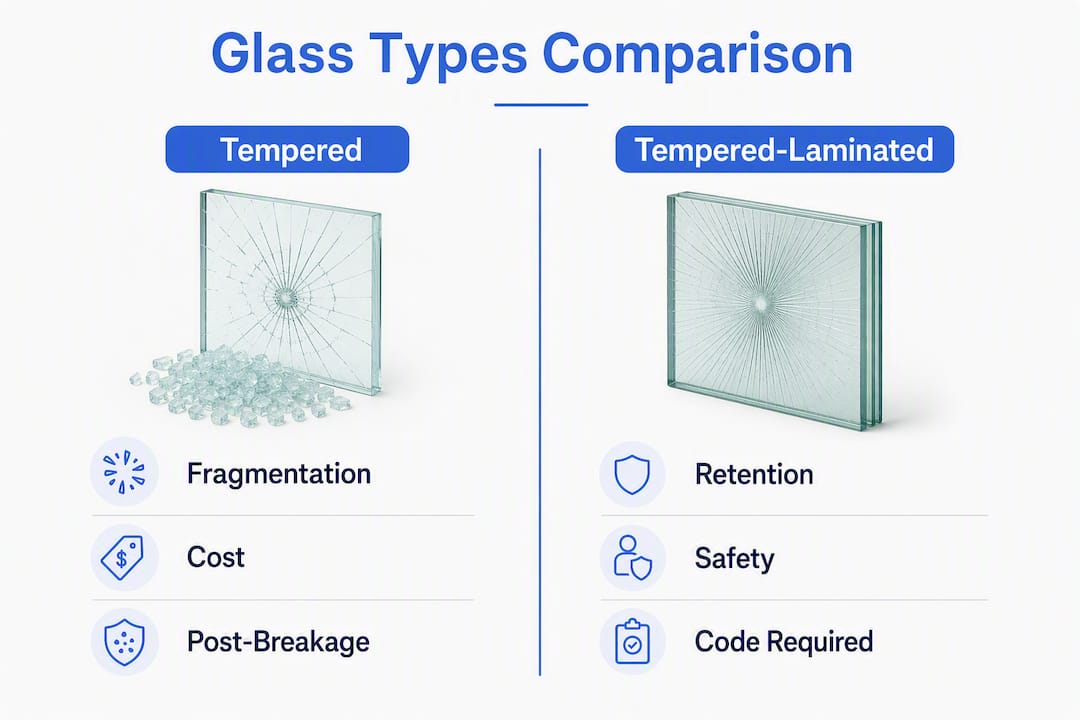
Following the 2015 IBC, laminated tempered or heat-strengthened glass became the standard for handrails and guards, with single fully tempered glass allowed only where there is no walking surface below or the surface below is permanently protected. Some jurisdictions go further: Chicago, for example, requires laminated construction except in very narrow exceptions.
The practical implication is that monolithic tempered is a shrinking option. If your project has any ambiguity about what lies below the railing, specify laminated. Practitioners report that roughly 95% of railing projects now use SGP laminated glass precisely because it removes the post-breakage argument from permit submittals.
One more thing on thickness: many installers assume a 9/16-inch laminated panel will pass structural review. Engineering often requires thicker laminates to meet residual-performance requirements, and discovering that mid-project means a change order and a delay.
Which U.S. Codes and Standards Do You Need to Verify?
Code compliance for glass railings runs across three intersecting requirements, and you must satisfy all three:
- Guard height and location rules under IBC Section 2407 (commercial) or IRC Section R312 (residential). These set minimum heights, opening limitations, and the trigger for when laminated glass is required.
- Assembly performance testing under ASTM E2353, which covers uniform load, pendulum impact, and post-breakage retention tested in the actual installed edge-support condition.
- Safety glazing rules under CPSC 16 C.F.R. 1201 (Category I or II) or ANSI Z97.1, which classify glazing by impact resistance.
For permit-ready procurement, collect these documents before ordering:
- Assembly-level test report (not just a component certificate) referencing ASTM E2353
- Nominal thickness and heat-treat certification (tempered or heat-strengthened per ASTM C1048)
- Laminate certification per ASTM C1172, including interlayer type and build-up
- PE-stamped drawings when required by the Authority Having Jurisdiction (AHJ)
- Safety glazing label or certificate per CPSC 16 C.F.R. 1201
Pro Tip: Do not assume component certificates add up to assembly compliance. Many AHJs require either an ASTM E2353 assembly test result or a PE letter demonstrating equivalent performance for your specific edge condition and hardware. Confirm this with your local building department before ordering.
The Glassrailingstore building codes resource covers IRC and IBC requirements in plain language and is a useful starting point for code research before you engage your AHJ.
Why Does Hardware and Whole-Assembly Testing Matter So Much?
The glass panel alone does not determine how a railing performs. Base shoes, point-fixed clamps, standoffs, and top rails all change load paths. They also change what happens after breakage: a base shoe that grips the bottom edge of a laminated panel can hold the panel upright even after the glass breaks, while a standoff-only system may not.

ASTM E2353 tests the glazing assembly under uniform load, pendulum impact, and post-breakage conditions, and it does so in the same edge-support configuration as the actual installation. A test report generated with a different base shoe, a different anchor spacing, or a different glass thickness does not transfer to your project.
Documents to require from any supplier:
- Assembly test report referencing ASTM E2353, with the tested edge condition clearly described
- Edge-detail drawings showing base shoe depth, anchor spacing, and clamp torque specifications
- Anchor pull-test data when anchors are supplied separately
- Stainless steel grade and finish declaration for all hardware
Pro Tip: For coastal, pool, or alkaline environments, specify 316L stainless steel and ask for the mill certificate. Grade 304 hardware corrodes faster in chlorine and salt exposure, and the visual difference between grades is invisible until the rust appears.
For a practical comparison of hardware selection and finish options, the guidance at Glass Shower Direct on shower glass hardware applies directly to the same stainless grade and finish decisions you face with railing clamps and standoffs.
How to Specify and Order High-Quality Glass Panels and Hardware
Follow these steps in order. Skipping any one of them is where change orders come from.
- Confirm the code trigger — Is there a walking surface below the railing? If yes, laminated glass is almost certainly required. Check IBC Section 2407 or IRC Section R312 for your occupancy type.
- Request assembly test reports and PE-stamped drawings. Confirm the test report matches your edge condition. Collect the complete compliance documentation before the order ships.
Pro Tip: Include glass labeling and traceability requirements in your purchase order. Each panel should carry a permanent label identifying the manufacturer, heat-treat process, and laminate build-up. This matters at inspection and for warranty claims.
What Do Glass Railings Actually Cost, and How Long Do They Take?
Cost drivers, in rough order of impact: laminated vs. monolithic, panel size and thickness, low-iron optical upgrade, edge finishing complexity, and hardware grade. A standard tempered-laminated panel in 11/16-inch thickness costs meaningfully more than a monolithic tempered panel of the same size, but the laminated option typically clears permit faster and eliminates post-breakage liability.
Custom laminated panels generally run 3–6 weeks from confirmed order to delivery. Add 1–2 weeks if engineering drawings or PE stamps are required. Hardware in stock grades ships faster, but 316L marine-grade items in non-standard finishes can add lead time.
On shipping: large glass panels are fragile in transit. Require crating or A-frame packaging, inspect every panel on delivery before signing the bill of lading, and photograph any damage immediately. Replacing a broken panel mid-project costs far more than the crating fee.
Common Mistakes and Red Flags to Watch For
Do not do these:
- Order panels without an assembly-level test report. A component certificate for the glass alone does not satisfy ASTM E2353.
- Mix glass and hardware from different vendors without written engineering verification that the combination has been tested or reviewed.
- Accept a 9/16-inch laminated panel on a structural engineer’s say-so without seeing the load calculation. Thickness requirements depend on span, load, and edge condition.
- Ignore edge-quality tolerances for exposed-edge frameless systems. Visible lamination misalignment or chipped edges cannot be fixed on site.
Red flags in a bid or supplier quote:
- No ASTM E2353 assembly test report, or a report that does not match the proposed edge condition
- No PE-stamped drawings when the AHJ requires them
- Vague laminate build-up spec (“laminated glass” with no interlayer type stated)
- Supplier unable or unwilling to state the stainless grade of hardware
When you spot any of these, request the missing documents in writing before proceeding. If the supplier cannot produce them, require a field mock-up or an engineer’s letter, or delay installation until the documentation is in hand.
Key Takeaways
For glass railing systems, quality is defined by post-breakage retention and assembly-level testing, not panel clarity alone; specify tempered-laminated glass with SGP interlayer, confirmed by ASTM E2353 assembly test reports, before ordering.
| Point | Details |
|---|---|
| Laminated glass is the standard | Tempered-laminated with SGP interlayer is required for most U.S. guard applications under IBC Section 2407. |
| Assembly testing, not components | ASTM E2353 tests the full glass-plus-hardware system; component certificates alone do not satisfy most AHJs. |
| Thickness needs engineering review | Many projects require thicker than 9/16-inch laminated panels; confirm with an engineer before ordering to avoid mid-project change orders. |
| Specify hardware grade early | 316L stainless steel is required for coastal, pool, and alkaline environments; confirm grade in writing before the order ships. |
| Glassrailingstore | Supplies tested tempered-laminated panels, 316L stainless hardware, and submittal packages; request a frameless railing quote to get assembly documentation with your order. |
The Case for Tested Assemblies Over Component-by-Component Procurement
The conventional wisdom in railing procurement is that buying premium-grade glass plus high-grade hardware equals a safe, compliant system. It does not. The assembly is what gets tested, and the assembly is what gets permitted.
What practitioners have learned the hard way is that two individually certified products can fail assembly testing when combined, because the edge condition, anchor spacing, and load path interact in ways that component specs do not predict. A base shoe that works perfectly with one glass thickness may allow excessive deflection or post-breakage drop with another. The test report is the only document that captures that interaction.
There is also a liability dimension that rarely gets discussed plainly. If a railing fails and the installer cannot produce an assembly test report matching the installed configuration, the exposure is significant regardless of the quality of the individual components. The test report is not just a permit document; it is the record that the system was designed to perform as a unit.
The shift toward laminated glass is the right call, and the shift toward requiring assembly-level evidence is equally correct. Buyers who push back on the cost of laminated panels or the time required for engineering review are optimizing for the wrong variable.
Glassrailingstore: Tested Assemblies, Ready to Order
Glassrailingstore ships custom tempered-laminated panels, 316L stainless hardware, and complete frameless railing systems with the documentation your project actually needs: assembly test reports, glass labeling, submittal drawings, and installation guidance included as standard deliverables, not add-ons.
For contractors and architects who need permit-ready packages, Glassrailingstore provides PE-stamped drawings (where available) and can match hardware to your specific edge condition and anchor layout. Stock panels like the 46-inch tempered glass panel ship with full traceability documentation. Custom laminates are fabricated to your specified build-up, interlayer type, and edge finish. Free shipping applies on orders over $3,000. Request a frameless glass railing quote or upload your drawings for a custom estimate and submittal package.
Authoritative Sources and Further Reading
Use these references when preparing permit submittals or verifying code requirements:
- IBC Chapter 24, Glass and Glazing (2018 IBC): The primary commercial building code chapter covering glass in guards and railings, including Section 2407 guard requirements.
- ASTM E2353: Standard Test Methods for Performance of Glazing in Permanent Railing Systems, Guards, and Balustrades: The assembly-level test standard most AHJs and engineers reference for compliance evidence.
- ASTM E2358: Standard Specification for Performance of Glazing in Permanent Railing Systems, Guards, and Balustrades: The companion specification that sets classification and design performance requirements.
- FB33-11 (2017): Use of Laminated Glass in Glass Railing Systems (Glass Association of North America): Industry guidance on laminated glass fabrication tolerances, interlayer selection, and exposed-edge specifications.
- IR 24-1: Glass Panel Railings, 2025 CBC (California DSA): A model state-level interpretation showing how model code requirements are applied in practice; useful even outside California.
- Glassrailingstore: Glass Railing Building Codes Compliance Guide: Plain-language walkthrough of IRC and IBC requirements with submittal guidance for U.S. projects.
- Glassrailingstore: American Building Code for Glass Railing: Concise overview of how model codes apply to typical residential and commercial railing projects.
Recommended
- The Importance of Quality Glass in Railing Systems: What You Need to Know – The Glass Railing Store
- How to Ensure Your Glass Railings Meet Local Safety Standards – The Glass Railing Store
- What Types of Glass Are Commonly Used For Railing Systems? – The Glass Railing Store
- Why Architects Choose Glass Railings: Expert Insights And Trends – The Glass Railing Store