

Glass Balcony Railings: $100–$250/ft Tradeoffs and Specs for Homeowners
Glass railings are the right call when an unobstructed view matters more than low maintenance, and the wrong call when a homeowner won’t keep up with regular cleaning or wants a lower upfront price. They buy you light, sightlines, and wind protection in exchange for higher installation cost and the need for regular glass care. The checklist and specification notes below will tell you which side of that trade you’re actually on.
TL;DR:
- Glass railings demand higher upfront costs, especially for larger or custom panels, but they maximize sightlines and natural light compared to traditional railings.
- Regular cleaning is essential because glass shows water spots, fingerprints, and pollen more easily, especially in hot or humid climates.
- Proper specification of glass type, hardware grade, and structural support is crucial to meet safety codes and handle environmental exposure.
- Frameless systems offer the clearest view with minimal hardware, but need precise mounting surfaces, while framed options suit irregular balcony edges and tighter budgets.
- A careful comparison of warranty, included services, and installation requirements helps avoid costly modifications or safety issues later.
Table of Contents
- The Real Advantages of Balcony Glass Railings
- Disadvantages and Realistic Downsides
- Design Variants and Mounting Methods That Matter
- Safety, Building Codes, and Structural Checks Before You Buy
- Maintenance and Durability: Keeping Glass Railings Looking Sharp
- Cost and Value: Budgeting for a Glass Balcony Railing
- A Practical Decision Checklist Before You Order
- What Years of Specification Questions Teach You About Glass Railings
- How the Glass Railing Store Can Help You Specify the Right System
- Sources
- FAQ
The Real Advantages of Balcony Glass Railings
The single biggest reason people choose glass is sightline preservation. A solid panel of tempered glass keeps the view of a backyard, skyline, or coastline completely open, and it lets more natural light reach the interior rooms behind the balcony door. That combination alone is why glass railing systems increase perceived space and light compared to picket or panel railings that chop up the view with vertical bars.
Beyond the view, glass panels double as a wind shield. A solid glass run blocks gusts the way a baluster railing never could, which effectively adds usable square footage to a small balcony on a windy floor. That’s a meaningful upgrade for anyone above the fourth or fifth story, where wind load on an open deck can make sitting outside unpleasant most of the year.
- Frameless and semi-framed options let you match the railing to the architecture, from a minimalist glass wall to a stainless-topped hybrid, adapting to various design preferences.
- Tempered and laminated glass resist the rot, rust, and paint failure that eventually hits wood and iron railings.
- A continuous glass barrier, when specified to code, gives a gap-free line of protection that works well for households with young kids or pets.
Pro Tip: If your balcony faces a busy street or a neighboring building, glass still lets in the light while keeping the visual noise of a typical railing design out of the picture.
Safety and compliance are part of the pitch too. Modern glass railing systems can provide a solid, gap-free barrier suitable for families and pets once the system is specified to meet local building codes and structural load requirements.
Disadvantages and Realistic Downsides
Cost is the first hurdle. Glass systems generally run higher upfront than aluminum or wood railings of the same length, and installation complexity increases if your balcony edge wasn’t built with a compatible fixing surface. Add a change to the substrate or a custom panel size and the budget grows further.
Cleaning is the second issue people underestimate. Glass shows every water spot, fingerprint, and pollen streak that a solid rail never would. Glass railings are low maintenance compared to wood and painted metal, but they do require more frequent glass cleaning to keep that clear look intact.
- South and west-facing balconies can turn glass into a mild greenhouse, trapping heat on hot afternoons.
- Full transparency means less privacy from neighbors or the street unless you add frosting or tint.
- Tempered glass shatters into small pieces if it fails; laminated glass holds together, which matters for higher floors and heavy wind zones.
- Hardware, especially lower-grade steel, can corrode or streak in coastal or high-humidity climates over several years.
Pro Tip: Ask any supplier for the glass type and hardware grade in writing before you order. “Tempered” and “laminated” aren’t interchangeable, and the wrong choice on an exposed balcony is expensive to fix later.
Design Variants and Mounting Methods That Matter
The design decision usually comes down to three formats, and each one changes how the railing performs.
- Frameless panels use thick tempered or laminated glass with minimal hardware, which maximizes sightlines and is engineered to meet safety requirements when properly specified. This is the go-to for modern frameless vs. framed projects where the view is the priority.
- Semi-frameless systems add a slim top or side rail for extra rigidity, a good middle ground on longer balcony runs.
- Framed systems enclose the glass on multiple sides, which tends to suit budget-driven projects or balconies with irregular edge geometry.
Mounting depends on the balcony’s edge construction. Top-fix posts need a solid slab edge; side-fix (or fascia) mounts work when the balcony floor structure isn’t deep enough for a top-mounted base shoe. In coastal or humid climates, marine-grade stainless hardware cuts corrosion risk substantially over standard steel.
Safety, Building Codes, and Structural Checks Before You Buy
Every glass railing has to satisfy local guard height, maximum opening, and load requirements before it goes on a balcony, so check your municipal code before finalizing a design. Glass selection matters just as much as the numbers on a code sheet.
- Confirm guard height and gap limits with your local building department; these vary by jurisdiction and occupancy type.
- Choose tempered glass for standard applications, but move to laminated glass on higher floors or high-wind exposures where fail-safe behavior matters more.
- Verify the substrate (concrete, wood, steel) can handle the anchoring hardware specified for your system.
- Ask for load-test documentation, not just a verbal assurance.
Correctly specified tempered or laminated panels paired with tested hardware can meet rigorous safety standards, but the specification has to match your actual exposure, not a generic default. Reviewing a load-bearing capacity guide before ordering saves a lot of back-and-forth with an installer later.
Maintenance and Durability: Keeping Glass Railings Looking Sharp
A monthly wipe with glass cleaner and a microfiber cloth handles most smudges and water spots before they set in. Hard water areas need a vinegar rinse occasionally to stop mineral deposits from etching the surface over time.
- Inspect hardware connections twice a year, and always after a major storm.
- Watch for loose base shoes or side brackets; tightening early prevents bigger repairs.
- Avoid abrasive pads that scratch the glass surface permanently.
- Ask suppliers about warranty length and what voids it, since exposure conditions affect lifespan more than the glass itself.
Pro Tip: Follow a set of preventive maintenance steps right after installation, not months later. Fresh hardware seals and sealants are easiest to protect before grime builds up.
Cost and Value: Budgeting for a Glass Balcony Railing
Price tracks four things: glass thickness and type, total run length, hardware system, and installation difficulty. A framed glass railing runs $100 to $130 per linear foot, semi-frameless systems run $165 to $250 per linear foot, and DIY glass panel kits start around $60 and go up to $130 per linear foot for readers handling installation themselves.
- Cheaper materials like painted metal need repainting or rust treatment on a cycle that glass avoids entirely.
- A clean glass railing tends to boost curb appeal and perceived home value more than a comparable metal or wood option.
- Budget a contingency for custom panel sizes or structural adaptation if your balcony edge isn’t a standard depth.
A Practical Decision Checklist Before You Order
- Rank your priority: is the view worth trading maintenance time for, or would a lower-upkeep material serve you better?
- Check whether your balcony edge suits top-fix or side-fix mounting; this often decides your whole design direction, since substrate condition dictates what’s practical.
- Request technical data sheets, load-test evidence, and warranty terms from any supplier before signing.
- Get at least two site-specific quotes and confirm in writing who handles the engineering sign-off.
Pro Tip: If a quote skips the engineering question entirely, ask directly. That gap is where most costly change orders originate.
What Years of Specification Questions Teach You About Glass Railings
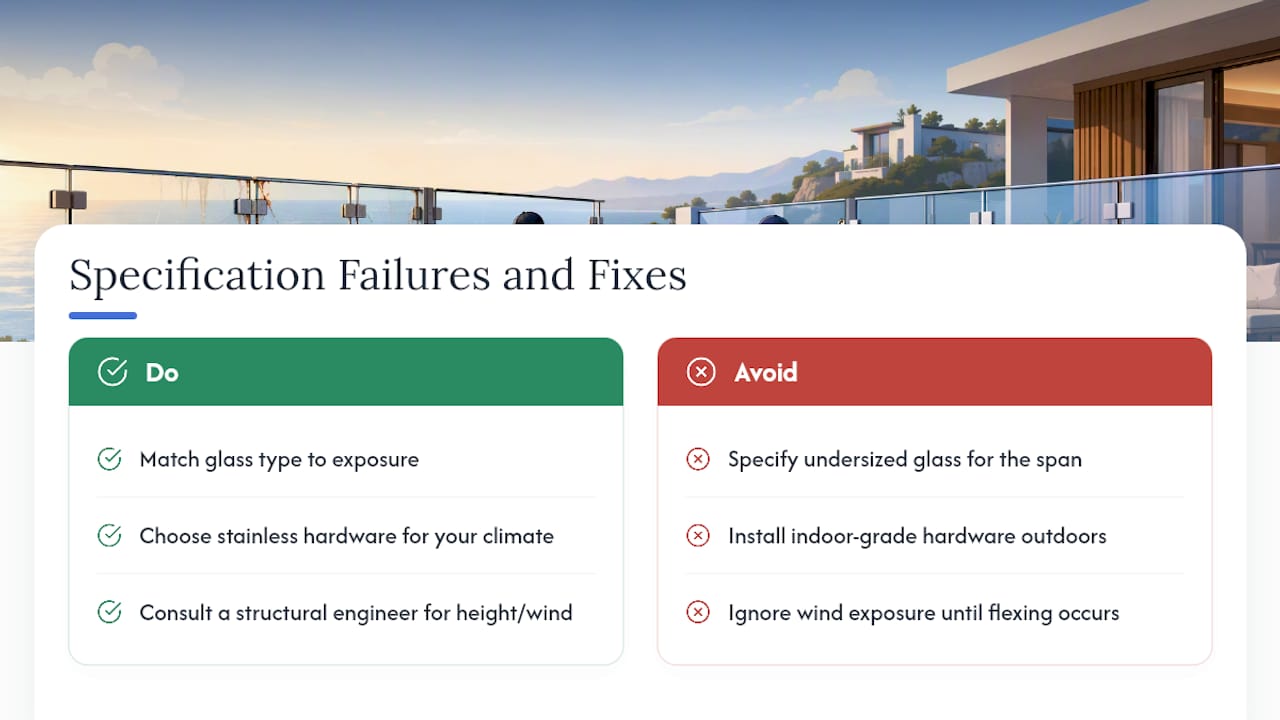
Working alongside a company that sells glass railing hardware daily surfaces the same three mistakes over and over: undersized glass for the span, hardware graded for indoor use installed outdoors, and wind exposure ignored until the railing flexes visibly in a storm. None of that is a design flaw in glass itself. It’s a specification failure.
The fix is not complicated. Match glass type to exposure, choose stainless hardware rated for your climate, and involve a structural engineer whenever the balcony height or wind zone raises any doubt. Most disappointing glass railing installations trace back to skipping one of those three steps, not to the material being wrong for balconies.
— Fuanne
How the Glass Railing Store Can Help You Specify the Right System
Some companies offer building blocks like framed glass railings, semi-frameless glass railings, frameless glass railings, and DIY glass panel kits, all built around tempered safety glass and stainless hardware rated for outdoor exposure.
If you already know your balcony’s view priority and mounting constraints, the next step is pricing it out. The glass railing cost guide breaks down per-linear-foot pricing by system type, and if you’re leaning frameless, you can request a frameless glass railing quote directly. When you compare quotes from any supplier, check three things specifically: warranty length, what’s included in shipping, and whether installation labor and engineering sign-off are part of the scope or billed separately.
Sources
For deeper specification detail, review laminated vs. tempered glass for material selection, load-bearing capacity standards for code compliance, and high-wind balcony guidance for exposed sites. For finish details where railing fixings meet balcony flooring, this tile edging guide is a useful cross-reference.
- What Are the Benefits of a Glass Railing System? 5 Reasons to Install - Golden Glass
- Benefits of Frameless Glass Railings - Modern & Durable
FAQ
What Are the Downsides of Glass Railings?
The main downsides are higher upfront cost, more frequent cleaning to manage smudges and water spots, and reduced privacy on street-facing balconies. Tempered glass can also shatter into small pieces on impact, which is why laminated glass is often specified for higher floors or high-wind sites.
Is a Glass Railing a Good Idea for a Balcony?
It’s a good idea when preserving the view and letting in natural light outweighs the extra cleaning effort and higher installation cost. Glass railings preserve sightlines and increase natural light, making them a strong fit for balconies with a view worth showing off.
Which Type of Railing Is Best for a Balcony?
There’s no single best option. Frameless glass suits balconies where the view is the priority and the edge structure supports top or side-fix mounting, while framed or semi-framed systems fit tighter budgets or irregular edges better.
What Are the Pros and Cons of Glass Railing Compared to Steel Railing?
Glass wins on view preservation, natural light, and resistance to rust compared to unpainted or poorly coated steel. Steel typically costs less upfront and needs less frequent surface cleaning, but it blocks the view and needs periodic rust prevention that glass doesn’t.
How Much Does a Glass Balcony Railing Cost?
Framed systems run $100 to $130 per linear foot, semi-frameless runs $165 to $250 per linear foot, and DIY panel kits start at $60 and go up to $130 per linear foot. Frameless system pricing depends on project specifics and is available on request.