

Choose Surface or Fascia Mount by Framing, Not Looks for Homeowners & Pros
Fascia mount posts bolt to the deck’s rim joist from the side, keeping the entire deck surface clear. Surface mount posts bolt straight down through the decking into the framing below, which is usually the faster, more forgiving install. Choose fascia mount when the rim joist and blocking are solid and documented; choose surface mount for retrofits, concrete slabs, or when you can’t verify what’s behind the fascia board. Either way, The Glass Railing Store carries hardware built for both.
TL;DR:
- Fascia mount requires verified solid rim joists and blocking for safe load transfer, while surface mount can be installed on less certain framing details.
- Fascia mount preserves full deck width and offers a cleaner appearance, but depends heavily on waterproofing and moisture management at rim joist penetrations.
- Surface mount is easier and faster for DIY installation, especially on retrofit decks, and is more suitable when framing inspection or reinforcement is not possible.
- Conduct a thorough framing inspection before choosing a mount to ensure adequate support; in cases of unknown framing or rot, surface mount is the safer choice.
- Both hardware types are designed for specific mounting methods; match your system to your framing condition, framing plan, and waterproofing requirements to ensure safety and compliance.
Table of Contents
- Surface Mount vs Fascia Mount: Comparing Space, Looks, and Load Path
- What Framing and Code Requirements Should You Check First?
- How Hard Is Installation, and What Tools Do You Need?
- Why Moisture Management Matters More for Fascia Mounts
- How Do You Choose the Right Mount for Your Deck?
- Who’s Behind This Guide, and Where to Learn More
- What the Data Actually Tells You to Prioritize
- Get Hardware Matched to Your Mount Type
- Sources
- FAQ
Surface Mount vs Fascia Mount: Comparing Space, Looks, and Load Path
The core trade-off comes down to where the post sits and where the load travels once someone leans on the railing. Surface mount posts plant on top of the deck boards, close to the edge, and send force straight down into the joist or blocking beneath them. Fascia mount posts tuck against the outer rim board, hidden below the decking line, and send force sideways into that rim joist and whatever blocking backs it up.
That difference shows up first in usable space. A surface mount post base typically eats up 4 to 6 inches of deck width along the perimeter, which matters on a narrow balcony or a tight stair landing. Fascia mount posts sit outside the decking plane entirely, so the walking surface runs edge to edge with nothing interrupting it.
Looks matter too, but not the way most people expect. Fascia mount tends to read cleaner because the hardware disappears below the fascia trim, leaving just the glass and cap rail visible from the yard. Surface mount hardware sits in plain sight, though most buyers find a low-profile stainless base plate is barely noticeable once glass panels are installed.
- Space: fascia preserves full deck width; surface mount narrows the usable edge slightly.
- Aesthetics: fascia hides hardware; surface mount shows a base plate but simplifies alignment.
- Load path: surface mount pushes straight down into joists; fascia mount pushes sideways into the rim, which is why rim-joist condition matters more for that option.
- Stairs and narrow runs: surface mount is generally more forgiving on stair stringers, where fascia framing is thinner and harder to reinforce.
Neither option is universally “better.” A new build with engineered blocking is a great fit for fascia mount. A 30-year-old deck with an unknown rim assembly is a much safer candidate for surface mount, simply because you can see and reinforce the framing you’re bolting into.
What Framing and Code Requirements Should You Check First?
Before you pick a mount type, find out what’s actually holding your deck together. The American Wood Council’s prescriptive guidance is the baseline most builders use for rim joist and blocking details, and it’s blunt about one thing: don’t fasten a fascia post to thin decking or a poorly connected rim board. That single mistake causes most fascia mount failures reported by installers.
The concentrated load a residential guard rail must resist under the IRC guard and opening provisions is significant and is applied at any point along the top rail, in any direction. In-fill panels like glass need to handle a 50-pound load over a small area. Those numbers aren’t abstract. They’re what determine whether your blocking needs to tie into two joists or three, and whether a single lag screw into rim sheathing will hold up over time.
The AWC DCA6 guide spells out blocking placement and fastener patterns designed to spread that lateral force across multiple framing members, not just one screw and a prayer. When your existing framing doesn’t match those specs, you have two options: add blocking and plates to bring it up to standard, or switch to a manufacturer-tested anchor system rated for the load. On anything marginal, loop in your local building department or a structural engineer before you drill. Inspectors care about load path, not intentions.
How Hard Is Installation, and What Tools Do You Need?
Surface mount installation is the more DIY-friendly path, and it’s not close. You’re bolting down through the decking into joists or blocking you can inspect from below, sealing the base plate against water intrusion, and moving to the next post. Installers consistently rank surface mount as faster and more retrofit-friendly because you get top-down access without opening up the rim.
Fascia mount takes more coordination. You’re aligning a bracket against the outside of the rim board, drilling horizontally into framing you often can’t see, and confirming blocking exists before you commit to a hole pattern. Most fascia jobs go faster with two installers, one holding the bracket level while the other drives fasteners.
- Confirm blocking and joist layout before any drilling starts.
- Dry fit the post or bracket and check level and plumb.
- Drill pilot holes sized for stainless lag bolts or through bolts.
- Apply sealant or flashing at every penetration point.
- Torque fasteners to the hardware manufacturer’s spec, not by feel.
Your tools list stays short: a drill/driver, a torque wrench, stainless fasteners rated for exterior use, a manufacturer template, and flashing tape or sealant compatible with your deck’s waterproofing. The most common pitfall is measuring only the finished decking edge and skipping a visual check of what’s actually behind it. That habit is how installers end up bolting into rim sheathing instead of solid framing.
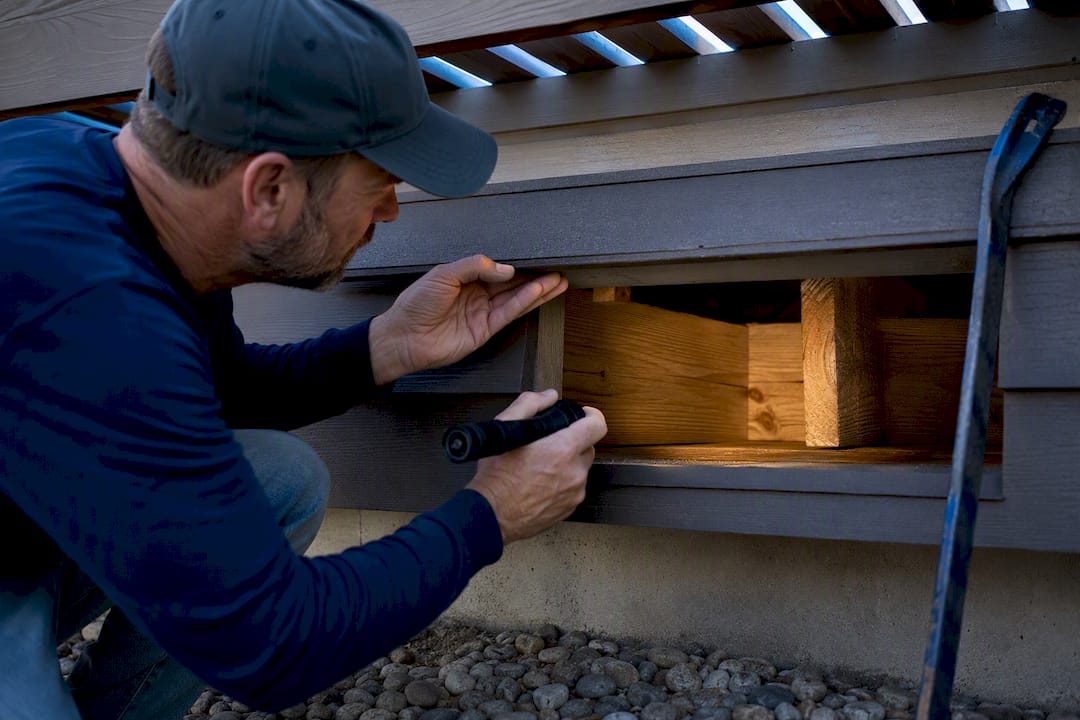
Pro Tip: Pull up a section of skirting or trim before you order hardware. Five minutes with a flashlight can save you from discovering rotted blocking after the posts are already on order.
Why Moisture Management Matters More for Fascia Mounts
Every hole you drill into a rim joist is a potential water entry point, and fascia mounts put several of them right at the seam where the rim meets the ledger and decking. That’s the exact spot where trapped moisture rots framing the fastest, out of sight, for years.
- Sealant alone is not a substitute for a proper flashing detail; on waterproofed decks, penetrations need a compatible flashing or membrane sleeve, not just a bead of caulk.
- Check the membrane manufacturer’s approved penetration method before drilling. Some systems require a specific curb, sleeve, or washer to keep the warranty intact.
- Where possible, route the penetration through the decking surface with a standoff base plate instead of through the waterproofed rim, which preserves the membrane’s integrity.
- Stainless washers and butyl based sealants at every fastener point outperform silicone caulk over the long run.
Surface mount doesn’t eliminate moisture risk, but it concentrates penetrations on the horizontal decking surface, which is generally easier to flash and inspect than a vertical rim assembly buried behind fascia trim.
How Do You Choose the Right Mount for Your Deck?
Run through a short set of questions before you order anything, and the right answer usually becomes obvious.
- Is the rim joist solid, connected, and backed by verified blocking? If yes, fascia mount is on the table.
- Is this a new build where blocking can be planned into the framing? Fascia mount is often the better long-term choice.
- Is this a retrofit where you can’t confirm what’s behind the fascia board? Surface mount is the safer default.
- Is the deck narrow, or does every inch of walking surface matter? Fascia mount preserves that space.
- Are you mounting to a concrete slab or patio instead of a wood deck? Surface mount with slab anchors is your practical option, since there’s no rim joist to attach to.
- Is there any sign of rot, water staining, or soft framing near the rim? Stop and call an engineer before choosing either mount.
New construction with engineered blocking favors fascia mount nearly every time, since planned framing and flashing details make it a space-preserving, attractive choice. Older decks with unknown framing history, narrow stair stringers, or concrete surfaces almost always point toward surface mount instead.
Who’s Behind This Guide, and Where to Learn More
This guide draws on prescriptive framing standards from the American Wood Council, IRC guard load provisions, and manufacturer waterproofing guidance, cross checked against how installers actually handle fascia and surface mount jobs in the field. It’s written and edited by Fuanne for Glassrailingstore’s editorial team.
Glassrailingstore backs that guidance with product lines built for both mounting styles, along with installation resources on surface mounting for decks and step-by-step framing guidance for builders covering blocking and rim joist requirements. The company provides customer support and warranties covering the hardware purchased.
What the Data Actually Tells You to Prioritize
Most articles on this topic lead with looks. That’s backwards. The framing decision has to come first, because it determines which mount type is even structurally viable on your deck, and only after that should you weigh how the hardware looks from the yard.
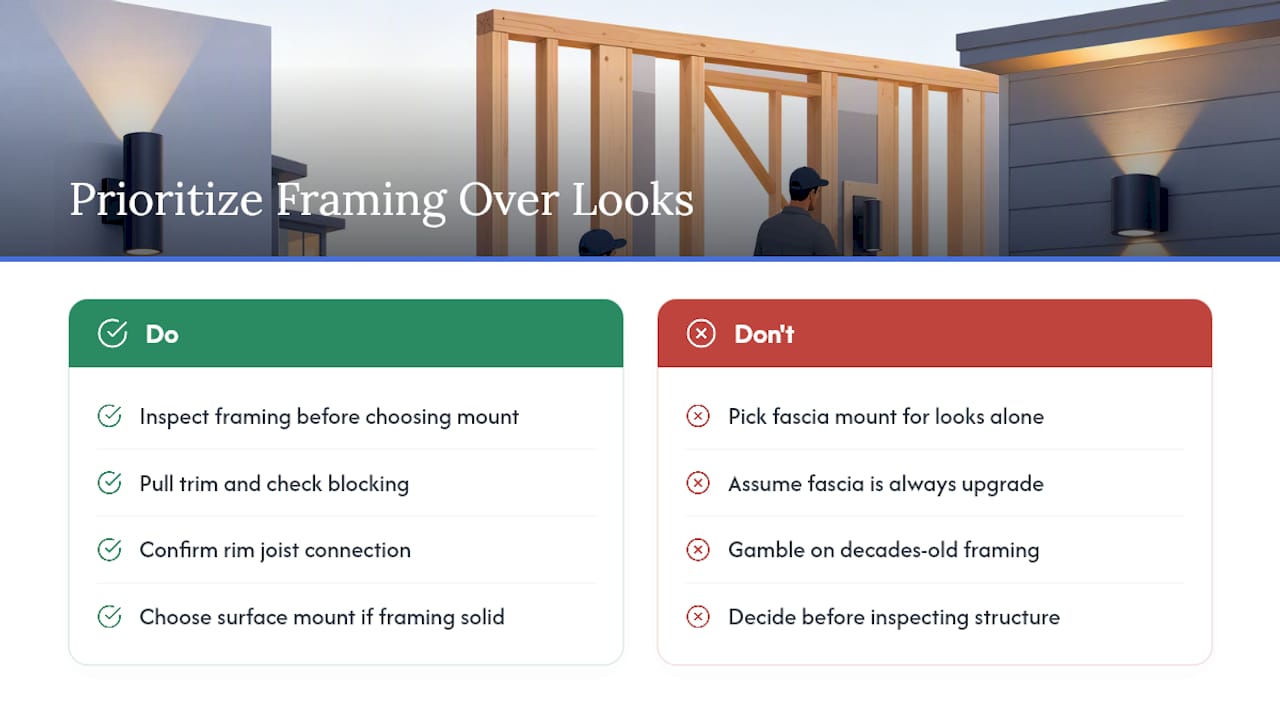
Here’s what the research actually supports: fascia mount is the better-looking option in a vacuum, but it’s only as good as the rim joist behind it. Conventional advice treats fascia mount as the upgrade choice for anyone who cares about aesthetics. That’s misleading for retrofits, where you’re often gambling on framing installed decades ago by someone who didn’t plan for a glass railing system.
If you take one thing from this guide, make it this: inspect before you decide. Pull the trim, check the blocking, confirm the rim joist connection. A surface mount system on solid framing beats a fascia mount system on questionable framing every time, regardless of how it photographs. Once the structural question is settled, choosing between The Glass Railing Store’s frameless and framed systems becomes the easy part.
— Fuanne
Get Hardware Matched to Your Mount Type
Glassrailingstore is the direct alternative to guessing at generic hardware kits. Both frameless and semi-frameless systems ship with base plates and brackets engineered for surface mount or fascia mount, so you’re not retrofitting mismatched parts once your framing decision is made.

Frameless systems run without published pricing, semi-frameless panels run $165 to $250 per linear foot, and framed panels run $100 to $130 per linear foot, all detailed on the glass railing cost page. Every product page includes sizing specs, and if you already know your rim joist condition, request a frameless glass railing quote with your measurements and mount preference. Installation guides walk through blocking checks, torque specs, and flashing details for both mounting styles, so you’re not starting from scratch. Get your project measured and priced before you buy a single bracket.
Sources
Keep these on hand before you finalize a mount decision: the AWC DCA6 deck framing guide, the IRC guard and load provisions, and Steel Frame Manufacturing’s technical resources on connection detailing.
- American Wood Council (AWC)
- ICC / IRC code (guards and openings)
- Formulated Materials — railing penetrations and waterproofing
FAQ
What Does Fascia Mount Mean?
Fascia mount means the railing post bolts sideways into the deck’s rim joist, below the decking surface, rather than down through the deck boards. It keeps the full walking surface clear but depends heavily on solid rim framing and blocking behind the fascia trim.
What Type of Porch or Balcony Railing Is Best?
The best system is a complete, code-compliant assembly rated for the concentrated and in-fill guard loads your local authority requires, not a specific style. For most retrofits, surface mount glass railing systems from Glassrailingstore offer the easiest install with verified load paths.
What Are the Different Ways to Attach Deck Railings?
The two main methods are surface mounting, where posts bolt down through the decking into joists or blocking, and fascia mounting, where posts bolt sideways into the rim joist. Some concrete patios also use surface mount base plates with slab anchors instead of either wood framing method.
Are Horizontal Railings to Code?
Horizontal cable or rail designs aren’t automatically banned under model building codes, but many jurisdictions restrict them over child-climbability concerns. Always verify your adopted code and local interpretation with your building department before finalizing a horizontal design.