

Specifiers: SGP vs PVB: When 5× Tear Strength Justifies the Cost
Choose SGP (ionoplast) for exposed-edge, structural, and open-edge glazing where post-breakage strength matters. Choose PVB (polyvinyl butyral) for standard safety glazing, framed installations, and anywhere acoustic performance or budget drives the decision. SGP runs stiffer and roughly five times more tear-resistant than standard PVB, but it also carries a higher material cost. Read the comparison below, then confirm the final build-up against ASTM and IBC requirements for your specific application.
TL;DR:
- SGP offers roughly five times the tear resistance and double the load-bearing capacity of standard PVB, enabling thinner glass for similar structural performance.
- SGP’s stiffness remains more consistent across temperature ranges, making it suitable for applications requiring genuine composite action under sustained loads.
- For exposed-edge, open-edge glazing in balustrades or overhead panels, SGP is preferred to improve residual capacity and reduce fall-through risk after breakage.
- Good fabrication requires tight control of lamination conditions, especially moisture management and validated process parameters, to ensure edge stability and prevent delamination.
- Total cost of ownership for SGP can be comparable or lower than PVB in long-term, hard-to-access installations due to its superior edge stability and lower replacement frequency.
Table of Contents
- SGP vs PVB Comparison: Stiffness, Strength, and Optics
- When Should You Specify SGP Instead of PVB?
- What Engineering Documentation Do You Need for Each Interlayer?
- Is SGP Worth the Extra Cost Over the Life of the Building?
- How Do Fabrication and Quality Control Differ Between SGP and PVB?
- Most railing failures we hear about don’t trace back to a bad interlayer choice. They trace back to nobody asking the exposed-edge question at all. Panels built around tempered safety glass and stainless hardware require careful interlayer selection, which matters most on frameless, open-edge balustrade and stair designs where SGP’s residual strength earns its premium. For framed deck rail sections with lower exposure risk, standard PVB laminated or tempered-only builds often make more sense.
- Ready to Spec Your Glass Railing Project?
- Sources
SGP vs PVB Comparison: Stiffness, Strength, and Optics
The numbers separate these two interlayers more sharply than most specifiers expect. SGP’s ionoplast chemistry gives it a shear modulus significantly stiffer than conventional PVB, according to manufacturer data cited by Kuraray. That stiffness translates directly into deflection: less bending under wind or live load means the glass behaves more like a monolithic structural element than a flexible sandwich.
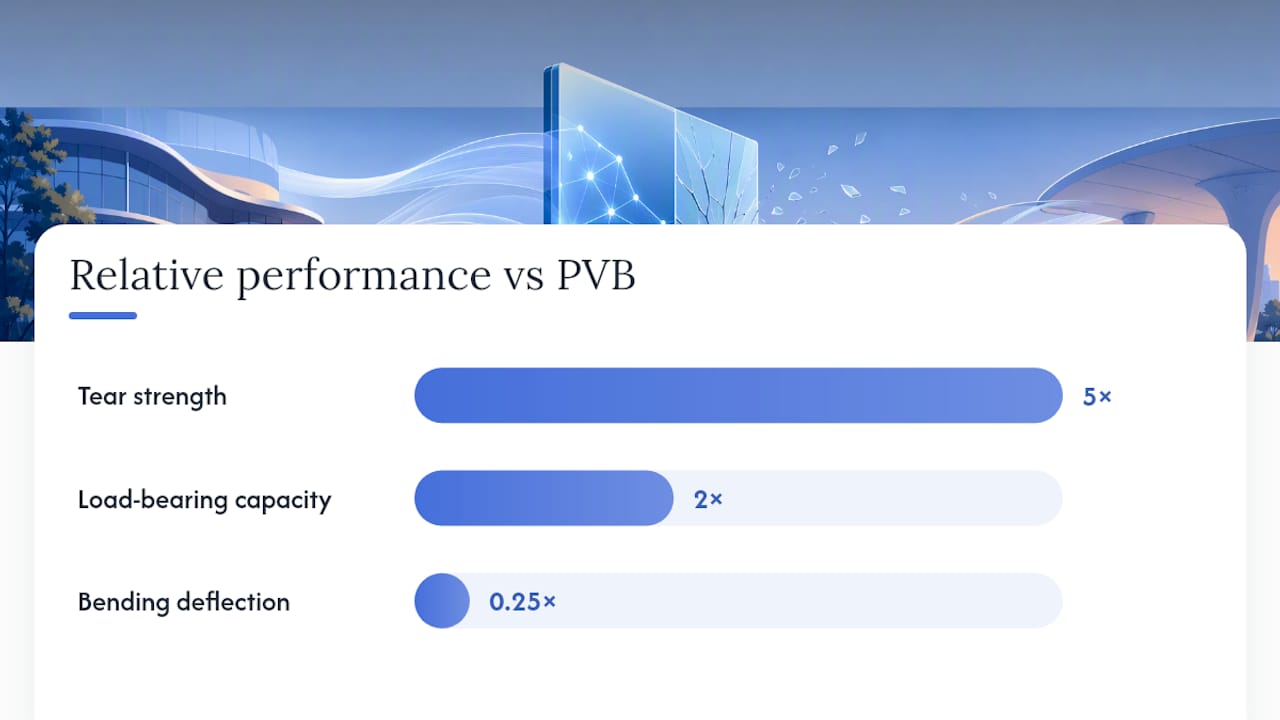
Tear strength follows the same pattern. SCGMA’s technical bulletin reports SGP delivering about five times the tear resistance of standard PVB, along with roughly double the load-bearing capacity at comparable thickness and only a quarter of the bending deflection. Those are the figures that let engineers spec thinner glass for the same structural performance.
Temperature matters more than most spec sheets admit. PVB is viscoelastic, meaning its stiffness drops as temperature rises and creeps under sustained load over time. SGP holds its mechanical properties far more consistently across the temperature range a building actually sees, which is part of why GlasVue’s structural analysis calls it capable of genuine composite action under sustained loading.
| Metric | PVB | SGP |
|---|---|---|
| Stiffness / modulus | Lower, temperature-sensitive | Significantly stiffer |
| Tear strength | Baseline | ~5× higher |
| Optical clarity / long-term yellowing | Good, can yellow at exposed edges over time | Superior edge stability, resists yellowing |
| Moisture / edge resistance | More moisture-sensitive | Stronger edge stability |
| Acoustic performance | Better damping, acoustic grades available | Weaker acoustic damping |
Key takeaways include that SGP offers higher load-bearing capacity, reduced bending deflection, and greater tear strength compared to standard PVB. Exact multiples vary by source and application.
Acoustically, PVB still wins. Its viscoelastic structure absorbs sound energy in a way rigid SGP simply doesn’t match, and acoustic-grade PVB formulations exist specifically for sound-critical projects. If a railing or partition doubles as a noise barrier, that’s worth reading through our technical guide to soundproofing with glass railings.
When Should You Specify SGP Instead of PVB?
Match the interlayer to how the glass edge is treated and what happens after breakage, not just to the glazing type.
- Framed windows and interior partitions — PVB is standard here; edges are protected and acoustic damping usually matters more than residual strength.
- Exterior open-edge balustrades and pool fences — SGP is preferred when the edge is exposed and there’s no metal frame to carry load after a crack.
- Canopies and overhead glazing — SGP’s superior post-breakage capacity reduces fall-through risk if a panel cracks.
- Glass floors — SGP’s stiffness limits deflection under foot traffic and supports the residual capacity codes increasingly expect.
- Hard-to-access exterior glazing — SGP’s weathering stability cuts the odds of a costly high-access replacement.
Ask yourself: is the edge exposed? Is replacement access difficult? Does the span require reduced deflection? Does the project need documented residual capacity after breakage? Two or more “yes” answers point to SGP; otherwise, PVB covers the job at lower cost. For structural railing panels specifically, our comparison of laminated versus tempered glass walks through how that decision plays out in practice.
What Engineering Documentation Do You Need for Each Interlayer?
Post-breakage behavior is where code compliance actually gets tested. “Residual capacity” means the broken panel still carries load through composite action between the glass fragments and the interlayer, rather than collapsing outright. SGP’s higher stiffness and tear strength generally produce better residual capacity than standard PVB at the same thickness, which is why some interpretations of IBC guardrail provisions lean toward SGP for open-edge, life-safety applications, though final compliance always depends on local code and a licensed engineer’s calculations.
Specifiers should request:
- ASTM E1300 structural glass design calculations for the specific build-up
- Impact testing data (ASTM C1048, ANSI Z97.1, or hurricane-zone equivalents where applicable)
- Manufacturer-certified interlayer data sheets, not just generic marketing claims
- A PE stamp on any open-edge or elevated glazing application
Pro Tip: Never accept a fabricator’s verbal assurance that “SGP is stronger, so it’s fine.” Get the actual load calculation for your span and support condition in writing before approving shop drawings. Our engineering testing resource covers what documentation to request before signing off.
Is SGP Worth the Extra Cost Over the Life of the Building?
SGP’s raw interlayer cost runs commonly cited at three to five times that of PVB, but that number alone misleads specifiers who stop reading there. Total cost of ownership depends on more than interlayer price:
- Interlayer price itself (the biggest gap between the two materials)
- Glass thickness required to hit the structural target (SGP often allows thinner glass, offsetting some of the premium)
- Autoclave cycle time and scrap rate during fabrication
- Long-term maintenance and replacement frequency, especially for hard-to-access installations
On a large span or a balustrade three stories up with no easy access, SGP’s edge stability and lower breakage-replacement odds can flip the “cheaper” choice from PVB to SGP over a building’s service life. Ask vendors for alternate build-ups priced both ways rather than assuming the lowest interlayer quote wins.
How Do Fabrication and Quality Control Differ Between SGP and PVB?
Lamination process control separates a good panel from a delaminating liability years later.
- Humidity control — PVB lamination is sensitive to moisture during autoclave processing; poor control leads to hazing or edge delamination.
- Validated process parameters — SGP requires tighter, manufacturer-validated temperature and pressure cycles; deviations show up as edge cloudiness or bond failure.
- Edge sealant compatibility — confirm sealants used on exposed edges are compatible with the specific interlayer to prevent moisture ingress.
- Documentation — request material safety data sheets, lamination cycle records, and any available sample-weathering test data before accepting a shipment.
Pro Tip: Ask fabricators for a sample panel that’s been through accelerated weathering testing, not just a fresh-cut sample. Edge stability problems rarely show up on day one.
Before you send an RFP, confirm: exposed edges (yes/no), access for future replacement, span and support spacing, whether local code requires documented residual capacity, and whether acoustic performance factors into the spec. That short list resolves most SGP-versus-PVB debates faster than another round of stiffness charts.
— Fuanne
Ready to Spec Your Glass Railing Project?
Whichever interlayer your engineer specifies, the hardware carrying that panel needs to match the load path you designed for. Glassrailingstore stocks tempered glass panels built for both framed and frameless railing systems, along with the connectors and wall-mount hardware that turn a specified panel into an installed one.

If your project calls for a top rail, our caprail connectors are engineered to match standard panel dimensions, and for interior transitions where PVB’s acoustic benefits matter, it’s worth reviewing decorative and interior glazing options like those covered in this look at interior glass doors before finalizing your build-up. Request a quote through Glassrailingstore’s product pages, and send your panel dimensions and support conditions along with it so our team can flag any hardware compatibility issues before you order.
Sources
- SCGMA Technical Bulletin – Laminated Glass, PVB and SGP Interlayers
- Structural laminated glass: The technical superiority of SGP (Ionoplast) vs. PVB — GlasVue