

Marine Grade Stainless Steel Explained for Builders
Marine grade stainless steel is defined as grade 316L or 316 marine grade stainless steel, engineered specifically to resist chloride-induced corrosion in saltwater and coastal environments. The term “marine grade” is an industry shorthand, not an official metallurgical classification. The recognized standard is 316 stainless steel marine grade, which contains 16–18% chromium, 10–14% nickel, and 2–3% molybdenum. That molybdenum content is what separates it from every other common stainless steel grade. If you are specifying hardware for a coastal deck railing, a pool fence, or a marine railing system, understanding what makes 316 different from 304 is not optional. It is the difference between a 20-year installation and a rust-streaked failure in three seasons.
The core of marine grade stainless steel explained properly starts with chemistry. Chromium forms a thin, self-repairing chromium oxide layer on the steel surface. This passive layer is what gives all stainless steels their corrosion resistance. The problem is that chloride ions in seawater aggressively attack this layer, breaking it down and initiating pitting corrosion.

Molybdenum is the solution. In 316 stainless steel marine, molybdenum stabilizes the passive layer, making it far more resistant to chloride attack than 304 can manage. The result is a steel that resists the two most destructive corrosion types in marine settings: pitting corrosion and crevice corrosion.
Key metallurgical properties of 316 stainless steel marine grade include:
- Chromium (16–18%): Forms the protective oxide layer that gives stainless steel its corrosion resistance.
- Nickel (10–14%): Stabilizes the austenitic structure, keeping the steel non-magnetic, ductile, and weldable.
- Molybdenum (2–3%): Enhances resistance to chloride pitting and crevice corrosion, the defining feature of marine grade performance.
- 316L variant: The “L” denotes low carbon content, which reduces carbide precipitation during welding and preserves corrosion resistance at weld joints.
Engineers use the Pitting Resistance Equivalent Number, or PREN, to quantify corrosion resistance across grades. 316 stainless steel carries a PREN of approximately 24, while Duplex 2205 reaches approximately 35 and Super Duplex 2507 exceeds 43. The higher the PREN, the more aggressive the environment the steel can handle.
Pro Tip: Always specify 316L over standard 316 for welded assemblies in coastal applications. The low carbon content prevents sensitization at weld heat-affected zones, which is a common failure point in marine hardware.
The most common and costly mistake in marine grade stainless steel glass hardware procurement is treating 304 and 316 as interchangeable. They are not. The compositional difference is significant, and the performance gap in saltwater exposure is dramatic.
| Property | 304 Stainless Steel | 316 Stainless Steel |
|---|---|---|
| Chromium content | ~18% | 16–18% |
| Nickel content | ~8% | 10–14% |
| Molybdenum content | None | 2–3% |
| Chloride resistance | Moderate | High |
| Marine suitability | Protected/inland coastal | Direct saltwater exposure |
| Typical cost | Lower | Higher (10–20% typically) |
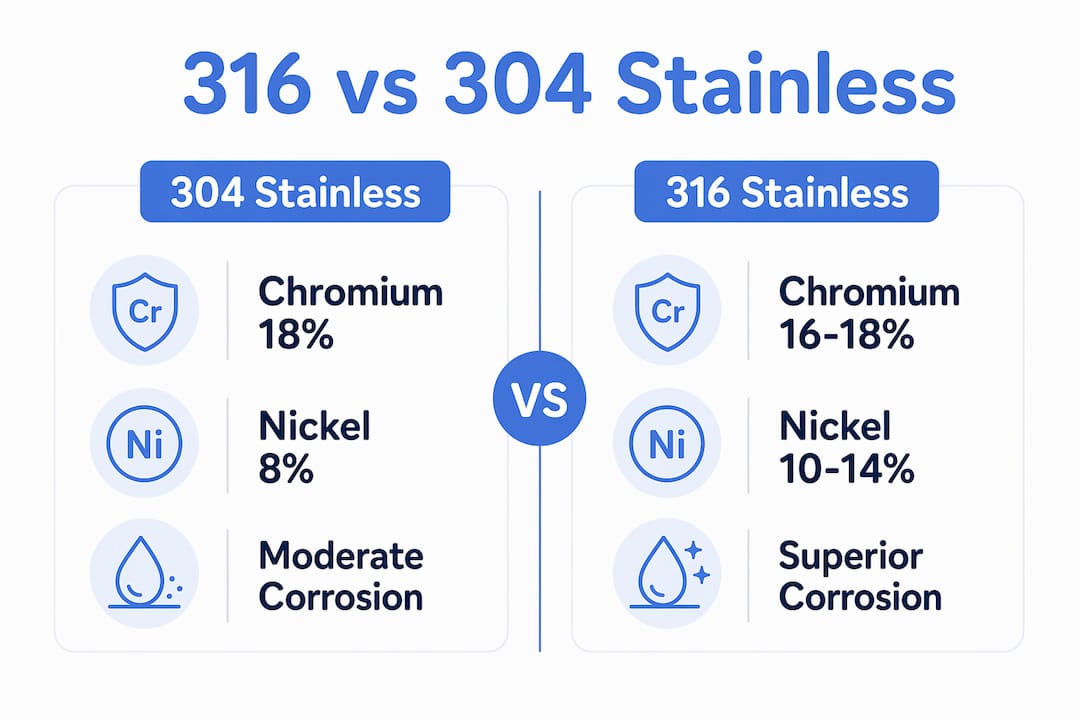
304 stainless steel is appropriate for coastal service, splash zones, and intermittent freshwater submersion. It is not recommended for direct saltwater atmospheres or extended marine exposure. Use 304 for interior hardware in a marina building, not for the exterior railings facing the water.
The procurement risk here is serious. 304 and 316 are visually identical. No visual inspection or dimensional check can tell them apart. Only chemical analysis confirms the grade. This means a supplier can ship 304 labeled as 316, and you will not know until corrosion appears months later.
Pro Tip: Always request a mill test report (MTR) or material certification from your supplier before accepting any marine grade stainless steel hardware for marine or coastal use. Strict procurement policies that require chemical verification are the only reliable defense against grade substitution.
The cost difference between 304 and 316 is real but modest compared to the cost of replacement. A railing system that fails in three years due to grade substitution costs far more in labor, materials, and reputation than the premium for verified 316 hardware upfront.
Choosing marine 316 stainless steel is necessary but not sufficient. Design geometry is as critical as material grade in preventing corrosion failures. A perfectly specified 316 fitting installed with poor geometry will still corrode.
The four marine grade stainless steel exposure zones each demand different thinking:
- Atmospheric zone: Above the waterline, exposed to salt spray and humidity. Standard marine 316 stainless steel performs well here with regular rinsing. This is the zone where most coastal railing hardware lives.
- Splash zone: Intermittently wetted by waves or spray. 316 stainless steel marine grade is the minimum acceptable grade. Crevice geometry becomes critical because water pools and oxygen is depleted in tight joints.
- Tidal zone: Alternately submerged and exposed. Corrosion rates accelerate significantly. Duplex 2205 or coated systems are strongly preferred.
- Fully immersed seawater: The most aggressive environment. 316L can initiate crevice corrosion at temperatures as low as 0°C in full immersion. Super Duplex 2507 or titanium alloys are the correct specification here.
Crevice corrosion is the specific failure mode that catches most designers off guard. It occurs when a tight gap between two surfaces traps seawater, depletes oxygen, and creates an acidic micro-environment that destroys the passive layer. Common crevice traps include bolt holes, overlapping plates, and poorly fitted connectors.
Galvanic corrosion adds another layer of complexity. When 316 stainless steel marine contacts dissimilar metals like aluminum or carbon steel in a saltwater electrolyte, galvanic and stress corrosion cracking risks increase substantially. Duplex stainless steels handle these conditions better than standard austenitic grades.
Pro Tip: Design all marine grade stainless steel connections to drain freely. Avoid horizontal surfaces that collect water, and use sealed or gasketed connections wherever possible to eliminate crevice geometry. This single design habit extends hardware life more than any coating.
Temperature matters too. Warmer seawater accelerates chloride attack. An installation in Florida or Hawaii faces more aggressive corrosion than the same hardware in Maine, even with identical exposure.
Where Marine Grade Stainless Steel Is Used in Practice
316 stainless steel marine grade is the standard for approximately 90% of marine grade stainless steel applications, covering rails, handrails, cleats, and deck hardware. That dominance reflects a straightforward reality: no other common alloy delivers the combination of corrosion resistance, strength, workability, and aesthetic finish that 316 provides at a reasonable cost.
Practical applications where 316 stainless steel marine grade is the correct specification include:
- Deck and balcony railings on coastal homes and commercial buildings, where salt spray is constant and appearance matters.
- Pool fencing and gate hardware, where chlorinated water and coastal humidity combine to attack lesser grades.
- Boat fittings and cleats, where direct saltwater contact is continuous.
- Architectural cladding and fasteners on coastal buildings, where replacement is expensive and disruptive.
- Stair railings on piers and docks, where splash zone exposure is unavoidable.
The benefits of marine grade stainless steel in these applications go beyond corrosion resistance. The material maintains its appearance over decades, which matters for residential resale value and commercial property aesthetics. It requires no paint or protective coating in atmospheric zones, reducing long-term maintenance costs. It is fully recyclable, which matters for LEED-certified projects.
Failures in this space are almost always traceable to one of two causes: wrong material grade or poor design. A coastal railing project that used 304 hardware because it was cheaper will show rust staining within one to two seasons in a direct ocean-facing location. A project that used 316 but installed fittings with trapped water geometry will show crevice corrosion at the joints while the flat surfaces remain pristine. Both failures are preventable with correct specification and attention to stainless steel hardware selection.
For designers and contractors working on weatherproof railing systems in coastal climates, the specification checklist is short: confirm 316 or 316L grade with mill certification, design for drainage, avoid dissimilar metal contact, and plan for annual rinsing with fresh water. That protocol covers the vast majority of atmospheric and splash zone installations.
Key Takeaways
Marine grade stainless steel means 316 or 316L, verified by chemical certification, designed to drain, and matched to the specific exposure zone of the installation.
| Point | Details |
|---|---|
| 316 is the standard | Grade 316 or 316L with 2–3% molybdenum is the correct specification for direct marine exposure. |
| Verify with certification | Visual inspection cannot distinguish 304 from 316; always require a mill test report from your supplier. |
| Design geometry matters | Crevice traps cause corrosion failures even in correctly specified 316 hardware; design for drainage. |
| Match grade to exposure zone | Atmospheric zones suit 316; tidal and fully immersed zones require Duplex 2205 or Super Duplex 2507. |
| PREN guides selection | Use the Pitting Resistance Equivalent Number to match alloy grade to environment severity beyond generic labels. |
Why Marine Grade Is Not a Guarantee
I have reviewed enough failed coastal installations to say this plainly: the label “marine grade” on a product tag means very little without verification. The term has no regulatory definition. Any supplier can print it on hardware that turns out to be 304 or even a lower grade. The only thing that protects you is a mill test report with chemical composition data.
The second thing I have learned is that 316 is not invincible. Contractors sometimes treat it as a universal solution for any saltwater environment. It is not. If you are specifying hardware for a tidal zone or a fully submerged application, 316 will eventually fail. The PREN metric exists precisely to push professionals past generic grade labels and into real environmental matching. A seaside commercial project in a high-humidity, warm-water climate warrants a conversation with a structural engineer about Duplex 2205, not a default to 316 because it is “marine grade.”
Local conditions matter more than most specifications acknowledge. A deck railing in coastal Maine and a coastal glass railing in Miami face fundamentally different corrosion environments, even if both face the ocean. Temperature, humidity, and proximity to the waterline all shift the calculus. Specifying for your actual site, not a generic “marine environment,” is the professional standard.
Proactive maintenance is the final piece most people skip. Even correctly specified marine 316 stainless steel hardware in a well-designed installation benefits from a fresh water rinse every few months to remove salt accumulation. That simple habit extends service life significantly and keeps the installation looking the way it should.
— Fuanne
Build with Confidence Using Glassrailingstore Hardware
Glassrailingstore supplies marine grade stainless steel hardware engineered for coastal and outdoor railing systems, from 90-degree connectors to wall mounts and caprail fittings. Every hardware component is built to perform in the environments this article describes: salt spray, humidity, and the demanding conditions of coastal residential and commercial builds.

Glassrailingstore backs its hardware with engineering testing documentation and building code compliance resources, giving designers and contractors the technical support they need to specify with confidence. If you are planning a coastal deck, balcony, or pool fence project and need verified marine grade hardware that meets code, Glassrailingstore is the right starting point. Browse the full hardware catalog or request a quote directly through the site.
FAQs
1. What is marine grade stainless steel?
Marine grade stainless steel is grade 316L or 316 stainless steel marine, containing 2–3% molybdenum that provides superior resistance to chloride-induced pitting and crevice corrosion in saltwater environments. The term “marine grade” is an industry shorthand, not a formal metallurgical classification.
2. Is 316 stainless steel marine grade suitable for full seawater immersion?
Standard 316L can initiate crevice corrosion in fully immersed seawater at temperatures as low as 0°C. For tidal and fully submerged applications, Duplex 2205 or Super Duplex 2507 are the correct specifications.
3. How do i tell 304 from 316 stainless steel marine?
You cannot tell them apart visually or dimensionally. Only chemical analysis or a mill test report confirms the grade. Always request material certification from your supplier before accepting hardware for marine use.
4. What is PREN and why does it matter?
PREN stands for Pitting Resistance Equivalent Number, a metric that accounts for chromium, molybdenum, and nitrogen content to rate corrosion resistance. Grade 316 scores approximately 24, Duplex 2205 scores approximately 35, and Super Duplex 2507 exceeds 43, giving engineers a precise tool for matching alloy to environment.
5. What maintenance does marine grade stainless steel require?
In atmospheric and splash zone applications, rinsing with fresh water every few months removes salt accumulation and significantly extends service life. No paint or protective coating is required for 316 stainless steel marine in above-waterline coastal installations.
Recommended
- Why Choose Stainless Steel Hardware for Outdoor Builds – The Glass Railing Store
- Weatherproof Glass Railing Features: A Homeowner’s Guide – The Glass Railing Store
- Essential Glass Railing Tools for Builders and Homeowners – The Glass Railing Store
- Structure Reinforcement for Glass Railings: 2026 Guide – The Glass Railing Store