
Avoid Retrofit Costs: Bird Friendly Glass Railing Specs for Architects
The most reliable bird-friendly glass railing uses durable visual markers on the outer, first surface: factory-applied ceramic frit, first-surface etch, or a verified UV-pattern coating paired with reflection control. Specify these treatments on surface 1 at schematic design, not as a change order after a collision complaint. Review the specification checklist below before your next glazing package goes out for bid.
TL;DR:
- Using factory-applied ceramic frit or first-surface etching on the outer surface of glass railings is essential for durability and effectiveness in deterring bird collisions.
- Pattern placement must be verified on shop drawings, with proper alignment across panels and joints, to prevent unmarked flight paths that attract birds.
- For high-risk sites, combining physical patterning with reflection control measures like overhangs or dimming lights significantly enhances bird safety.
- UV-reflective coatings are less reliable for high-risk locations due to species-specific detection limitations and potential quick degradation.
- Incorporating bird-safe glazing specifications early in design prevents costly retrofit modifications and ensures compliance with local planning or environmental requirements.
Table of Contents
- What makes a glass railing bird friendly?
- Design integration: pattern spacing, placement, and complementary measures for real projects
- When do codes or LEED require bird-safe railings?
- How effective are bird-safe glass treatments, really?
- Specifying and installation checklist for bird-friendly railings
- How The Glass Railing Store supports bird-safe railing projects
- Installation best practices to maintain bird-friendliness over time
- Maintenance practices specifically to ensure markers/signals remain effective
- The gap between the standard advice and what actually works on site
- Get factory-applied bird-safe panels without the retrofit costs
- Sources
What makes a glass railing bird friendly?
“Bird-friendly glass railing” isn’t a term you’ll find in most glazing codes. The industry term is bird-collision deterrent glazing, or bird-safe glazing, and it’s what architects should be writing into specs. The mechanism is straightforward: birds don’t perceive glass as a solid barrier, they perceive reflections of sky and vegetation, and a railing panel mounted at canopy height near trees or water becomes an invisible wall at exactly the altitude birds fly.
Four glazing approaches dominate the market for railings, and they don’t perform equally.
- Ceramic frit is a silk-screened pattern fired into the glass during tempering, typically on surface 1 (the outward-facing side). It’s permanent, resists abrasion and salt exposure, and works across a wide range of species because it’s a physical marker, not a spectral trick.
- First-surface laser etching cuts a fine pattern directly into the glass. It scores well in tunnel testing across species and reads as a subtle, frosted texture rather than an opaque dot pattern, which architects often prefer for sightline-sensitive projects.
- UV-reflective coatings apply a pattern visible to birds under ultraviolet light but nearly invisible to people. The appeal is obvious: you keep the glass looking clear. The catch is that not every species reads UV cues with the same sensitivity, so UV-only glazing is a weaker default choice for high-risk sites like wetland edges or migratory corridors.
- Retrofit films and decals cost far less upfront and can be applied to existing railings without swapping panels. They also degrade faster under UV exposure and require more frequent replacement in exterior applications, especially on south- and west-facing runs.
For marine environments or high-abrasion locations like pool decks and coastal balconies, factory-applied frit or etch outperforms adhesive film every time, simply because there’s no bond line to fail, highlighting the value of the luxury of glass interior doors in design-minded projects.
Design integration: pattern spacing, placement, and complementary measures for real projects
Spacing is where good intentions fall apart on paper but hold up on site. The American Bird Conservancy’s 2"x2" rule calls for markers spaced no more than 2 inches apart vertically or 4 inches apart horizontally, and that pattern needs to sit on the glazing’s outer surface to be effective, since reflections form on the outside face.
Three things separate a spec that works from one that fails inspection or, worse, fails birds after installation:
- Verify first-surface placement in the shop drawings, not just the product data sheet. A pattern applied to surface 2 or 3 loses much of its effectiveness because the reflection forms in front of it.
- Check pattern continuity across panel joints. Mullions and gaps between panels can create an unmarked flight path if the tessellation doesn’t align panel to panel, so shop drawings should show the pattern running edge to edge with stated tolerances.
- Layer in complementary measures where the site risk is high: angling glass slightly downward, adding overhangs or sunshades to break up reflections, and dimming exterior lighting at night to reduce attraction for migratory species.
For projects where clients push back on visible dot patterns, non-directional or randomized line patterns preserve more of the view than a uniform grid while still meeting the 2x2 spacing rule.
Pro Tip: Ask your glazing fabricator for a physical sample panel held at an angle outdoors, in daylight, before finalizing the pattern. Reflectivity changes dramatically with sun angle, and a pattern that looks subtle on a spec sheet can disappear entirely under certain lighting.
When do codes or LEED require bird-safe railings?
Bird-safe glazing isn’t universally mandated by national building code, but it shows up as a requirement more often than most design teams expect, usually triggered during local planning or environmental review rather than at the building code stage.
Common triggers include:
- Proximity to designated habitat, waterfront edges, or wetlands, where municipal planning departments increasingly condition approval on bird-safe glazing.
- Green roof installations, which attract birds and raise collision risk for adjacent glass railings and curtain wall.
- Projects triggering discretionary design review, where reviewers may request bird-safety measures even absent a specific ordinance.
- City-specific guidance, including New York City’s bird-friendly design requirements for qualifying new construction and major renovations.
On the voluntary side, LEED offers a Biodiverse Habitats credit pathway that recognizes bird-collision deterrence as part of a project’s ecological performance, which matters for developers chasing certification points on mixed-use or institutional work.
The cheapest way to handle any of this is to put bird-safety language directly into your RFP and permit submittal package, before a reviewer flags it. A last-minute redesign to add frit to already-fabricated panels costs far more than specifying it correctly the first time.
How effective are bird-safe glass treatments, really?
Effectiveness isn’t a matter of opinion. It’s measured. The ABC’s Avoidance Index and Threat Factor scoring come from tunnel testing, where products are evaluated by how often birds avoid a treated panel versus flying toward it.
The threshold that matters: Products scoring below those marks are typically not adequate for high-risk sites like wetland-adjacent balconies or migratory flight paths, regardless of how attractive they look on a mockup.
Lifecycle cost tells a different story depending on which end you’re standing on. Factory-applied frit or etch costs more at fabrication but needs essentially no maintenance and won’t degrade the pattern over the railing’s service life. Retrofit films cost less initially but face UV degradation and adhesive failure over time, particularly in direct sun, meaning a five- or seven-year replacement cycle isn’t unusual on south-facing exposures.
For high-risk sites, don’t rely on UV-only coatings alone. Combine physical patterning with reflection control for the most dependable outcome.
Specifying and installation checklist for bird-friendly railings
Get these items into the spec section and shop drawing review before fabrication starts, not after:
- Surface placement: require first-surface (surface 1) application, stated explicitly, not inferred from the product name.
- Pattern spacing: cite the 2"x2" rule directly and require documentation of Avoidance Index or Threat Factor test results.
- Approved materials: name ceramic frit, first-surface etch, or tested UV coatings; require manufacturer certification for factory application.
- Fabrication tolerances: specify tempered or laminated glass with coating tolerances that survive tempering heat and edge-seaming without pattern distortion.
- Pattern continuity: require shop drawings showing tessellation across panel joints and mullions with no unmarked gaps.
- Close-out documentation: include warranty terms for coatings or films, and set inspection and replacement intervals in the maintenance manual.
How The Glass Railing Store supports bird-safe railing projects
Getting factory-applied treatment right starts with the supplier, not the installer. The Glass Railing Store fabricates tempered panels in custom sizes with marine-grade stainless steel and aluminum hardware, and offers sample ordering so your team can evaluate pattern visibility and glare before committing to a full order.
Engaging early, at the schematic design phase, is what actually saves money. Factory-applied frit or etch built into fabrication avoids the retrofit cost of adding film after installation, and it holds up under years of cleaning and weather exposure in a way adhesive treatments can’t match. Request a sample panel, get a quote on your panel dimensions, or ask for specification language you can drop straight into your bid documents.
Installation best practices to maintain bird-friendliness over time
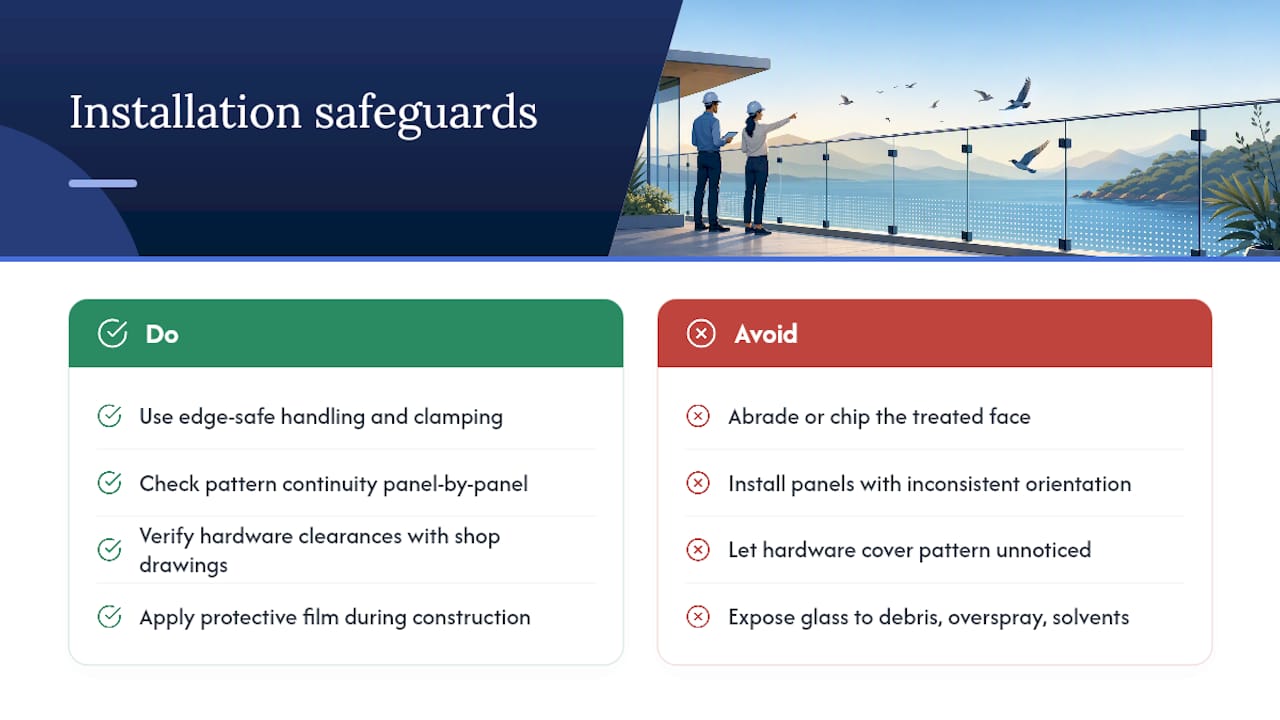
A perfectly specified pattern can still fail on site if installation doesn’t preserve it. Panel handling matters more than most crews realize: etched or fritted surfaces need edgework and clamping procedures that don’t abrade or chip the treated face, particularly at cutouts for post connectors and hardware.
Alignment across the run is the next failure point. If panels aren’t installed with consistent pattern orientation, a horizontal frit line can end up offset by an inch or two between adjacent panels, creating exactly the kind of unmarked visual gap the Glass Association of North America warns against. Installers should check pattern continuity panel by panel during mounting, not just at final walkthrough.
Attachment clearances also need attention. Standoff hardware and post caps sometimes cover a portion of the patterned surface near panel edges, which is fine structurally but can create small unmarked zones if the pattern design didn’t account for hardware placement. Reviewing shop drawings against actual hardware locations before installation catches this before it becomes a punch-list item.
Finally, protect the glass during the construction phase itself. Job site debris, sealant overspray, or aggressive cleaning solvents used during finish-out can dull or discolor a coated surface before the building even opens. A simple protective film during construction, removed at substantial completion, prevents avoidable damage to a treatment you’ve already paid to have factory-applied.
Maintenance practices specifically to ensure markers/signals remain effective
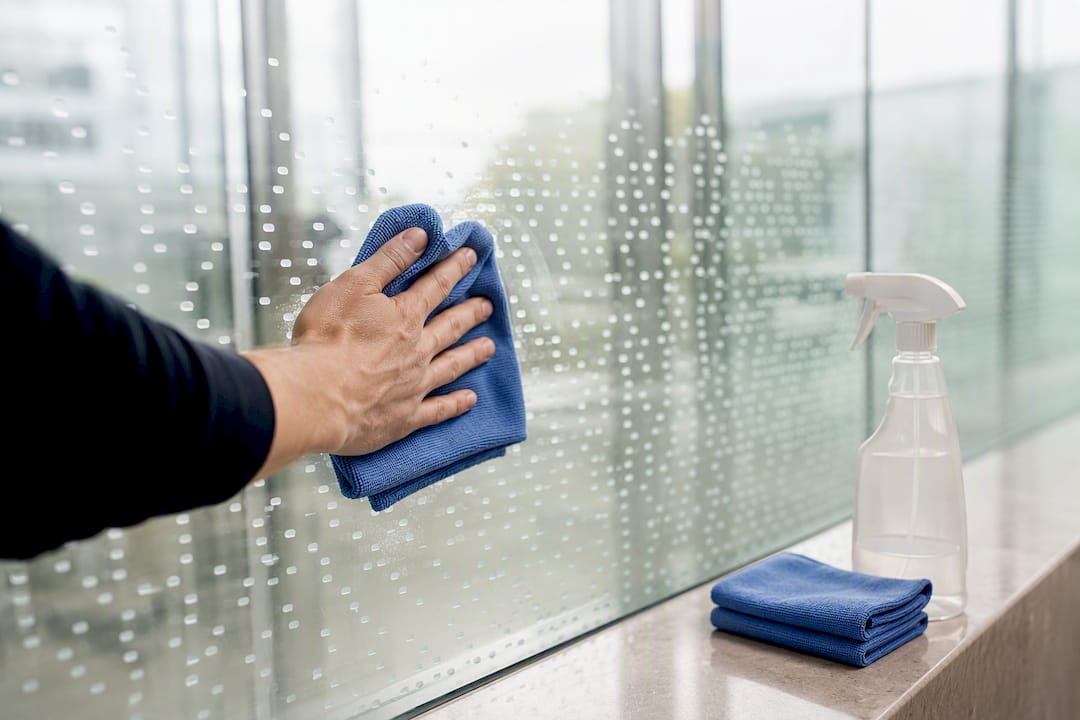
Bird-safe glazing doesn’t need special care so much as it needs the right care avoided. Standard glass cleaning with mild, non-abrasive solutions is fine for ceramic frit and etched surfaces; the risk comes from pressure washing at close range or using abrasive pads that can wear down an etched pattern over years of maintenance cycles.
For UV-coated panels, the maintenance conversation is different. Some UV-reflective coatings can degrade faster under harsh chemical cleaners than frit or etch, since the coating sits on the surface rather than being fired or cut into the glass itself. Building maintenance staff should follow whatever cleaning protocol the coating manufacturer specifies, and that protocol belongs in the building’s maintenance manual, not just in a supplier’s installation packet that gets filed away.
Retrofit films need the most active management. Adhesive-applied films are more vulnerable to UV degradation and edge lifting over time than factory-applied treatments, so a periodic inspection schedule, checking for peeling corners, bubbling, or fading, should be written into the property’s maintenance routine rather than left to be noticed by accident.
Set a simple annual inspection trigger: walk the railing runs, check pattern visibility against the original spec photos, and note any panel where the marker has visibly faded or lifted. Catching degradation early is far cheaper than re-treating an entire run after a collision incident prompts a complaint.
The gap between the standard advice and what actually works on site
Most guidance on bird-safe glazing treats every treatment as roughly interchangeable, as if the choice between frit, etch, film, and UV coating is mostly aesthetic. It isn’t. The species-specific limits on UV-only coatings are the detail that gets glossed over most often, and it’s the one that matters most on high-risk sites near wetlands or migratory corridors, where a subtle UV pattern simply won’t register for every bird flying past.
The bigger failure isn’t choice of technology, though. It’s timing. Bird-safety gets treated as a value-engineering afterthought, something to address if the budget allows, rather than a schematic-design decision. That’s backwards. A factory-applied frit pattern costs a fraction of what a full panel replacement costs after a building opens and someone files a collision complaint.
If there’s one thing worth prioritizing above the rest, it’s pattern continuity across panel joints. Reviewers focus on spacing and coverage; installers and shop drawings are where continuity actually breaks down, and it’s the detail most specs never mention explicitly.
— Fuanne
Get factory-applied bird-safe panels without the retrofit costs
The Glass Railing Store cuts out the guesswork that comes with adding bird-safety after the fact. Where retrofit films and site-applied coatings mean ongoing replacement and inspection cycles, factory-applied frit and etch on our tempered panels are built to last the life of the railing, with marine-grade hardware that holds up in coastal and high-abrasion settings.
If you’re specifying panels for a project with collision risk, whether it’s a wetland-adjacent balcony or a rooftop deck near mature trees, start with a standard tempered panel sized to your run, or go with a custom stair or balcony configuration if your project needs nonstandard dimensions or factory-integrated frit. Request a sample panel to check pattern visibility firsthand, or get a quote on your full glazing package before your next bid deadline.
Sources
- American Bird Conservancy (ABC) guidance on bird-friendly building design
- Bird-friendly glass design strategies (Glass Association of North America)
- San Francisco Planning Department bird-safe building standards