

Why Choose Stainless Steel Hardware for Outdoor Builds
Stainless steel hardware is defined by a minimum 10.5% chromium content that forms a self-repairing passive oxide layer, making it the top material choice for outdoor structures, glass railings, decks, and coastal builds. That layer does not require paint, plating, or chemical treatment to stay active. It repairs itself when scratched or abraded, which is why contractors and builders consistently reach for stainless steel fasteners, connectors, and fittings when long-term performance matters. If you are weighing why to choose stainless steel hardware over alternatives like carbon steel, brass, or zinc-plated options, the answer starts with that invisible protective film and extends into lifecycle cost, aesthetics, and sustainability.
Why choose stainless steel hardware: the science of corrosion resistance
The passive oxide layer that protects stainless steel is only 1 to 3 nanometers thick, yet it outperforms coatings many times its size. That thinness is not a weakness. The layer bonds directly to the steel surface and re-forms within seconds when exposed to oxygen after a scratch or cut. No other common hardware material offers this self-healing behavior without reapplication.
Understanding grades is where most buyers make their first mistake. The two grades you will encounter most often are 304 and 316:
- Grade 304 contains 18% chromium and 8% nickel. It handles general outdoor environments, covered decks, and interior applications without issue.
- Grade 316 adds molybdenum to the alloy, which enhances resistance to chloride corrosion. This makes it the correct choice for coastal properties, poolside railings, and marine structures where salt air or chlorinated water is present.
- Grade 316L is the low-carbon variant of 316, preferred for welded assemblies and high-pressure fittings where heat from welding could otherwise reduce corrosion resistance at the weld zone.
One failure mode that surprises even experienced contractors is crevice corrosion. The passive film breaks down in tight joints, under washers, or inside threaded connections where oxygen cannot reach the surface. This is not a flaw in the material. It is a predictable outcome of oxygen deprivation, and it is entirely preventable through proper joint design and grade selection.
Pro Tip: Never select a stainless steel grade based on price alone. Grade mismatches in coastal or poolside environments cause visible rust within one to two seasons, which costs far more to fix than the upfront difference between 304 and 316.
How does stainless steel compare to carbon steel, brass, and zinc-plated hardware?
The comparison between stainless steel and alternative materials comes down to one practical question: how much maintenance are you willing to do over the life of the structure?
| Material | Corrosion resistance | Maintenance required | Typical lifespan outdoors |
|---|---|---|---|
| Stainless steel (316) | Excellent, self-repairing | Minimal, occasional rinse | 20 to 50+ years |
| Carbon steel | Poor without coating | High, regular painting | 5 to 15 years |
| Brass | Moderate, tarnishes | Moderate, periodic polishing | 10 to 20 years |
| Zinc-plated steel | Low, coating chips | High once coating fails | 3 to 10 years |
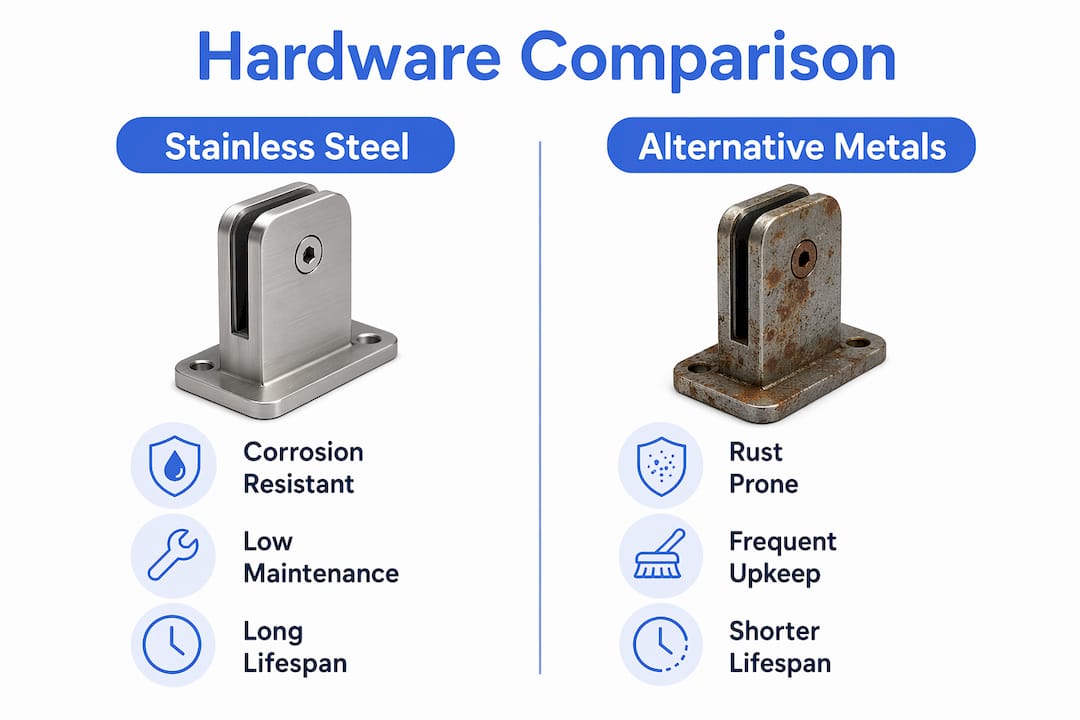
Carbon steel is stronger in raw tensile terms, but that strength is irrelevant once rust compromises the cross-section of a fastener or connector. Zinc plating provides a temporary barrier, but the coating chips at contact points and thread edges during installation, exposing bare steel immediately. Brass looks attractive on interior fixtures but tarnishes in UV-exposed outdoor settings and carries a lower load rating than stainless steel of the same diameter.
Stainless steel hardware has a higher upfront cost than all three alternatives. That cost gap closes within a few years through avoided repainting, fewer replacement cycles, and no emergency repair calls caused by corroded structural connectors. For a deck, balcony, or glass railing system that is expected to last decades, the math consistently favors stainless steel.
The aesthetic argument is equally strong. Stainless steel maintains its appearance without intervention. Brass and zinc-plated hardware both change color over time in ways that look unintentional rather than aged. For modern frameless glass railing systems, where the hardware is visible and part of the design, that consistency matters.
What practical factors should guide your hardware selection?
Selecting the right stainless steel hardware requires more than picking a grade. The environment, finish, and installation method all affect how the hardware performs over its service life.
- Classify your environment first. Indoor dry spaces tolerate 304 without issue. Outdoor humid climates call for 304 at minimum. Coastal zones within one mile of saltwater require 316. Marine environments with direct salt spray or immersion demand 316L or higher-specification alloys.
- Match the grade to the environment before considering size or thread. Correct grade selection is the single most important decision in the process. Choosing the wrong grade and then compensating with a larger fastener does not solve the corrosion problem.
- Choose the right finish for your application. A brushed finish hides surface scratches well and suits most architectural applications. Passivation removes surface iron contamination and strengthens the oxide layer. Electropolishing goes further by reducing surface roughness to minimize points where corrosive agents can accumulate. Electropolished hardware is standard in food processing and medical environments but is also worth specifying for poolside or coastal railing hardware.
- Apply anti-seize compound to all stainless-to-stainless threaded connections. Stainless steel threads gall under friction, meaning the threads weld together during tightening and the fastener becomes impossible to remove without destruction. Anti-seize eliminates this failure mode entirely and costs almost nothing to apply.
- Inspect joint design for crevice risk. Anywhere two surfaces sit tightly together with no oxygen access is a potential crevice corrosion site. Use sealed or vented joint designs where possible, and specify 316 or 316L in any application where crevice exposure is unavoidable.
Pro Tip: For glass railing post bases and standoff fittings, check that the hardware supplier specifies the exact grade in writing. “Stainless steel” without a grade number is not a specification. It is a marketing term.
For guidance on how hardware grade affects railing post stability, the Glassrailingstore article on securing glass railing posts walks through the installation requirements in detail.
How does stainless steel hardware support sustainable building practices?
Stainless steel is one of the most recycled materials in construction. Its durability and recyclability align directly with green building certification programs like LEED, which reward material longevity and reduced replacement cycles. A fastener or fitting that lasts 30 years generates far less waste than one replaced every five years.
The sustainability case for stainless steel hardware includes several concrete advantages:
- Reduced replacement waste. Longer service life means fewer fasteners, connectors, and fittings ending up in landfills over the life of a structure.
- Lower chemical maintenance. Carbon steel and zinc-plated hardware require rust-inhibiting paints and treatments that introduce chemicals into the environment. Stainless steel needs only water and occasional mild cleaning.
- Full recyclability at end of life. Stainless steel scrap carries significant market value and is routinely remelted into new product, unlike coated or plated hardware where the coating complicates recycling.
- Compatibility with green home design. Builders working on eco-conscious residential projects increasingly specify stainless steel hardware as a default to reduce long-term environmental impact and meet certification thresholds.
Modern architectural design also benefits from stainless steel’s clean, consistent appearance. Frameless glass railing systems, cable railing, and open-tread staircases all use exposed stainless steel hardware as a visual element. The material’s neutral tone works with concrete, wood, and glass without competing for attention. For builders and architects working on contemporary residential or commercial projects, that design flexibility is a practical advantage, not just an aesthetic preference.
Key takeaways
Stainless steel hardware outperforms all common alternatives in outdoor and demanding environments because its self-repairing chromium oxide layer eliminates the maintenance cycles that make carbon steel, brass, and zinc-plated hardware expensive over time.
| Point | Details |
|---|---|
| Grade selection is the first decision | Choose 304 for general outdoor use and 316 or 316L for coastal, marine, or poolside environments. |
| Self-repairing passive layer | The chromium oxide film re-forms after damage, providing protection without coatings or treatments. |
| Lower total ownership cost | Reduced maintenance, fewer replacements, and no repainting offset the higher upfront price. |
| Anti-seize prevents galling | Apply anti-seize compound to all stainless-to-stainless threaded connections to prevent seized fasteners. |
| Sustainability advantage | Full recyclability and long service life reduce waste and support green building certifications. |
What I’ve learned from watching grade mismatches fail in the field
After reviewing hundreds of railing and outdoor hardware projects, the pattern that causes the most preventable damage is not poor installation technique. It is grade confusion. Buyers see “stainless steel” on a product label and assume the job is done. It is not.
I have seen 304 hardware installed on oceanfront decks within 200 feet of the waterline, looking fine at the six-month inspection and showing visible rust staining at the 18-month mark. The contractor knew the difference between 304 and 316 in theory. The problem was that the hardware supplier shipped 304 as a substitute when 316 was backordered, and nobody caught it. That is not a material failure. That is a supply chain and verification failure.
The second mistake I see repeatedly is skipping anti-seize on stainless standoff fittings. A galled fitting on a glass railing post is not just an inconvenience. It means cutting the fitting off, which risks cracking the glass panel, which turns a $15 tube of anti-seize into a $400 repair call. The fix is trivial. The oversight is costly.
My recommendation for any project using stainless steel hardware in a structural or safety-critical application: require the supplier to provide a material test report or mill certificate confirming the grade. Glassrailingstore provides this level of specification transparency, which is exactly what you should expect from any supplier handling hardware that supports people’s weight. For context on what separates a premium system from a basic one, the guide on premium glass railing systems covers hardware quality standards in plain language.
The upfront cost of 316 over 304 is real but small relative to the total project budget. The cost of replacing corroded hardware in a finished structure is not small. Prioritize grade verification before you prioritize price.
— Fuanne
Explore stainless steel hardware and glass railing systems at Glassrailingstore
Glassrailingstore stocks both 304 and 316 marine-grade stainless steel hardware across its full range of glass railing systems, standoff fittings, connectors, and post bases. Every product is designed for outdoor performance and tested to meet residential and commercial load requirements.

Whether you are building a coastal deck, a poolside barrier, or a modern interior staircase, the hardware grade and engineering certification behind your railing system determine how it performs over decades. Glassrailingstore’s engineering-tested railing solutions give you documented proof of performance, not just a product description. For fully customized builds, the custom glass railing configurator lets you specify hardware grade, glass thickness, and post spacing to match your exact project requirements.
FAQs
1. What makes stainless steel better than galvanized hardware outdoors?
Stainless steel forms a self-repairing chromium oxide layer that does not depend on a surface coating, while galvanized hardware relies on a zinc coating that chips and degrades over time. Once the zinc layer fails, the underlying steel corrodes rapidly.
2. Is 316 stainless steel worth the extra cost for a backyard deck?
For decks more than a mile from saltwater in a non-poolside setting, 304 stainless steel is sufficient and the cost difference is not justified. Within one mile of the coast or adjacent to a pool, 316 grade hardware is the correct specification and the price premium is small relative to the cost of premature replacement.
3. Why do stainless steel bolts sometimes seize during installation?
Stainless steel threads gall under friction when two stainless surfaces contact each other without lubrication, causing the threads to cold-weld together. Applying anti-seize compound before assembly prevents this entirely.
4. Can stainless steel hardware rust?
Stainless steel is corrosion-resistant, not rust-proof. In oxygen-restricted crevices or when the wrong grade is used in a chloride-rich environment, localized corrosion can occur. Correct grade selection and proper joint design prevent the vast majority of rust failures.
5. How do I verify the stainless steel grade of hardware I purchase?
Request a material test report or mill certificate from your supplier confirming the alloy composition. Reputable suppliers like Glassrailingstore specify the grade in the product listing and can provide documentation for structural or safety-critical applications.
Recommended
- Outdoor Staircase Glass Ideas That Combine Style and Safety – The Glass Railing Store
- Tempered glass advantages: enhance safety and design outdoors – The Glass Railing Store
- How to Select Railing Suppliers for Any Project – The Glass Railing Store
- The Role of Glass in Outdoor Safety Explained – The Glass Railing Store