

Glass Railing Coastal Homes: Design, Safety, and Care
Glass railings for coastal homes are defined as barrier systems combining tempered safety glass panels with corrosion-resistant hardware to deliver unobstructed views, structural safety, and long-term durability in marine environments. The industry term for these systems is “glass balustrade,” though “glass railing” is the standard American term used across building codes and product specifications. For any property within reach of salt air, the choice of railing material is not cosmetic. It is a structural and safety decision. Glass railing coastal homes that use marine-grade stainless steel hardware and IBC-compliant tempered glass panels outperform wood, cable, and aluminum systems in every measurable category relevant to seaside conditions.
What Makes Glass Railings Ideal for Coastal Conditions?
The coastal environment attacks metal relentlessly. Salt spray, humidity, and UV exposure combine to corrode standard hardware within a few years. Glass railing systems built for marine use solve this with two core material choices: 316L or 2205 duplex stainless steel for all hardware, and 12mm tempered glass for the panels.
316L stainless steel carries a Pitting Resistance Equivalent Number (PREN) of approximately 25, which measures its resistance to chloride-induced pitting corrosion. Properties within 1 km of the shoreline require at least this grade for all posts, spigots, fasteners, and anchors. For direct salt spray zones, 2205 duplex stainless steel offers twice the yield strength and superior chloride resistance compared to 316L, though it costs 20–40% more upfront. That premium pays off in reduced maintenance and fewer hardware replacements over the system’s lifespan.
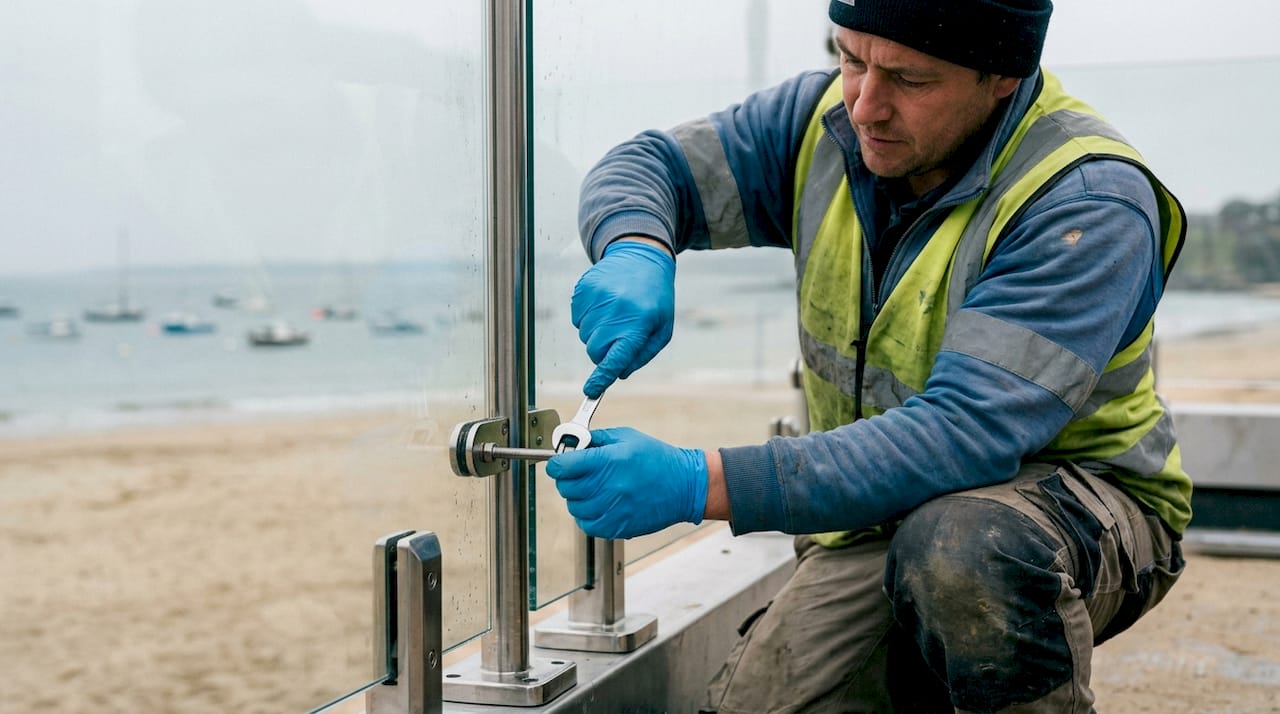
One detail most homeowners miss is galvanic corrosion. Mixing dissimilar metals in a single railing system, such as pairing 316L posts with standard carbon steel fasteners, triggers an electrochemical reaction that accelerates pitting even when the primary components are high grade. Every metal element in the system, from bolts to anchors, must be the same marine-grade alloy.
Beyond corrosion resistance, solid glass panels function as effective windbreaks. Glass panels block direct wind in ways that open picket or cable systems cannot, making exposed waterfront decks genuinely usable on breezy days. That functional benefit is often undervalued when homeowners compare railing types on price alone.
Key material advantages of glass railings in coastal settings:
- 316L or 2205 stainless steel hardware resists chloride-induced pitting that destroys standard metals within years
- 12mm tempered glass panels meet impact and load standards while withstanding wind pressure on exposed decks
- Solid glass surface acts as a windbreak, extending comfortable outdoor time on windy days
- Matched alloy hardware throughout prevents galvanic corrosion from dissimilar metal contact
- No organic material means no rot, warping, or splintering that affects wood railings in humid climates
Pro Tip: When ordering hardware, confirm that every component in the kit, including the smallest set screw, is the same stainless steel grade. One mismatched fastener is enough to start a corrosion chain that spreads to adjacent components.
How Do Building Codes and Safety Standards Shape Glass Railings in Coastal Homes?
Compliance is not optional. The International Building Code (IBC) and California Building Code (CBC) set the minimum structural requirements for any guard railing, and coastal installations face additional seismic and wind load considerations on top of those baselines.
The IBC and CBC require guard railings to reach a minimum height of 42 inches and withstand a concentrated load of 200 lbs applied at the top rail. The 4-inch sphere infill test governs spacing between glass panels or between the panel and any post, preventing a child’s head from passing through. These are non-negotiable minimums. You can review the full American building code requirements for glass railings to understand how these rules apply to your specific installation.
Coastal properties in seismically active regions, particularly those in Seismic Design Category D (SDC D), require anchoring systems engineered to absorb lateral movement without loosening glass panels or cracking base fittings. California homeowners should check the California Building Standards Code provisions that address both seismic anchoring and coastal wind loads simultaneously.
The table below summarizes the core code requirements that apply to most coastal glass railing installations:
| Requirement | Standard / Specification |
|---|---|
| Minimum guard height | 42 inches (IBC/CBC) |
| Concentrated load capacity | 200 lbs at top rail |
| Infill opening test | 4-inch sphere must not pass through |
| Glass panel thickness | 12mm tempered minimum for structural loads |
| Seismic anchoring (SDC D) | Engineered anchor systems required |
Tempered glass is the standard choice for most installations. Laminated glass, which holds together when broken rather than shattering into cubes, is specified in some jurisdictions for overhead or high-traffic applications. For vertical guards on coastal decks, 12mm tempered glass meets both the load requirements and the impact resistance needed in high-wind zones.
What Design Options Best Preserve Views in Coastal Glass Railings?
The defining design trend for coastal glass railings in 2026 is the frameless, minimalist system. Spigot-mount and base-rail-mount configurations hold glass panels with minimal visible hardware, creating what designers call a “disappearing barrier.” The glass does its structural job while the ocean view remains uninterrupted from floor to horizon.
Low-iron tempered glass takes that visual clarity further. Standard tempered glass has a slight green tint from its iron content. Low-iron glass removes that tint, producing a nearly colorless panel that reads as pure transparency against a coastal backdrop. The difference is most noticeable in large panel installations where the cumulative tint of standard glass becomes visible at the edges.
Mounting method affects both aesthetics and cost. Spigot-mount systems attach individual posts to the deck surface at intervals, leaving the glass panels fully exposed between them. Base-rail systems run a continuous channel along the deck edge, which hides the bottom edge of each panel and creates a cleaner sightline. Both systems can meet IBC load requirements when properly engineered. The choice between them comes down to the architectural style of the home and the homeowner’s budget.
Design considerations worth weighing before you commit:
- Frameless spigot mount delivers maximum visual openness but requires precise post spacing and a level substrate
- Base-rail mount offers a cleaner bottom edge and slightly more forgiving installation tolerances
- Low-iron glass eliminates the green tint visible in large panels, worth the added cost for premium coastal builds
- Panel size and layout should account for local wind load requirements, which affect maximum unsupported panel width
For homeowners who want to understand how unobstructed views factor into property value and design decisions, the relationship between railing transparency and perceived space is well documented in coastal architecture.
How to Maintain and Clean Glass Railings in Coastal Climates for Longevity
Maintenance in a coastal climate is not the same as maintenance inland. Salt spray deposits mineral residue on glass and hardware within days of cleaning. A consistent schedule is the only way to stay ahead of buildup that, left unchecked, etches glass surfaces and accelerates hardware corrosion.
Follow this maintenance sequence for coastal glass railings:
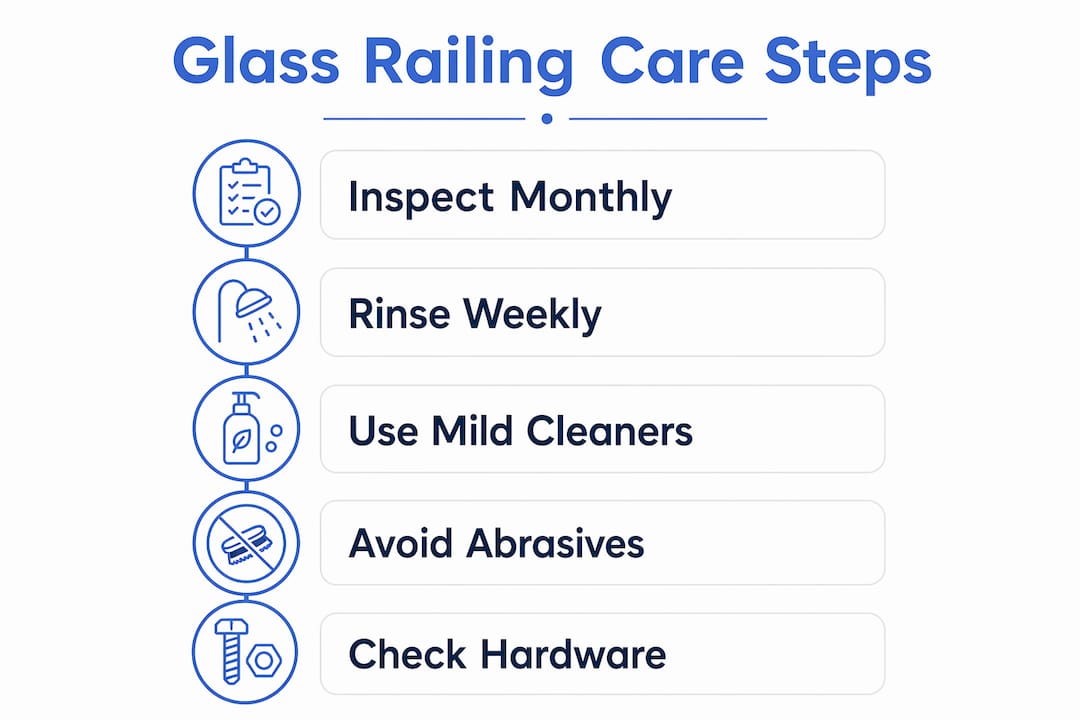
- Rinse with fresh water weekly. A simple garden hose rinse removes loose salt deposits before they bond to the glass or hardware. This single step does more to extend system life than any other maintenance action.
- Wash glass panels monthly using a mild, pH-neutral cleaner and a soft microfiber cloth or sponge. Work from top to bottom to prevent dirty water from running over clean sections.
- Clean hardware at the same time. Wipe down all stainless steel posts, spigots, and connectors with the same mild solution. Dry them thoroughly to prevent water spots and mineral deposits from forming in crevices.
- Inspect gaskets, seals, and fittings during every cleaning session. Look for cracked rubber gaskets, loose set screws, or any movement in the glass panels. Cleaning is a safety inspection, not just an aesthetic task.
- Apply a hydrophobic glass coating every six to twelve months. Products designed for automotive or marine glass work well on railing panels, causing water and salt spray to bead and run off rather than dry on the surface.
Two cleaning mistakes cause the most damage in coastal installations. Abrasive pads and metal scrapers create micro-scratches in tempered glass that trap salt and minerals, accelerating surface degradation. Cleaning glass in direct hot sun or when panels are cold from overnight temperatures induces thermal stress that can fracture tempered glass. Always clean in shade and at moderate temperatures.
Pro Tip: Keep a small inspection checklist on your phone and run through it during each monthly clean. Note any hardware that feels loose, any gasket that looks cracked, and any glass panel that shows movement. Catching a loose spigot early costs almost nothing to fix. Catching it after a panel shifts costs significantly more.
Key Takeaways
Glass railings in coastal homes require marine-grade 316L or 2205 stainless steel hardware, IBC-compliant 12mm tempered glass, and a consistent weekly rinse schedule to deliver long-term safety and clarity in salt air environments.
| Point | Details |
|---|---|
| Material grade determines lifespan | Use 316L or 2205 stainless steel for all hardware within 1 km of the shoreline. |
| Code compliance is non-negotiable | IBC/CBC require 42-inch height, 200 lb load capacity, and a 4-inch sphere infill test. |
| Frameless systems maximize views | Spigot and base-rail mounts create near-invisible barriers that preserve ocean sightlines. |
| Weekly rinsing prevents salt damage | A fresh water rinse removes loose salt before it bonds and etches glass or corrodes hardware. |
| Cleaning doubles as safety inspection | Every wash is an opportunity to check gaskets, fittings, and panel stability for early issues. |
What I’ve Learned About Coastal Glass Railings After Years of Watching Them Fail—and Last
The homeowners who get the most out of their coastal glass railings are the ones who treat the material specification as seriously as the design. I have seen beautiful frameless installations corrode within three years because the installer mixed 316L posts with standard-grade fasteners to save a few dollars per fitting. The glass looked perfect. The hardware failed. The entire system had to be replaced.
The other pattern I see repeatedly is homeowners who install a premium system and then do nothing for two years. Salt air is patient. It works on every surface, every day. A weekly rinse takes five minutes with a garden hose. Skipping it for a season means spending an afternoon scrubbing mineral deposits that have bonded to the glass and started working on the hardware beneath the surface.
My honest view on design: frameless is almost always the right choice for coastal properties. The visual payoff is real. A solid glass panel at the deck edge genuinely disappears when you are looking at the ocean. Framed systems with visible top rails and posts interrupt that view in a way that becomes more noticeable over time, not less. The extra cost of a frameless spigot system is recovered in the daily quality of the view.
One thing I would push back on is the assumption that laminated glass is always safer than tempered for coastal guards. Tempered glass, when it breaks, shatters into small blunt cubes. That is the safer failure mode for a vertical guard. Laminated glass holds together, which matters for overhead glazing, but for a deck railing the tempered option meets the code and performs well in coastal wind loads.
Prioritize the material spec, maintain the system consistently, and choose a frameless design if your budget allows. Those three decisions account for most of the difference between a coastal glass railing that looks great at year ten and one that looks tired at year three.
— Fuanne
Glassrailingstore’s Engineered Solutions for Coastal Properties
Glassrailingstore supplies glass railing systems built specifically for the demands of marine environments, with hardware available in both 316L and 2205 stainless steel grades.

Every system is backed by engineering testing and certification that confirms compliance with IBC and CBC load, height, and infill requirements. Tempered glass panels, including the 46-inch height panel designed for code-compliant guard applications, are available for direct order with free shipping on orders over $3,000. Glassrailingstore also provides expert consultation and planning support for homeowners and contractors who want to confirm their coastal installation meets local code before ordering.
FAQs
1. What type of stainless steel is required for coastal glass railings?
Marine-grade 316L stainless steel is the minimum requirement for hardware within 1 km of the shoreline. For direct salt spray zones, 2205 duplex stainless steel offers superior chloride resistance and is the preferred choice despite its higher cost.
2. What is the minimum height for a glass railing guard on a coastal deck?
The IBC and CBC both require a minimum guard height of 42 inches for residential applications. The railing must also withstand a concentrated load of 200 lbs applied at the top.
3. How often should I clean glass railings near the ocean?
Rinse glass panels and hardware with fresh water weekly to remove loose salt deposits. Perform a full wash with a mild cleaner monthly, and apply a hydrophobic coating every six to twelve months.
4. Does frameless glass railing meet building code requirements?
Yes. Frameless spigot-mount and base-rail-mount systems meet IBC and CBC requirements when engineered to the correct load, height, and infill specifications. Confirm your system includes code-compliant hardware before installation.
5. Can I mix different grades of stainless steel in one railing system?
No. Mixing grades such as 316L posts with standard-grade fasteners causes galvanic corrosion, an electrochemical reaction that accelerates pitting and hardware failure even when the primary components are high grade. All metal elements must be the same alloy throughout the system.
Recommended
- Avoid these glass railing mistakes for a safe, stylish home – The Glass Railing Store
- Outdoor Staircase Glass Ideas That Combine Style and Safety – The Glass Railing Store
- Weatherproof Glass Railing Features: A Homeowner’s Guide – The Glass Railing Store
- Glass railing durability: Build it right, build it to last – The Glass Railing Store