

Glass Railing Appraisal Impact Explained for Homeowners
Yes, properly specified and code-compliant glass railings typically improve appraisal and resale prospects — but only when they match the home’s architecture, highlight a genuine view asset, and come with permits and documentation. Industry guides estimate that glass railing upgrades on view-oriented properties can recover 80–120% of their cost in favorable markets, with appraisers treating the upgrade as a condition and quality lift rather than a fixed dollar line item. The glass railing appraisal impact explained below covers every scenario where that number applies, and the ones where it doesn’t.
Before your appraisal or listing, do these first:
- Pull your building permit and confirm the final inspection was signed off.
- Gather the glass specs (thickness, laminated vs. tempered, ASTM certification).
- Photograph the installation from multiple angles, including any view it preserves.
- Confirm the hardware grade (marine-grade stainless if near salt air or moisture).
- Ask your installer for PE-stamped drawings if the project required engineering review.
Immediate action checklist:
- If permits are missing, contact your local building department now — an unpermitted railing can trigger required remediation at closing.
- If the railing shows visible corrosion or loose anchorage, get a contractor assessment before the appraiser arrives.
Table of Contents
- 1. How glass railings add value: what buyers and appraisers actually notice
- 2. Typical costs and how to estimate ROI before you list
- 3. What appraisers look for when valuing a glass railing upgrade
- 4. Code, safety, and inspection essentials U.S. homeowners must meet
- 5. Scenarios where glass railings may not improve appraisal or resale appeal
- 6. Specifying materials and choosing an installer: a homeowner’s checklist
- 7. How to present glass railings when listing your home
- 8. Should you install glass railings before selling? A decision matrix
- 9. What data and industry experts say about value impact and safety
- Key Takeaways
- The upgrade that earns its keep — when it’s done right
- Glassrailingstore: code-ready glass railing systems for homeowners who want it done right
- Useful sources and further reading
1. How Glass Railings Add Value: What Buyers and Appraisers Actually Notice
The clearest mechanism is visual. Glass panels preserve sightlines that wood balusters and metal pickets cut off entirely. In listing photos, a frameless glass railing on a deck or staircase reads as open space rather than barrier, which makes rooms and outdoor areas photograph larger and brighter. Real estate professionals consistently describe glass railings as a marketing tool for listings because they improve the first impression both online and in person.
Where value concentrates:
- Primary decks and balconies facing a view — ocean, mountain, cityscape, or even a well-landscaped yard. The railing stops being a safety feature and starts being a picture frame.
- Main staircases — the most photographed interior feature after kitchens and baths. A frameless glass stair treatment signals a luxury renovation.
- Pool surrounds — glass fencing around a pool adds a resort aesthetic that resonates with buyers in warm-weather markets.
- Coastal and windy climates — glass panels provide wind protection that extends the usable outdoor season, a concrete functional benefit buyers in those markets pay for.
Secondary locations — a side yard fence, a utility staircase, a basement egress — rarely move the needle. Spend the budget where buyers look first.
The durability argument also carries weight. Glass systems remain largely maintenance-free for decades when properly specified, unlike wood railings that require annual staining and sealing or painted metal that eventually rusts. Buyers doing the math on future maintenance costs notice that difference, especially in climates with harsh winters or salt air.
2. Typical Costs and How to Estimate ROI Before You List
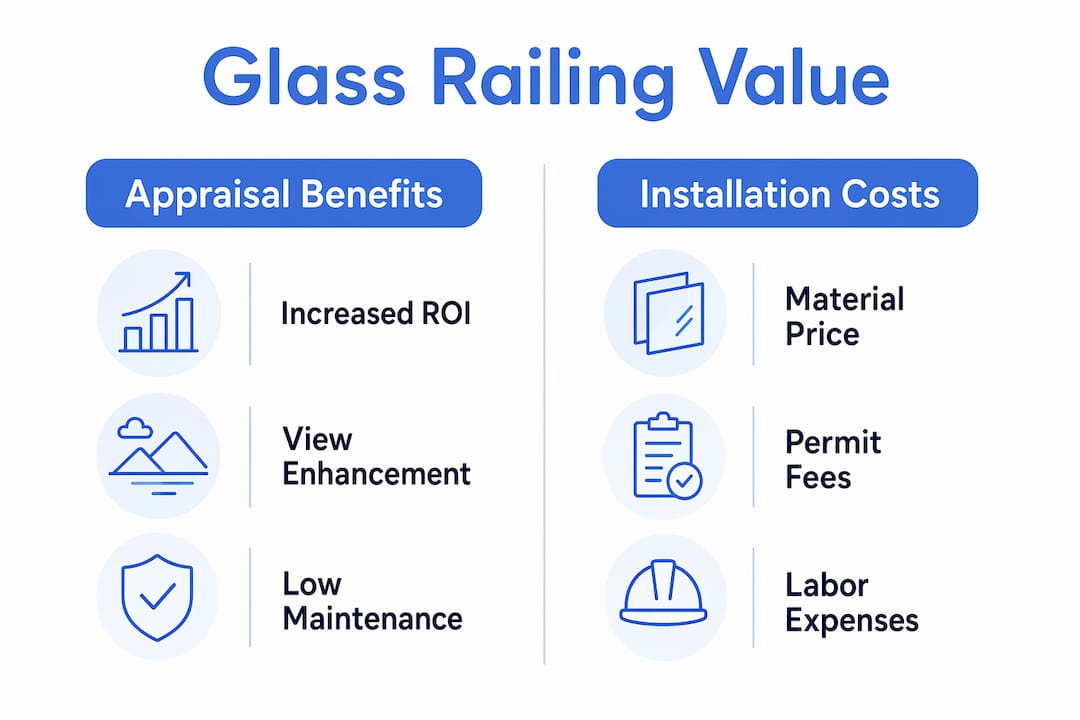
Glass railing costs vary more than most homeowners expect. Glass railing costs vary widely depending on system type, glass specification, hardware, and site complexity. A straightforward deck run in a post-mounted system typically incurs moderate installation costs, while more complex frameless channel systems with engineering requirements can be substantially higher.
What drives the price up:
- Frameless (channel-mounted) vs. post-mounted or semi-framed systems
- Laminated glass vs. tempered (laminated costs more but is increasingly code-required)
- Low-iron glass for maximum clarity on view-facing installations
- Marine-grade stainless hardware in coastal environments
- Engineering fees and PE-stamped drawings where required by the local authority having jurisdiction (AHJ)
- Guard height: IRC allows 36-inch guards for single-family homes while IBC/commercial projects typically require 42 inches, and that six-inch difference means larger panels, thicker glass, and higher cost
Sample ROI calculation:
| Scenario | Install Cost | Estimated Uplift | Net Return |
|---|---|---|---|
| View-facing deck, luxury market | — | — | $3,000–— |
| View-facing deck, mid-market | $10,000 | $10,000–— | — |
| Interior stair, urban condo | — | —–$12,000 | — |
| No-view suburban deck | — | $4,000–— | — |
How to localize your estimate:
- Ask a local real estate agent to pull comps with and without glass railings in your zip code.
- Get two to three contractor bids that itemize glass type, hardware grade, and permit costs separately.
- Add 10–15% to the contractor bid for permit fees, inspection, and any engineering review.
- Compare the adjusted install cost to the comp-based uplift estimate before committing.
The math works most reliably in luxury and upper-mid markets where buyers are already comparing premium finishes. In entry-level suburban markets, the cost often approaches or exceeds the likely uplift.
3. What Appraisers Look for When Valuing a Glass Railing Upgrade
Appraisers don’t pull out a price list and credit $X for a glass railing. Instead, they treat the upgrade as a qualitative improvement that can shift the home into a higher condition or quality bracket, which then gets compared against better comps. That shift can translate to several thousand dollars in value, but only if the appraiser can verify the installation is permanent, code-compliant, and well-executed.
What appraisers want to see:
- A copy of the building permit and the signed final inspection certificate
- PE-stamped drawings if engineering was required (common for frameless systems and commercial-grade heights)
- Glass specification sheets: thickness, lamination type, ASTM certification
- Hardware specs: stainless grade, post spacing, anchorage method
- Photos taken at the time of installation showing the substrate and mounting details
- Any manufacturer warranty documentation
How comps work in your favor: If you can point the appraiser to two or three recent sales in your market where glass railings were noted in the MLS listing and the homes sold at a premium, that gives them a direct comparable adjustment to work with. Pull those comps yourself before the appraisal and have them ready.
Pro Tip: The single most useful document you can hand an appraiser is a one-page summary sheet: permit number, inspection date, glass spec (e.g., “3/8-inch heat-strengthened laminated safety glass, ASTM E2353 tested”), hardware grade, installer name and license number, and warranty terms. Appraisers see dozens of upgrades with no documentation; a clean summary sheet makes yours stand out as a serious, permanent improvement.

4. Code, Safety, and Inspection Essentials U.S. Homeowners Must Meet
The 2015 edition of the International Building Code was a turning point: it mandated laminated glass in handrail and guardrail systems, replacing the older practice of using monolithic tempered glass in most applications. There is a narrow exception for single fully tempered glass that complies with CPSC 16 CFR Part 1201 Category II or ANSI Z97.1 Class A, but only where no walking surface exists below or that surface is permanently protected. If your installation predates 2015 and used monolithic tempered glass, a broken panel may require upgrading the entire system to current code.
Key code thresholds at a glance: Guard height: 36 inches minimum under IRC (single-family residential); 42 inches under IBC (commercial and many multi-family applications). Load requirements: 50 lb/ft distributed load and 200 lb concentrated load are the standard engineering cases designers must satisfy. Glass standard: ASTM E2353 (test methods) and ASTM E2358 (performance specification) are the primary references for glazing in permanent railing systems.
Homeowner code checklist:
- Confirm guard height matches the applicable code for your building type (IRC vs. IBC).
- Verify glass is laminated safety glass or qualifies under the tempered exception with documentation.
- Check that glass thickness and laminate interlayer were verified by an engineer for the required load cases.
- Confirm hardware anchorage is appropriate for the substrate (concrete, wood framing, steel).
- Obtain a copy of the local building codes for glass railings from your AHJ before starting any work.
Codes vary significantly by state and county. What passes inspection in one jurisdiction may require additional engineering in another. The American building code for glass railing provides a useful federal-level overview, but always verify with your local AHJ — the authority having jurisdiction is the final word on what gets approved.
5. Scenarios Where Glass Railings May Not Improve Appraisal or Resale Appeal
Not every home benefits from a glass railing upgrade before sale. Getting this wrong is an expensive mistake.
Style mismatch. A frameless glass railing on a 1920s craftsman bungalow or a traditional colonial signals renovation confusion to buyers and appraisers alike. For the strongest appraisal impact, glass railings should harmonize with the home’s architectural language; a hyper-modern treatment on a traditional house can limit buyer appeal and reduce ROI rather than improve it.
Privacy-first markets. In dense suburban neighborhoods where buyers expect privacy screening, transparent glass railings can feel like a liability. Frosted or tinted glass is an option, but highly customized tints or colors narrow the buyer pool further.
Poor installation or low-grade hardware. Visible corrosion on hardware, improper anchorage, or non-compliant glazing can trigger negative appraisal adjustments and inspector concerns. A cheap installation is worse than no installation at all.
Red flags that often generate negative notes:
- Rust staining on posts or clamps (wrong stainless grade for the environment)
- Visible flex or movement in panels when pressure is applied
- Missing or expired permits
- Glass that chips, crazes, or shows delamination at edges
- Post spacing that doesn’t match engineering drawings
Timing without permits. Installing glass railings within 30–60 days of listing without a final inspection creates a disclosure problem. If the permit is open at closing, buyers’ lenders may require it to be resolved before funding. That can delay or kill a sale.
6. Specifying Materials and Choosing an Installer: A Homeowner’s Checklist
The quality of the installation determines whether the upgrade adds value or subtracts it. Industry professionals are direct on this point: glass railing is a life safety product, and the engineering and code complexity involved means that many contractors who think they can do it correctly cannot.
Material specs to require in writing:
- Laminated safety glass as the default (SGP interlayer preferred for structural applications)
- Minimum 3/8-inch thickness for most residential applications; engineer to confirm for your load case
- Low-iron glass for view-facing installations where color neutrality matters
- Marine-grade 316 stainless steel hardware for coastal or high-humidity environments; 304 stainless for dry interior applications
- Manufacturer ASTM certification documentation for the glass panels
Hardware and finish guidance:
- Avoid powder-coated aluminum hardware in salt-air environments — it degrades faster than stainless
- Specify brushed or satin finishes rather than polished, which shows fingerprints and scratches more readily
- Confirm post base plates are sealed against water infiltration at the substrate
Installer vetting questions:
- Are you licensed and insured in this state, and can you provide proof?
- Have you completed projects requiring PE-stamped drawings and load calculations?
- Can you provide references from projects that passed final inspection?
- Do you carry or have access to a licensed structural engineer for this project?
- What warranty do you offer on materials and installation labor?
Pro Tip: Request a closeout package as a contract deliverable before final payment: as-built photos showing mounting details, the signed inspection report, manufacturer material certificates for the glass and hardware, and the PE-stamped drawings if applicable. This package is what you hand to the appraiser and the buyer’s agent at listing.
Working with a contractor experienced in deck railing systems who can coordinate permit applications and inspections from the start saves significant time and cost compared to retrofitting compliance after the fact.

7. How to Present Glass Railings When Listing Your Home
Clean glass is non-negotiable for listing photos. Smudges, water spots, and fingerprints read as neglect in photographs, which is the opposite of the premium signal you are trying to send. Clean every panel the morning of the photo shoot.
Photo tips that actually move buyers:
- Shoot through the railing toward the view at golden hour — the transparency becomes the feature
- Include a before/after comparison if you replaced wood or metal railings
- Capture a wide-angle shot from inside the home looking out through the glass to show how it opens the interior
- Get a close-up of the hardware and glass edge to signal quality to detail-oriented buyers
Listing language that supports the appraisal narrative:
Use specific, verifiable language rather than vague luxury descriptors. Compare these two approaches:
- Weak: “Beautiful glass railings throughout”
- Strong: “Frameless laminated glass railing system with PE-stamped engineering, permitted and inspected [year], marine-grade stainless hardware”
The second version gives an appraiser, a buyer’s agent, and a home inspector something concrete to verify. It signals that the upgrade was done correctly.
Disclosure best practices:
- Include the permit number, inspection date, and installer information in the seller’s disclosure packet
- Attach the glass and hardware specification sheets to the agent’s marketing packet
- Note the warranty terms and whether they are transferable to the buyer
Sellers who document permits, engineering, and inspection results and highlight unobstructed views consistently get stronger offers than those who list the same upgrade without supporting documentation.
8. Should You Install Glass Railings Before Selling? A Decision Matrix
| Scenario | Recommendation |
|---|---|
| Property has a significant view (water, mountain, city) | Install before listing — highest ROI scenario |
| No meaningful view, suburban market | Skip or delay — cost likely exceeds uplift |
| Target market is luxury or upper-mid tier | Install before listing if current railing is dated |
| Target market is entry-level or traditional neighborhood | Skip — style mismatch risk outweighs benefit |
| Time to sale is 6+ months | Install now, allow time for permits and inspection |
| Time to sale is under 60 days | Skip — unpermitted work creates closing risk |
| Current railing needs replacement anyway | Replace with glass — marginal cost for significant upgrade |
| Current railing is in good condition | Evaluate ROI carefully; cosmetic upgrade may not pencil |
| Coastal or high-wind location | Strong case for glass regardless of view |
| Historic property or traditional architecture | Avoid — style mismatch reduces buyer pool |
The matrix is a starting point, not a guarantee. A local real estate agent who has sold comparable homes in your specific neighborhood is the most reliable source for whether glass railings resonate with your buyer pool.
9. What Data and Industry Experts Say About Value Impact and Safety
The ROI case for glass railings is strongest when the conditions align: a view-facing installation, a quality spec, permits in order, and a market where buyers are already comparing premium finishes. Published industry estimates place cost recovery in the 80–120% range in favorable situations, with example projects showing high installation costs accompanied by substantial uplift on view properties. Those numbers represent ceiling cases rather than typical averages.
The safety and code compliance angle matters as much as the aesthetics. The Appraisal Institute notes that appraisers assess permanent improvements for their contribution to value, condition, and marketability — all three of which a code-compliant glass railing can support. A railing that fails inspection, by contrast, can trigger a required repair condition that reduces the appraised value below what a basic wood railing would have delivered.
On maintenance costs, the long-term economic argument is straightforward. Wood railings require annual staining or sealing and periodic replacement of rotted components. Painted metal rusts. Glass, when properly specified with quality hardware, requires only periodic cleaning and holds its appearance for decades. For a long-term owner who eventually sells, that avoided maintenance cost is real money.
The engineering complexity is also worth acknowledging honestly. Industry professionals are clear that glass railing is not a simple DIY category — the code requirements, load calculations, and lamination standards require genuine expertise. Cutting corners on the specification to save money upfront is the fastest way to end up with a railing that fails inspection or generates a negative appraisal note.
Key Takeaways
Glass railings add measurable appraisal and resale value when they are code-compliant, properly documented, and installed on view-facing properties in markets where buyers expect premium finishes.
| Point | Details |
|---|---|
| ROI depends on context | Industry estimates place cost recovery on view-facing properties at 80–120% in favorable cases, while non-view suburban installations may often break even or not recoup costs. |
| Appraisers value documentation | Permits, PE-stamped drawings, glass specs, and inspection certificates move a railing from “cosmetic” to “permanent improvement” in appraisal terms. |
| Code compliance is non-negotiable | IBC requires laminated glass in guard applications; guard height is 36 inches under IRC and 42 inches under IBC — verify with your local AHJ before installing. |
| Style match determines buyer appeal | Glass railings on traditional or historic homes can reduce buyer pool; the upgrade works best on contemporary, open-concept, or view-oriented properties. |
| Glassrailingstore supplies the spec | Glassrailingstore offers tempered and laminated glass systems with marine-grade stainless hardware and installation resources designed to meet code and support appraisal documentation. |
The Upgrade That Earns Its Keep—When It’s Done Right
There’s a version of this upgrade that genuinely moves the needle at appraisal and a version that costs $10,000 and gets you nothing. The difference almost always comes down to three things: where the railing is, whether it was permitted, and how well it was specified.
If the property has a view worth preserving and the target buyer is someone who cares about finishes, a glass railing is one of the few outdoor upgrades that photographs well, holds up over time, and gives an appraiser something concrete to work with. The documentation piece is where most sellers leave money on the table. An appraiser who walks in with a one-page spec summary, a permit number, and a signed inspection report has everything needed to justify a condition upgrade. An appraiser who walks in with nothing but a nice-looking railing has to be conservative.
The timing caution is real. Installing glass railings within 60 days of listing without a final inspection is a liability, not an asset. If the permit is still open, it becomes a closing condition. Get the inspection signed off before the listing goes live.
For a home without a meaningful view in a traditional neighborhood, the honest answer is to skip it before the sale. The cost rarely comes back, and a style mismatch can actually narrow the buyer pool. Save the upgrade for the next owner or do it for your own enjoyment if you plan to stay.
Glassrailingstore: Code-Ready Glass Railing Systems for Homeowners Who Want It Done Right
If you’ve worked through the decision matrix and the answer is yes, the next step is getting the specification right before you call a contractor. Glassrailingstore supplies custom glass railing systems built from tempered and laminated safety glass with marine-grade stainless steel hardware — the same spec combination that satisfies IBC requirements and gives appraisers the documentation they need.

Every system ships with material certificates and product specifications you can hand directly to your installer, your building department, and your appraiser. The site also carries detailed glass railing compliance guides that walk through IBC, IRC, and state-level variations so you understand exactly what your local AHJ will require before the first panel goes in. Free shipping applies on orders over $3,000, and the team is available for quotes and planning support. Get your quote at glassrailingstore.com and go into your appraisal with the paperwork already in hand.
Useful Sources and Further Reading
The following resources back the code, appraisal, and specification claims in this article. Internal Glassrailingstore pages are noted as such; external links are independent industry or regulatory sources.
- Building Codes for Glass Railings — Glassrailingstore (internal): IBC/IRC state variations and compliance guidance for homeowners and contractors.
- American Building Code for Glass Railing — Glassrailingstore (internal): U.S. federal-level code overview for glass guards and handrails.
- Glass Railing Building Codes: Complete 2025 Compliance Guide — Glassrailingstore (internal): detailed compliance guide covering local AHJ requirements and inspection checklists.
- Code Q&A: Glass Railings and Guards — Glass Magazine (external): IBC and ASTM E2353/E2358 requirements for laminated glass in guard applications.
- News Analysis: Railings January 2026 — US Glass Magazine (external): industry expert commentary on code compliance, engineering requirements, and laminated glass mandates.
- Appraisal Institute: How Consumers Interact with Appraisers — Appraisal Institute (external): guidance on how appraisers assess permanent improvements and condition adjustments.
- What Are the Benefits of a Glass Railing System? — Golden Glass (external): maintenance, durability, and safety benefits of tempered and laminated glass systems.
- Who Pays $20k+ for a Staircase Railing? — Eridion Glass (external): cost drivers, IRC/IBC height differences, and engineering cost implications.