

Glass Panel Thickness: What You Need to Know
Most people ordering glass panels for a deck, balcony, or renovation think thickness is a simple spec. Pick something that looks sturdy, and you’re done. What glass panel thickness actually means, and why it matters, is far more involved than that. The wrong thickness can fail a building inspection, overload your hardware, or flex dangerously under wind pressure. This guide breaks down standard thickness ranges by application, how safety standards drive minimum requirements, and what engineering factors quietly determine whether your choice holds up or becomes a costly rework.
Table of Contents
- Key takeaways
- Standard glass panel thickness by application
- How safety standards set minimum thickness
- Engineering factors that influence thickness
- How to choose the right glass panel thickness
- My honest take on thickness decisions
- Get the right glass thickness for your project
- FAQ
Key takeaways
| Point | Details |
|---|---|
| Thickness varies by application | Railings, windows, and shower doors each have different standard thickness ranges based on load and support type. |
| Safety standards set minimums | Compliance with local building codes and safety standards determines the floor for thickness selection, not personal preference. |
| Engineering loads matter | Wind load, panel size, and deflection limits directly influence whether a given thickness will perform safely. |
| Glass type changes the equation | Tempered and laminated glass behave differently at the same nominal thickness, so type and thickness must be chosen together. |
| Professional verification prevents rework | Incorrect thickness is one of the most common causes of failed inspections and overbuilt, over-budget projects. |
Standard Glass Panel Thickness by Application
Not all glass is created equal, and neither are the jobs it performs. A shower door, a deck railing, and a residential window each face different loads, different support conditions, and different consequences if they fail. Here is where the numbers get practical.
Windows
Double-pane residential windows typically use glass that is about 3 to 4 mm thick per pane, roughly 1/8" to 5/32". Triple-pane windows use similar per-pane thickness but add a third layer for better thermal performance. The total unit thickness grows, but the glass itself stays in that same range. Thicker individual panes are used in specialty applications like hurricane-rated glazing or acoustic windows.

Shower Doors and Enclosures
Frameless shower doors in the United States most commonly use 10 mm (3/8") tempered safety glass as the standard. Larger walk-in enclosures step up to 12 mm (1/2") for added rigidity. Framed shower doors can use thinner glass since the frame itself carries structural load, often dropping to 6 mm.
Railings and Balustrades
Glass railings are where thickness decisions carry the most safety weight. The table below shows how typical glass panel size options and support methods map to common thickness selections:
| Application | Common thickness | Notes |
|---|---|---|
| Framed residential railing | 6 mm to 8 mm | Frame provides structural support |
| Frameless deck or balcony railing | 10 mm to 12 mm | Thickness must resist lateral load alone |
| Pool fence | 12 mm | Higher impact and wind exposure requirements |
| Commercial frameless railing | 12 mm to 19 mm | Larger panels and higher load ratings |
Tempered vs. laminated vs. annealed: Tempered glass is heat-treated to be roughly four times stronger than annealed (standard) glass at the same glass panel thickness. Laminated glass panel dimensions is the combined measurement of both panes plus the interlayer. A common laminated makeup is 6 mm glass plus a 1.52 mm PVB interlayer plus another 6 mm glass, totaling 13.52 mm. That total changes sound performance, safety behavior on breakage, and resistance to penetration. When you’re reading a glass thickness guide, confirm whether the spec refers to a single pane or the total laminated assembly.
How Safety Standards Set Minimum Thickness
Knowing the numbers without knowing the rules behind them is only half the picture. Safety standards exist precisely because glass failures in construction have serious consequences.
Most jurisdictions require safety glass in any application where human impact is possible. In Australia, shower screens must comply with AS/NZS 2208 performance requirements, and thickness is determined by panel size and support type rather than a single fixed number. Frameless panels typically land at 10 mm under these standards, while framed panels can use 6 mm. In the United States and Canada, the International Building Code (IBC) and regional codes govern minimum glass thickness for railings, balconies, and guards.
Support method has a direct effect on what counts as adequate thickness:
- Fully framed glass: The frame carries much of the structural load, so thinner glass may comply even in exposed locations.
- Frameless or semi-frameless systems: The glass itself must handle lateral force, impact load, and deflection with no frame assist. Minimum thickness requirements go up significantly.
- Point-supported glass: Stress concentrates around the fixing points, which means thickness requirements are driven partly by local stress calculations, not just overall panel dimensions.
Pro Tip: Check your local building codes for glass railings before you finalize any thickness spec. Code requirements vary by state, province, and municipality, and what passes in one jurisdiction may fail in another.
Glass type and support method together determine safety far more than thickness alone. A 10 mm annealed glass panel in a frameless railing is a very different safety proposition than a 10 mm tempered panel in the same application, even though they measure identically.
Engineering Factors that Influence Thickness
This is where projects can go sideways if you are making decisions based on catalog numbers alone.
-
Wind load. Any exterior glass panel faces wind pressure, and engineers calculate required thickness based on the maximum expected load for the site and exposure category. A panel on a high-rise balcony faces far greater wind load than the same panel on a ground-floor residential deck.
-
Deflection limits. The L/175 deflection limit is the standard used in exterior glazing. It means the center of the panel should not flex more than the panel’s span length divided by 175 under maximum load. For a 2100 mm tall panel, that cap is 12 mm of deflection. If your chosen glass panel sizes allows 20 mm of movement under load, you need to go up in thickness.
-
Panel size and shape. A larger panel requires proportionally more thickness to meet the same deflection limit. Going from a 900 mm wide panel to a 1200 mm wide panel at the same height can shift the required thickness by a full increment. This is why optimal glass panel depth cannot be determined by application type alone without knowing the actual panel dimensions.
- Hardware compatibility. Increasing from 10 mm to 12 mm glass in a frameless shower or railing system is not just swapping one panel for another. Heavier glass demands hinges, brackets, and base channels rated for the additional weight and load. The door geometry also shifts, which affects swing clearance and latch alignment. Hardware mismatches from glass thickness charts changes without coordinated upgrades are a frequent cause of rework on renovation projects.
Pro Tip: Whenever you change glass thickness charts mid-project, run the full hardware spec again from scratch. Assume nothing carries over from the previous design.
Avoiding overspecification is just as real a concern as underspecification. Incorrect glass thickness standards choices drive up material cost, add weight that complicates installation, and can require structural reinforcement that was never budgeted. Procurement teams on commercial projects increasingly require wind-load and deflection reports specific to the project before approving a final glass spec.
How to Choose the Right Glass Panel Thickness
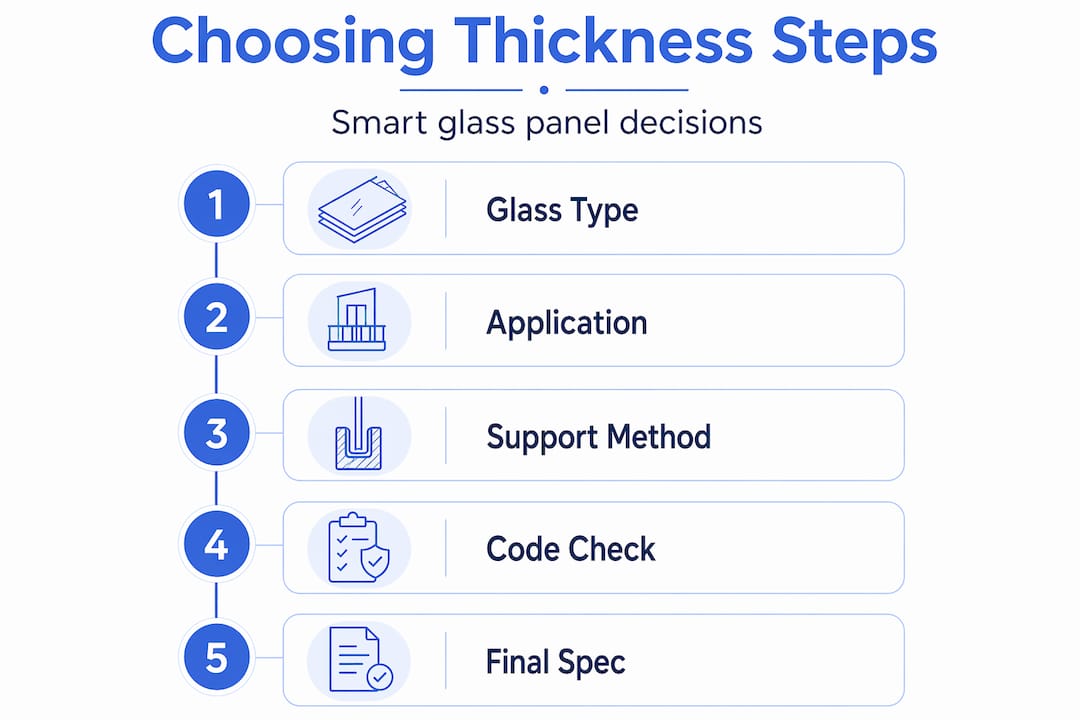
Getting this right comes down to a clear process, not a guess. Here is how to choose the right glass thickness without leaving gaps.
-
Define the application first. Is this a railing, a window, a partition, a pool fence? Each category has a different starting point for thickness minimums and different performance expectations.
-
Know your panel size. Thickness requirements scale with panel size. Before you can confirm how thick a glass panel needs to be, you need final dimensions. Preliminary sizes will get you preliminary specs, but do not lock in orders on preliminary specs.
-
Identify your support method. Framed, frameless, and point-supported systems all have different minimum glass thickness standards requirements for the same panel size. This single factor can move you up a full thickness grade.
-
Check local code requirements. The American building code for glass railings sets specific minimums for residential and commercial applications. Pull the applicable code for your location before specifying anything.
-
Confirm glass type alongside thickness. Tempered glass is the standard for safety applications in railings and shower enclosures. Tempered glass advantages go beyond strength. When tempered glass breaks, it fractures into small blunt pieces rather than sharp shards, which is a safety behavior that annealed glass at the same thickness cannot replicate.
- Get the hardware spec confirmed at the same time. Do not order glass, then figure out hardware. Confirm the full system specification together so you avoid the scenario where your glass arrives and your hardware is incompatible.
Installing glass that is too thin for frameless applications creates flexing, puts strain on hardware, and risks failure over time. That failure mode is not dramatic or sudden in most cases. It is gradual: a slight bow, a hinge that starts binding, a gap that widens. By the time it is visible, it is already a problem.
My Honest Take on Thickness Decisions
I’ve reviewed enough glass railing projects to know where the confusion lives, and it is almost never in the thickness number itself. It is in treating thickness as the only variable.
What I’ve seen repeatedly is this: a contractor or homeowner gets fixated on the spec sheet thickness, orders the right number, then installs the glass in a support system that was designed for a different thickness or a different glass type. The glass is technically to spec. The installation is not. That gap is where failures happen.
My experience tells me the best projects treat glass thickness as one part of a coordinated system. The thickness, the glass type, the support method, and the hardware all need to be confirmed together by someone who knows how those variables interact. Choosing glass thickness for railings is not a lookup exercise. It is a design decision.
I have also learned that overbuilding feels safe but costs real money. Going one increment thicker “just to be safe” without running the load calculations means heavier glass, heavier hardware, potentially reinforced posts, and a higher total cost, often for no measurable safety gain. Get the spec right. Spend on what the engineering says you need, not on what feels more solid.
— Fuanne
Get the Right Glass Thickness for Your Project

When your project depends on meeting code and holding up under real-world conditions, guessing on glass panel thickness is not a risk worth taking. Glassrailingstore carries tempered glass panels in multiple size options designed for residential and commercial railings, with products that comply with safety standards for frameless and exterior applications. Whether you need a 46" tempered glass panel for a standard deck railing or a larger panel for a commercial balustrade, the product lineup is built around the thickness and quality specs that installations actually require. If you want engineering-backed confidence that your glass selection meets code, the glass railing engineering testing service gives you documentation you can submit with your permit application.
FAQs
1. What is the standard glass panel thickness for railings?
Frameless residential railings most commonly use 10 mm to 12 mm tempered safety glass. Framed systems can use thinner panels, often 6 mm to 8 mm, because the frame provides structural support.
2. How thick is glass panel for a frameless shower door?
The standard in the United States is 10 mm (3/8") tempered glass for frameless shower doors. Larger enclosures typically use 12 mm (1/2") for added rigidity and reduced flex.
3. Does glass panel thickness affect hardware selection?
Yes. Thicker glass panels are heavier and require hinges, brackets, and base channels rated for the increased load. Changing glass thickness without updating hardware specifications is a leading cause of installation rework.
4. What is the L/175 rule in glass thickness selection?
The L/175 deflection limit means the center of a glass panel should flex no more than its span length divided by 175 under maximum expected wind load. Engineers use this calculation to confirm that a chosen thickness is sufficient for the panel size and site exposure.
5. How do I know if my glass panel thickness meets local building codes?
Pull the applicable residential or commercial building code for your location and confirm the minimum thickness and glass type requirements for your specific application. For glass railings, codes vary by state and province, so local verification is always required before ordering.