

Glass Railing Subcontractor Scope: A GC's Guide
The glass railing subcontractor scope is defined as the full set of responsibilities a glazing subcontractor carries from initial shop drawing submittals through material procurement, installation, and post-installation warranty management. General contractors and project managers who treat this scope as just “install glass” consistently face change orders, permit delays, and inspection failures. Getting the scope right before award is the single most effective way to protect your schedule and budget on any glass railing project.
What Does a Glass Railing Subcontractor’s Scope of Work Include?
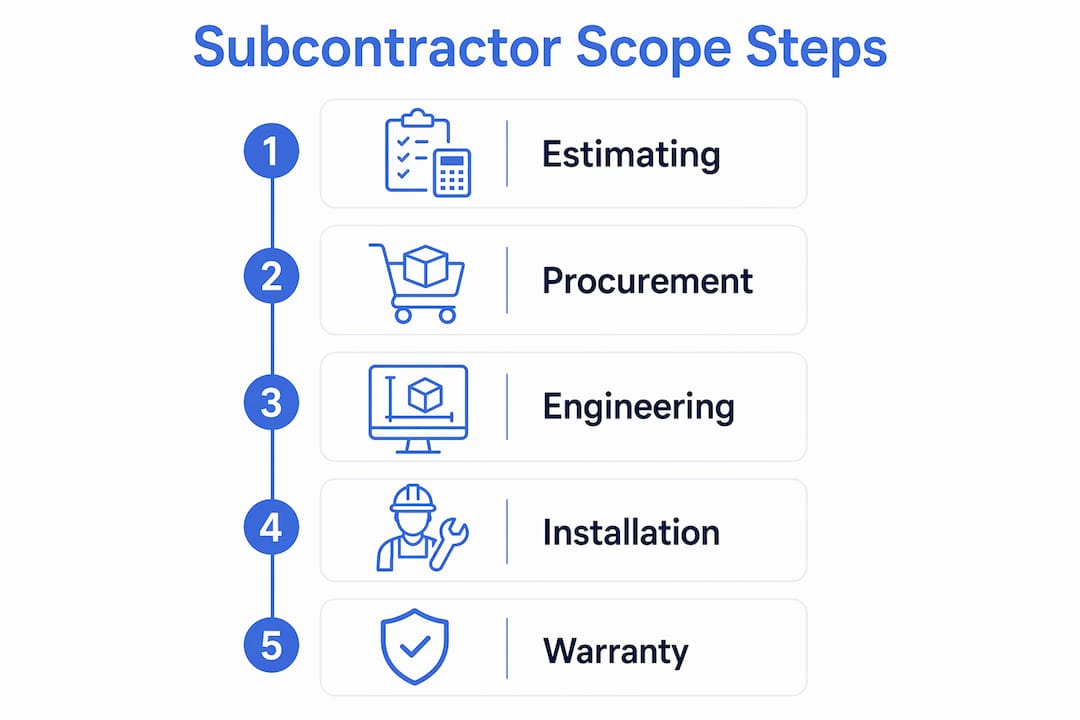
The glass railing subcontractor scope covers far more than physical installation. Glazing subcontractor scope includes shop drawing submittals with frame profiles, anchor conditions, glass specifications, installation details, and product approval documentation for regulated jurisdictions. That means the subcontractor owns the paper trail from design through closeout, not just the labor on site.
The major scope elements break down as follows:
- Shop drawing submittals: Frame profiles, anchor layouts, glass build-up specs, edge details, and connection conditions at posts, walls, and corners. These must be submitted and approved before fabrication begins.
- Material procurement: The subcontractor sources tempered glass panels, base channels, spigots, standoffs, cap rail, and all associated hardware. Commercial glazing lead times often run 6–18 weeks, making procurement a critical schedule risk on any project.
- Installation tasks: Setting base channels, installing glass panels, fitting cap rail, sealing, and completing all punch list items. The subcontractor coordinates access, lifts, and temporary protection.
- Engineering input: For frameless systems, the subcontractor typically carries delegated design responsibility. That includes fixing design, anchor pull-out verification, and stamped drawings for permit submission.
- Warranty obligations: The subcontractor manages both the manufacturer product warranty and their own workmanship warranty after substantial completion.
Pro Tip: Require the subcontractor to list every item they exclude from scope in writing at bid time. Exclusions are where change orders are born.
The subcontractor scope is an end-to-end responsibility. It spans estimating, procurement, and post-installation performance management, not just the installation day itself.
How Do RFQ Details Affect Subcontractor Scope and Project Risk?
Unclear RFQs are the leading cause of divergent bids and costly variation orders on glass railing projects. When a subcontractor makes assumptions about substrate type, mounting method, or corner conditions, those assumptions get priced into the bid. The cheapest bid almost always reflects the most optimistic assumptions, and those assumptions become change orders after award.
A well-structured RFQ eliminates guesswork before it starts. Defining mounting interfaces before the RFQ, including substrate type, mounting method, post spacing, corner conditions, and finish, prevents costly shop drawing revisions. Here is the sequence that reduces risk:
- Confirm substrate type: Concrete, steel, wood framing, and composite decking each require different anchor systems. Specify it in the RFQ.
- Define the mounting method: Surface mount, fascia mount, and core drill installations have different labor and material costs. Ambiguity here creates the largest bid spread.
- Specify corner conditions: Inside corners, outside corners, and 45-degree returns require different hardware. Missing measurement data is a major cause of fabrication delays.
- State the glass build-up: Thickness, temper, interlayer type, and any low-iron or tinted requirements must be explicit.
- Confirm finish requirements: Powder coat color, anodize class, and marine-grade stainless specifications affect both cost and lead time.
Pro Tip: Send photos and dimensioned sketches of the substrate conditions to every bidder. Experienced subcontractors require this before quoting. If a bidder prices without it, that is a red flag.
Unclear RFQ scope fields lead to divergent subcontractor assumptions and significant change orders later in the project. The cost of a thorough RFQ is a few hours of coordination. The cost of skipping it is measured in weeks and dollars.
What Engineering and Code Compliance Responsibilities Fall Under the Subcontractor’s Scope?
Glass panels in balustrade systems are structural elements, not just infill. Glass panels in balustrades transfer crowd and horizontal loads to base fixings, making fixing design and anchor pull-out verification critical subcontractor scope items. This is fundamentally different from traditional glazing, where the glass is non-structural.

The table below summarizes the key engineering responsibilities and how they differ by system type:
| Scope item | Channel system | Point-fixed system |
|---|---|---|
| Base channel depth | 100–150 mm typical | Not applicable |
| Load path design | Distributed along channel | Concentrated at each fixing |
| Anchor pull-out check | Required at channel ends | Required at every spigot |
| Delegated design package | System drawings plus ICC-ES report | System drawings plus ICC-ES report |
| Stamped drawings for permit | Required for frameless systems | Required for all point-fixed systems |
Building permit requirements add another layer of complexity. New or second-storey balcony glass railings often require standalone permits costing $300–$600, including engineered drawings for frameless systems. Permit fees and scope vary by jurisdiction, so the subcontractor must confirm local requirements before bidding.
A complete delegated design package must include system drawings plus ICC-ES evaluation reports and jurisdiction supplements to avoid submittal delays. Subcontractors who skip this step create permit holds that stop the entire project. The American building code requirements for glass railings set the national baseline, but state and local amendments frequently add requirements on top. Contractors working in states like Michigan or Virginia should verify local supplements before finalizing the engineering scope.
The subcontractor’s role in coordinating engineering submittals is active, not passive. They must track review cycles, respond to RFIs from the engineer of record, and resubmit corrected drawings within the project schedule.
How Should Subcontractors Coordinate with Other Trades?
Trade coordination is where glass railing projects most commonly fall apart. Anchors and substrates must be ready before glass installation begins, and that readiness depends entirely on trades that the glass subcontractor does not control.
The critical coordination interfaces are:
- Concrete and structural steel: Embed plates, cast-in anchors, and core drill locations must be confirmed and installed before the glass subcontractor can finalize shop drawings. Changes after fabrication are expensive.
- Waterproofing: Base channel installations on decks and balconies must integrate with the waterproofing membrane. The sequence matters. Glass goes in after waterproofing is complete and inspected.
- Finishing trades: Tile setters, painters, and cladding contractors often work in the same zone as glass railings. Scheduling glass installation before adjacent finishes are complete leads to damage and rework.
- Inspections: Glass railing inspections typically require the system to be fully installed and anchored. Scheduling an inspection before adjacent work is complete wastes everyone’s time.
Inspection predictability improves when subcontractors sequence glass guard installation with adjacent trades rather than scheduling it as a standalone task. This is a practical insight that most project schedules ignore. Good material management practices treat glass railing installation as a dependent activity, not an independent one.
Pro Tip: Build a two-week lookahead specifically for the glass railing zone. Confirm substrate readiness, waterproofing sign-off, and adjacent trade completion before releasing the subcontractor to mobilize.
What Warranty Coverage Is Typical for Glass Railing Subcontractors?
Glass railing warranty for contractors operates in three distinct layers, and subcontractors must understand all three before signing a contract. Layered commercial glass warranties include glass manufacturer warranties covering seal failure for 10 years, framing manufacturer warranties covering finish for 10–20 years, and installer workmanship warranties covering leaks and anchorage failures for 1–5 years.
The workmanship warranty is the subcontractor’s direct liability. It covers:
- Anchorage failures caused by improper installation, under-torqued fasteners, or incorrect anchor selection
- Leak failures at base channels and wall connections resulting from poor sealant application
- Glass movement caused by inadequate setting blocks or incorrect panel sizing
Standard warranty exclusions matter just as much as what is covered. Weather damage, vandalism, impact from objects, and damage caused by improper cleaning products are universally excluded. Subcontractors should document the condition of the installation at handover with photos and a written punch list sign-off. That documentation is the first line of defense in any warranty claim process.
The glass railing warranty claim process typically starts with a written notice from the owner or GC, followed by a site inspection by the subcontractor within a defined response window, usually 5–10 business days. The subcontractor then determines whether the failure falls under workmanship, manufacturer defect, or excluded damage. Understanding the warranty fine print during bidding prevents disputes at closeout.
Key Takeaways
A well-defined glass railing subcontractor scope, covering shop drawings, procurement, engineering, trade coordination, and warranty, is the single most effective way to prevent change orders and schedule overruns on glass railing projects.
| Point | Details |
|---|---|
| Define scope before RFQ | Specify substrate, mounting method, corner conditions, and finish to eliminate bid assumptions. |
| Procurement drives the schedule | Commercial glazing lead times run 6–18 weeks; lock in procurement early to protect the critical path. |
| Engineering is a subcontractor task | Delegated design, anchor verification, and stamped drawings fall on the subcontractor, not the GC. |
| Coordinate trades before mobilizing | Substrates, waterproofing, and adjacent finishes must be complete before glass installation begins. |
| Warranty has three layers | Glass, framing, and workmanship warranties each have different durations, owners, and exclusions. |
What I've Learned Managing Glass Railing Scope on Commercial Projects
The most expensive mistake I see on glass railing projects is treating the subcontractor scope as a commodity. GCs issue a vague RFQ, collect three bids, and award the lowest number. Six weeks later, the shop drawing review kicks off a chain of RFIs about anchor conditions nobody specified. The variation orders that follow routinely exceed the original bid spread.
The fix is not complicated. A thorough RFQ with photos, dimensioned sketches, and explicit substrate conditions takes a few hours to prepare. That investment eliminates the ambiguity that feeds change orders. Early engineering coordination, ideally before the subcontractor is even awarded, catches permit and delegated design issues before they become schedule holds.
The other lesson I keep coming back to is sequencing. Glass railing installation is almost never on the critical path by itself. It becomes critical when it gets scheduled in isolation, without confirming that waterproofing, concrete, and finishing trades are actually done. Treat it as a dependent activity and build the lookahead accordingly. The subcontractors who consistently deliver on time are the ones who show up knowing exactly what is ready and what is not.
— Fuanne
Glassrailingstore Resources for Project Managers
Project managers working through glass railing scope requirements need reliable technical resources, not just product catalogs.
Glassrailingstore provides engineering testing services that support subcontractor scope fulfillment and code compliance, including load testing documentation that satisfies permit and delegated design requirements. The site also maintains a detailed building codes resource covering national and state-level requirements, so you can confirm jurisdictional scope before the RFQ goes out. For projects that need custom panel sizing or specific hardware configurations, Glassrailingstore offers a frameless glass railing quote service with scope-specific support built in.
FAQs
1. What is included in a glass railing subcontractor’s scope?
The scope covers shop drawing submittals, material procurement, delegated engineering design, installation, and workmanship warranty management. It does not typically include structural substrate preparation, which remains the GC’s responsibility.
2. How long do glass railing procurement lead times run?
Commercial glazing lead times typically run 6–18 weeks depending on glass specification, hardware finish, and supplier capacity. Project managers should lock in procurement decisions before the subcontractor is awarded to protect the schedule.
3. Who is responsible for pulling the glass railing permit?
The subcontractor typically pulls the glass railing permit, and refusal to do so is a red flag. New or second-storey balcony glass railing permits often cost $300–$600 and may require engineered drawings for frameless systems.
4. What does a glass railing workmanship warranty cover?
The installer workmanship warranty covers leaks and anchorage failures caused by installation error, typically for 1–5 years. It does not cover weather damage, vandalism, or damage from improper cleaning.
5. How do you prevent change orders on a glass railing subcontract?
Specify substrate type, mounting method, corner conditions, glass build-up, and finish in the RFQ before soliciting bids. Unresolved assumptions in the RFQ are the primary driver of variation orders during shop drawing review.