

Glass Railing on Composite Decking: What to Check First
Yes, glass railing works on composite decking, and it’s one of the most popular upgrades homeowners make to a Trex, TimberTech, or similar composite deck. The catch has nothing to do with the boards under your feet. It’s about what’s underneath them.
Composite decking is a finish surface, not a structural one. Post anchorage and load transfer happen at the rim joist, blocking, and framing, governed by IRC R301.5 load requirements. Before you order a single panel, confirm three things:
- Framing strength — can your rim joist and blocking handle through-bolted hardware?
- Mounting method — will you surface-mount, side-mount, or set posts in-deck?
- Glass and hardware spec — tempered or laminated glass, rated for outdoor guard duty?
Get those three right, and the composite boards themselves are almost a non-issue.
Key Takeaways
Glass railing succeeds on composite decking when post anchorage ties into solid framing rated for code-required guard loads, not into the decking surface itself.
| Point | Details |
|---|---|
| Compatibility depends on framing | Composite boards are cosmetic; rim joists and blocking must carry the load under IRC R301.5. |
| Pick the right system type | Frameless preserves views, framed systems cost less and install easier, glass-in-post splits the difference. |
| Mounting method drives prep work | Surface-mount, side-mount, and in-deck methods each demand different framing access and water management. |
| Specify glass and hardware carefully | Tempered or laminated glass paired with 316 stainless hardware holds up best outdoors. |
| Glassrailingstore supplies ready-to-order parts | Tempered panels, connectors, and installation guides are built specifically for composite deck attachment. |
Table of Contents
- Types of Glass Railing Systems for Decks
- What Composite Decking and Framing Must Provide
- Mounting Methods and an Installation Checklist
- Glass and Hardware Specs That Matter Outdoors
- Pros and Cons of Glass Railing on Composite Decks
- Measuring Panels and Meeting Code Requirements
- Cleaning, Maintenance, and Design Pairings
- How Glass Railing Store Supports Your Composite Deck Project
- Frequently Asked Questions
- Sources
Types of Glass Railing Systems for Decks
Not every glass railing looks or installs the same way, and picking the wrong type for your deck’s layout is the most common regret homeowners report after the fact.
Frameless systems use a base shoe or patch-fit hardware to hold panels with no visible top or bottom rail. You get the cleanest sightline for a view lot, but expect thicker glass and a higher parts bill.
Framed systems sandwich glass between top and bottom rails. They cost less, forgive minor measurement errors better, and are usually the easier DIY choice.
Glass-in-post or baluster-mounted systems sit in between: visible posts every few feet with glass infill panels instead of balusters. You keep some structure and reduce the reliance on perfect edge tolerances.
Pro Tip: If your deck faces a view you want unobstructed, go frameless. If you’re prioritizing budget and a straightforward weekend install, choose a framed system with pre-drilled rail components.
What Composite Decking and Framing Must Provide
The decking surface won’t hold your railing up. Composite boards flex and are not rated to anchor guard posts. What matters is whether the load from a 200-pound push on the top rail, plus the standard 50-pound-per-linear-foot uniform load required by code, can travel through your posts into solid framing.
Run this checklist before you order anything:
- Rim joist depth and condition (rot, old fastener holes, or undersized lumber are dealbreakers).
- Blocking between joists at every post location, or a plan to add it.
- Ability to through-bolt into framing rather than just into the decking surface.
- Ledger board condition where the deck meets the house, since post loads near that zone transfer through the same connection.
If you’re working with branded composite boards, check the manufacturer’s own compatibility notes. Trex publishes accessory and protection guidance for railing attachments, and it’s worth a quick read alongside the Glass Railing Store’s install guide for composite decks before you drill a single hole. Never rely on surface screws driven only into composite boards to anchor a post. That hardware needs to reach real structure, not just plastic-composite fiber.
Mounting Methods and an Installation Checklist
Three mounting methods cover almost every composite deck install.
Surface-mount bolts a post base directly onto the deck surface, with fasteners running through the composite board into the rim joist or blocking below. This is the most common retrofit method because it doesn’t require tearing up decking.
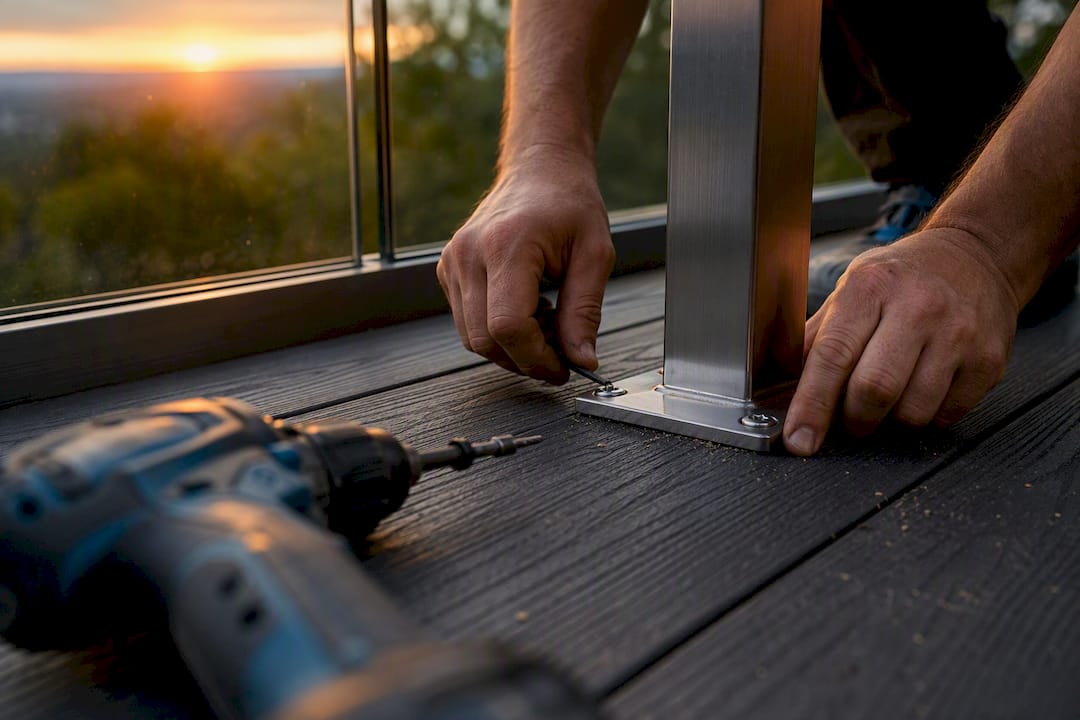
Side-mount attaches posts to the outer face of the rim joist or fascia board, which preserves a few extra inches of usable deck space and works well when you have clear access to the joist edge.
In-deck or post-mounted systems sink a post sleeve through a cut opening in the decking, anchored to framing below. Frameless systems often use this method for a flush, minimal look, though it requires more careful planning during the decking layout itself.
A practical installation sequence looks like this (see examples at Projects - J. Signor Exteriors):
- Inspect framing and confirm blocking at every post location.
- Measure spans and finalize your panel order.
- Order panels and matching hardware, including connectors for corners or straight runs.
- Drill mounting holes and install flashing or sealant around any deck penetrations.
- Set posts, torque hardware to spec, and confirm alignment before setting glass.
- Do a final inspection and load check on each post.
Composite boards need larger-diameter sleeve holes than wood decking in some in-deck applications, and any penetration needs proper water management to prevent moisture from tracking into the framing below.
Pro Tip: If you’re building a new deck and know glass railing is coming, add blocking at post locations before the decking goes down. Retrofitting blocking from underneath an existing deck is possible, but it’s a much bigger job than doing it during framing.
Glass and Hardware Specs That Matter Outdoors
Tempered glass is the standard for most deck railing panels, offering the impact resistance building codes require. Laminated glass, which sandwiches a plastic interlayer between two tempered panes, is increasingly chosen for pool-adjacent decks and balustrades because it stays in one sheet even if it cracks.
Panel thickness for residential deck applications commonly runs between three-eighths and half an inch, depending on the system and unsupported span. Confirm your supplier’s maximum unsupported width for the thickness you’re ordering. It’s one of the most overlooked spec details until a panel arrives too large for its intended gap.
Hardware matters just as much as the glass. Marine-grade 316 stainless steel resists corrosion far better than standard 304 stainless or coated aluminum, particularly in coastal or high-humidity regions. Fasteners, base shoes, and clips should carry the same corrosion rating.
- Confirm glass type (tempered vs. laminated) matches your local guard requirements.
- Ask about edge treatment and seal quality, since poor seals let moisture creep behind base shoes.
- Choose 316 stainless hardware if you’re within a few miles of saltwater or live somewhere with heavy humidity year-round.
Pros and Cons of Glass Railing on Composite Decks
Glass railing earns its popularity honestly, but it comes with real trade-offs worth weighing before you commit.
Pros:
- Unobstructed views, especially with frameless systems.
- A clean, modern look that pairs well with composite decking’s smooth finish.
- A partial wind break on exposed decks, unlike open baluster designs.
- No painting or staining upkeep compared to wood railing systems.
Cons:
- Higher upfront cost than aluminum or cable railing systems.
- Regular glass cleaning to keep panels looking sharp.
- Reduced privacy on decks facing neighbors or the street.
- A hard requirement for solid framing and correct anchorage, which can mean added prep work on older decks.
Frosted or acid-etched glass solves the privacy issue without sacrificing the wind-block benefit, and nano-coatings can cut down how often you need to clean the glass by repelling water and grime between washes.
Measuring Panels and Meeting Code Requirements
Getting measurements right the first time saves you from an expensive reorder. Measure the span between each post center, not just the visible gap, and always ask your supplier what fabrication tolerance they build into custom panels.
Code compliance for guards centers on a few numbers you should have memorized before you call for a quote:
- Guard height typically must reach at least 36 inches on residential decks (check local adoption, since some jurisdictions require more).
- Guards must resist the 200-pound concentrated load and 50-pound-per-linear-foot uniform load referenced under IRC R301.5.
- Glazing must meet safety glazing standards, meaning tempered or laminated glass rated to ASTM E2353 performance criteria.
The Glass Railing Store’s building code overview breaks these requirements down further if your local jurisdiction has its own variations. When you’re ready to order, confirm edge polish, hole placement for hardware, and whether connectors ship separately from the panels themselves.
Cleaning, Maintenance, and Design Pairings
Outdoor glass needs more attention than indoor panels, but the routine is simple. Rinse and wipe panels every one to two weeks, more often near the coast, using mild soap and a microfiber cloth or squeegee. Ammonia-based and abrasive cleaners will degrade seals and hardware finishes over time, so skip them entirely. Check hardware tightness every six to twelve months, since a loose bracket that goes unnoticed for a season can eventually work its way into a real structural problem.
On the design side, dark composite boards paired with brushed stainless hardware create a sharp, contemporary contrast that photographs well and hides fingerprints better than polished chrome. Light composite tones, on the other hand, pair nicely with matte black or bronze trim for a warmer look that doesn’t wash out in bright sun.
How Glass Railing Store Supports Your Composite Deck Project
Glassrailingstore stocks tempered glass panels in both frameless and framed configurations, along with 316 stainless and aluminum hardware sized for composite deck installs. Every product page includes the specs you need to confirm compatibility with your framing plan.
- Measurement guides and step-by-step installation instructions built specifically for composite decking attachment.
- Corrosion-resistance and warranty details listed on each hardware product, useful for comparing options before you buy.
- Planning support for both DIY installs and contractor-led projects.
DIY or Hire a Pro?
Surface-mount kits with short spans and easy access to framing are reasonable DIY territory if you’re comfortable with a drill and a level. Complex frameless installs, long unsupported spans, or framing you’re not 100% sure about call for a professional. My honest recommendation: get a structural inspection before you buy a single panel, not after.
Get the Right Parts for Your Deck Railing Project
Once you know your mounting method and panel specs, ordering is straightforward. Glassrailingstore carries 46-inch tempered glass panels for standard guard heights, plus connectors for corners and straight runs so you’re not stuck improvising hardware mid-install.

If your project needs panels cut to an unusual span or connectors for an angled deck layout, the custom glass railing option handles made-to-measure orders without forcing you into stock sizing. Homeowners tackling their first glass railing install often start by downloading a measurement checklist, then requesting a quote once they’ve confirmed their framing can carry the load. That’s the fastest path from “is this even possible on my deck” to panels sitting on your porch ready to install.
FAQs
1. Can I install glass railing on any composite decking brand?
Yes, as long as your framing meets code load requirements. Check brand-specific guidance, like Trex’s accessory documentation, for attachment recommendations tied to their board profiles.
2. Do I need laminated glass or is tempered enough?
Tempered glass meets most residential code requirements. Laminated is often chosen for pool-adjacent decks or where local code requires glazing to stay intact if broken.
3. How long does a typical glass railing installation take?
A straightforward surface-mount install on an existing deck with solid framing often takes a weekend. Frameless or in-deck installs, especially with framing repairs, can stretch to several days.
4. What’s the biggest mistake homeowners make with glass railing on composite decks?
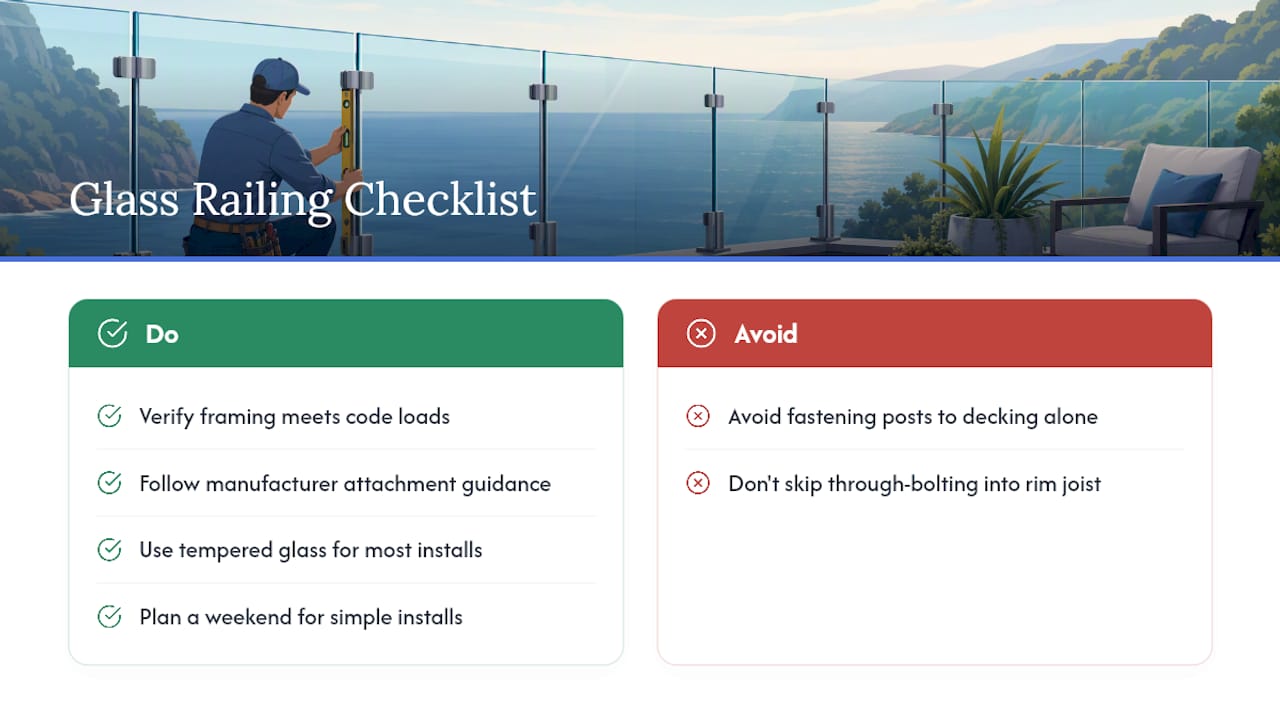
Anchoring posts with screws into composite boards alone instead of through-bolting into the rim joist or blocking. That’s the fastest way to end up with a wobbly, non-code-compliant railing.