

Stainless Steel Tea Staining: Removal and Coastal Spec Guide
Tea staining is a superficial, chloride-driven corrosion that leaves brown or yellow discoloration on stainless steel surfaces. It is primarily cosmetic, but left untreated it can progress to pitting and structural damage. Act quickly: rinse the affected area with fresh water, photograph and document the extent, and put on gloves and eye protection before applying any treatment.
Before you do anything else:
- Don PPE: chemical-resistant gloves, safety glasses, and ventilation if working indoors.
- Rinse with clean fresh water to dilute and remove loose chloride deposits.
- Photograph the affected areas for documentation and to track progression.
- Test any cleaner on a small, inconspicuous area first.
Avoid these from the start:
- Chlorine bleach and hypochlorite products — they accelerate chloride attack.
- Steel wool or carbon steel brushes — they embed iron particles that cause new corrosion.
- Hydrochloric (muriatic) acid — too aggressive for stainless steel surfaces.
- Undiluted acid cleaners on unprotected adjacent materials (concrete, glass, painted surfaces).
Key Takeaways
Tea staining is a chloride-driven passive-film failure that is cosmetic in its early stages but progresses to pitting if the environment and maintenance gap are not addressed.
| Point | Details |
|---|---|
| Choose the right grade | Specify Grade 316 minimum within ~5 km of surf; use duplex 2205 for splash zones or low-maintenance installs. |
| Design for drainage | Eliminate horizontal ponding surfaces and allow rain washing to reach all components. |
| Clean on schedule | Wash coastal installations monthly and after storms; use fresh water and mild detergent, never chloride-containing products. |
| Treat staining early | Use phosphoric- or sulphamic-acid cleaners with non-metallic pads; follow with citric-acid passivation to restore the passive film. |
| Escalate when pitting appears | Pitting, rapid recurrence after cleaning, or structural concerns require specialist assessment and likely component replacement. |
| Glassrailingstore | Supplies marine-grade stainless hardware and tempered glass panels with grade and finish documentation for coastal specifications. |
Table of Contents
- What stainless steel tea staining actually is (and what it isn’t)
- What causes tea staining and which conditions make it worse
- Which grades and finishes resist tea staining best
- How to prevent tea staining through design, fabrication, and maintenance
- How to remove tea staining safely, step by step
- When staining signals deeper corrosion that needs repair or replacement
- Specification checklist for coastal glass railing hardware
- The mistakes that cause most of the tea staining problems seen in the field
- Glassrailingstore supplies marine-grade hardware built for coastal exposure
- Sources
What Stainless Steel Tea Staining Actually Is (and What It Isn’t)
The term “tea staining” gets used for two completely different problems, and confusing them leads to the wrong fix. Architectural tea staining and kitchen tannin stains are distinct issues that require different remediation paths.
Architectural tea staining is a chloride-driven breakdown of the chromium-oxide passive film that protects stainless steel. When chlorides from marine air, de-icing salts, or contaminated water penetrate and disrupt that film, iron in the steel oxidizes and leaves brown, yellow, or orange discoloration on the surface. The staining typically appears in surface troughs, around weld heat-tint zones, and on rough or horizontal surfaces where salt-laden moisture pools and concentrates.
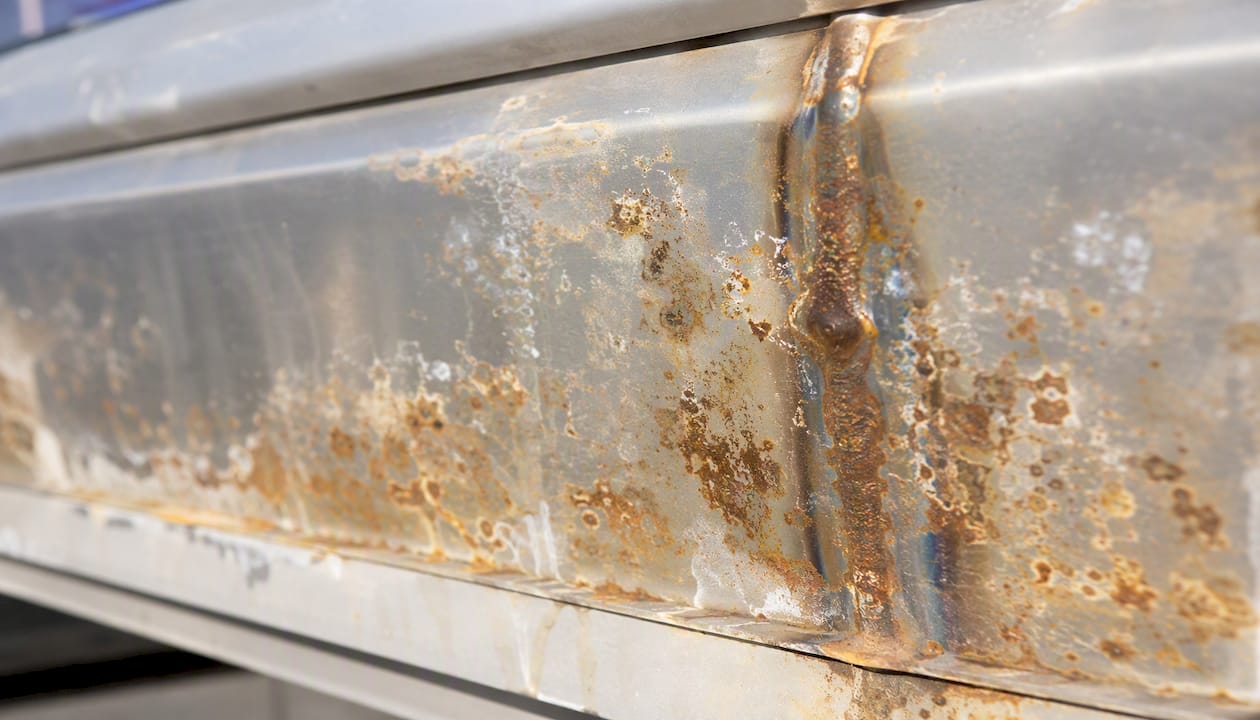
Kitchen “tea stains” are tannin deposits from beverages. They sit on top of the steel rather than reacting with it, and household remedies like baking soda paste, white vinegar, or lemon juice remove them effectively. Those same remedies do almost nothing for architectural chloride-driven staining.
True rust looks different from tea staining. Rust produces reddish-brown, textured pits with actual material loss. Tea staining, at least in its early stages, is a surface discoloration with no significant depth. Running a fingernail across it: if the surface feels smooth and the discoloration wipes partially with a damp cloth, it is likely surface staining. If it feels rough, pitted, or gritty, you may already be looking at something more serious.
What Causes Tea Staining and Which Conditions Make It Worse
The primary driver is chloride concentration at the steel surface. Marine air carries sodium chloride; de-icing salts carry chlorides; some cleaning products contain chlorides; even some municipal water supplies deposit chloride residue when they evaporate. Any of these can initiate the passive-film breakdown that produces staining.
Primary risk factors:
- Proximity to surf or coastal water — risk is generally elevated within roughly 5 km of surf, though local wind patterns, sheltering, and topography can push that boundary in either direction.
- Horizontal or ponding surfaces where salt-laden moisture sits rather than draining.
- Weld heat tint and uncleaned welds — the heat-affected zone has a depleted passive layer.
- Carbon steel contamination from tools, grinding debris, or adjacent structures.
- High surface roughness (Ra above 0.5 µm) that traps salt particles.
- High humidity combined with elevated temperature, which accelerates chloride attack.
- Infrequent washing — salt accumulates between rain events and concentrates as water evaporates.
| Environment | Surface finish | Cleaning frequency | Risk level |
|---|---|---|---|
| Coastal (within 5 km surf) | Rough mill / 2B | Infrequent (quarterly+) | Very high |
| Coastal (within 5 km surf) | Electropolished / mirror | Monthly or after storms | Moderate |
| Urban / industrial | Rough mill / 2B | Infrequent | Moderate |
| Urban / industrial | Mechanically polished | Regular (monthly) | Low–moderate |
| Sheltered inland | Any finish | Regular | Low |
| Sheltered inland | Electropolished | Regular | Very low |
Wind direction and local sheltering matter more than raw distance in some cases. A railing on the windward face of a beachfront building accumulates salt far faster than one on a sheltered courtyard two blocks from the water. When assessing a site, check the prevailing wind direction relative to the surf and note whether the installation is exposed or recessed.
Which Grades and Finishes Resist Tea Staining Best
Grade selection is the single most consequential decision for long-term appearance in coastal installations. Grade 304 is adequate for many inland applications, but near coastlines it stains readily and is not recommended for exposed exterior use. Grade 316 is the standard minimum specification within roughly 5 km of surf, with its molybdenum content providing meaningfully better chloride resistance than 304.
For splash zones, unwashed areas, or installations where maintenance access is limited, duplex 2205 or higher-alloy “super” grades offer substantially better resistance. The cost premium is real, but so is the reduction in remediation frequency over a 10–20 year installation life.
Surface finish hierarchy (best to worst for chloride resistance):
- Electropolished: removes the outermost layer of steel, eliminates surface peaks, and produces a dense, uniform passive film. The best performing finish for coastal exposure.
- Mirror / bright-annealed (BA): very smooth, low Ra, easy to clean. Good resistance, though electropolish still outperforms it.
- Mechanically polished (2B or better, Ra ≤0.5 µm): acceptable for moderate coastal exposure with regular washing.
- Mill finish / No. 1: rough, porous surface that traps salt. Avoid for exposed coastal applications.
Targeting a surface roughness of Ra ≤0.5 µm is a practical specification threshold. Below that value, salt particles have less surface area to adhere to and rain washing is more effective.
Fabrication matters as much as grade. Weld heat tint depletes the passive layer in the heat-affected zone, and that zone stains first. Post-weld treatment is non-negotiable for coastal installations. A TIG brush (electrochemical weld cleaner) removes heat tint without the aggressive material removal of grinding, and it restores the passive layer locally. For full-component treatment, passivation in nitric or citric acid solution, or electropolishing, gives the most uniform result. For more on marine-grade alloy choices and when to step up from 316, the Glassrailingstore resource covers the decision framework in detail.
Pro Tip: When long-term low-maintenance appearance is the priority, specify electropolished duplex 2205 for hardware in splash zones or unwashed areas. The upfront cost increase is typically recovered within two to three maintenance cycles.
How to Prevent Tea Staining Through Design, Fabrication, and Maintenance
Prevention is cheaper than remediation, and most of the effective strategies are design decisions made before a single component is installed.
Design rules that reduce staining risk:
- Avoid horizontal ledges, flat cap rails without drainage, and any geometry that allows water to pond.
- Orient grain direction vertically on flat surfaces so rain runs off rather than across.
- Allow rain washing to reach all surfaces — recessed or sheltered details that never get rained on accumulate salt without any natural rinse cycle.
- Specify free-draining post bases and connector housings; trapped moisture at the base of posts is a common staining initiation point.
Fabrication controls:
- Remove all iron contamination before installation. Carbon steel tools, grinding wheels, and wire brushes leave embedded iron particles that corrode independently and stain the surrounding stainless.
- Clean all weld heat tint with a TIG brush or pickling paste before the component leaves the shop.
- Follow passivation or electropolishing protocols as the final fabrication step.
- Use dedicated stainless steel tools — never share grinding discs or wire brushes between carbon steel and stainless steel work.
Handling and installation:
- Store components wrapped or sleeved to prevent contact with carbon steel surfaces during transport.
- Protect edges and fittings from contact with carbon steel scaffolding or brackets.
- After installation, rinse all surfaces with fresh water to remove any construction-phase contamination.
Maintenance schedule by environment:
| Environment | Minimum wash frequency | Notes |
|---|---|---|
| Coastal (within 5 km surf) | Monthly, plus after storms | Use fresh water and mild detergent; avoid chloride-containing cleaners |
| Urban / industrial | Every 2–3 months | Increase if near industrial pollution sources |
| Sheltered suburban | Every 3–6 months | Align with window-washing schedule as a practical rule of thumb |
| Inland / low exposure | Every 6 months | Inspect annually for early staining |
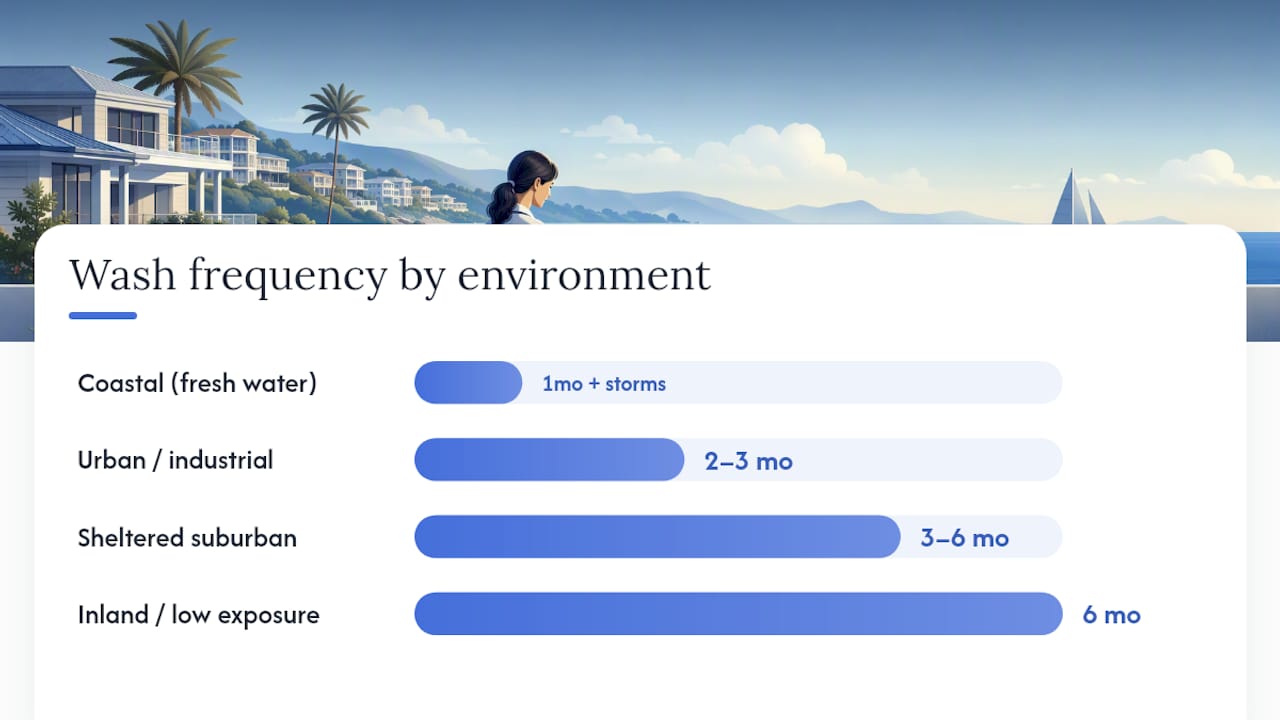
Washing stainless steel on the same schedule as windows is a practical rule of thumb for most commercial buildings. In coastal settings, that frequency needs to increase — monthly washing, plus a rinse after any storm event that deposits visible salt. For a detailed glass railing maintenance schedule tied to coastal exposure levels, Glassrailingstore’s planning guide covers frequency and product selection.
Safety when using acid-based cleaners: always dilute to the manufacturer’s recommended concentration, work in ventilated conditions, wear chemical-resistant gloves and eye protection, and neutralize and rinse thoroughly before the product dries on the surface.
How to Remove Tea Staining Safely, Step by Step
Diagnosis comes first. Before applying any treatment, confirm you are dealing with surface discoloration rather than embedded pitting. Run a gloved finger across the stain: smooth surface with color change is surface staining; rough, gritty texture with visible depth is pitting and needs a different response (see the next section).
Removal workflow:
- Photograph and document the affected area, including extent and severity. This baseline matters if you need to track whether treatment worked or whether staining returns quickly.
- Rinse with fresh water to remove loose salt deposits before applying any cleaner.
- Select a test area — a small, inconspicuous section of the same surface — and apply your chosen cleaner there first. Wait the full dwell time, rinse, and assess before treating the full area.
- Mechanical cleaning (mild staining): use a non-metallic Scotch-Brite pad or nylon brush, working along the grain direction of the steel. Never work across the grain; it creates micro-scratches that trap future deposits. Never use carbon steel wool or wire brushes.
- Chemical cleaning (moderate to heavy staining): phosphoric-acid–based cleaners and sulphamic-acid powder formulations are the recommended product categories. Oxalic-acid–based cleaners work on some stain types as well. Apply at the manufacturer’s recommended dilution, allow the specified dwell time, and scrub gently along the grain with a non-metallic pad.
- Citric-acid passivation kits are useful after stain removal to restore the passive film. Apply after cleaning and rinsing, allow the specified contact time, then rinse thoroughly. These are particularly valuable after mechanical cleaning that may have disturbed the surface.
- Neutralize and rinse. After any acid treatment, neutralize with a dilute alkaline solution (baking soda in water works for this step), then rinse with copious fresh water. Do not allow acid residue to dry on the surface.
- Protect adjacent materials. Mask or pre-wet concrete, glass panels, and painted surfaces before applying acid cleaners. Acid runoff etches concrete and can damage glass coatings.
Pro Tip: On vertical surfaces, gel or paste formulations hold contact time far better than liquid cleaners. A gel product applied with a brush stays where you put it for the full dwell time; a liquid runs off within seconds. This single switch often makes the difference between a treatment that works and one that needs three applications.
PPE checklist for chemical removal:
- Chemical-resistant gloves (nitrile or neoprene, not latex)
- Safety glasses or face shield
- Long sleeves and closed-toe shoes
- Ventilation — work outdoors or with forced-air ventilation indoors
- Neutralizing agent and water source within reach before starting
For safe product selection across the full railing system, the best cleaners for glass railings guide covers which formulations are safe on both stainless steel and tempered glass.
Note on household methods: baking soda, white vinegar, and lemon juice remove tannin-based kitchen tea stains effectively. For architectural chloride-driven staining on coastal installations, these are not adequate substitutes for targeted chemical treatment.
When Staining Signals Deeper Corrosion That Needs Repair or Replacement
Surface discoloration that responds to cleaning and does not return within a few weeks is a maintenance issue. Staining that returns within days of treatment, or that does not respond to chemical cleaning, is a different problem.
Red flags for deeper corrosion:
- Localized pitting — small, rough-edged craters that feel gritty under a gloved finger.
- Reddish-brown texture with visible depth, not just surface color.
- Staining that reappears within days of a thorough chemical treatment.
- Corrosion concentrated around welds, suggesting inadequate post-weld treatment or wrong filler grade.
- Any sign of structural compromise — looseness, cracking, or material loss at load-bearing connections.
Decision framework:
- Treat and watch: surface staining with no pitting, responds to cleaning, does not recur within 4–6 weeks. Continue the maintenance schedule and increase wash frequency.
- Passivation or pickling: staining that responds to cleaning but recurs within weeks, with no pitting. Full-surface passivation or pickling restores the passive layer and extends the interval before staining returns. Pickling is more aggressive and may alter the surface appearance slightly.
- Selective replacement: pitting present, structural components affected, or staining recurring immediately after treatment. Replace the affected components with correctly specified and finished material. Continuing to treat pitted components chemically does not restore lost material.
- Engage a corrosion specialist: when pitting is widespread, when structural integrity is uncertain, or when the installation is in a critical safety application (pool fencing, high-traffic balconies). A specialist can assess material loss, recommend alloy upgrades, and document findings for liability purposes.
Repeated remediation is a signal to reconsider the installed alloy or finish rather than continuing chemical treatments indefinitely. Moving from 316 to duplex 2205, or specifying electropolishing on replacement components, often breaks the cycle.
Specification Checklist for Coastal Glass Railing Hardware
Getting the specification right at the procurement stage is far less expensive than remediating a poorly specified installation. These checklist items belong in your tender documents and purchase orders.
Minimum specification requirements:
- Grade 316 stainless steel for all hardware within roughly 5 km of surf; duplex 2205 or higher for splash zones, unwashed areas, or installations with limited maintenance access.
- Surface roughness Ra ≤0.5 µm for all exposed components.
- Post-fabrication passivation or electropolishing documented and certified by the fabricator.
- Weld heat tint removed by TIG brush, pickling paste, or electropolishing — not by grinding alone.
- Protective packaging maintained until installation; no contact with carbon steel during storage or transport.
Questions to ask your supplier:
- Can you provide a mill certificate confirming grade and alloy composition?
- What passivation method was used, and can you provide a process record?
- What is the measured Ra of the finished surface?
- Do you have corrosion test results or case studies from comparable coastal installations?
- How were welds treated, and what filler grade was used?
Tender wording prompts:
- “All stainless steel hardware shall be Grade 316 minimum, electropolished or passivated after fabrication, with a documented surface roughness of Ra ≤0.5 µm.”
- “Supplier shall provide evidence of post-weld treatment and passivation for all welded components.”
- “Maintenance schedule and warranty shall explicitly address surface corrosion (tea staining) and define the supplier’s obligations for components that stain within [X] years of installation.”
Pro Tip: Request electropolished or mill-finish components with a documented Ra certificate rather than accepting a verbal assurance of “polished finish.” The certificate gives you a contractual baseline and a reference point if staining appears early.
For procurement guidance on why stainless steel hardware matters in outdoor builds, Glassrailingstore’s article covers the trade-offs between grades and finishes in practical terms.
The Mistakes That Cause Most of the Tea Staining Problems Seen in the Field
The pattern that shows up repeatedly on coastal installations is not a materials failure — it is a specification and handling failure. The wrong grade gets installed because the project budget was tight. Welds get left with heat tint because the fabricator skipped post-weld treatment. Components get stored against carbon steel framing on site and pick up iron contamination before they are ever exposed to salt air.
The fix that actually sticks is not a better cleaning product. It is specifying correctly from the start: 316 at minimum, electropolished where maintenance access is limited, and a documented passivation record from the fabricator. When a project does that and adds a monthly rinse schedule, the staining problem largely disappears. When a project skips those steps and relies on chemical treatment to compensate, the maintenance team is back on site every few months indefinitely.
One specification change that consistently reduces repeat staining: moving from mechanically polished 316 to electropolished 316 on handrail caps and horizontal surfaces. Those are the surfaces that pond water and accumulate salt fastest, and the smoother passive film on electropolished material resists initiation far better than a mechanically polished surface at the same Ra target.
Glassrailingstore Supplies Marine-Grade Hardware Built for Coastal Exposure
Specifying the right hardware from the start is the most cost-effective way to avoid repeat staining. Glassrailingstore supplies tempered glass panels and marine-grade stainless steel connectors and hardware designed for exposed coastal and exterior installations, with the grade and finish documentation that specifiers need for tender compliance.

The 90-degree connectors and wall connectors in the catalog are specified for exterior use and are available with the surface finish and grade data that procurement teams require. If you need specification assistance, material datasheets, or help matching hardware to a coastal exposure category, contact Glassrailingstore directly for a consultation — the team can help you match grade, finish, and maintenance requirements to your project before the order is placed.
Sources
The technical references below underpin the guidance in this article. Each covers a specific aspect of tea staining prevention, removal, or specification.
- FAQ 6: Preventing Coastal Corrosion (Tea Staining)
- Removing Tea Staining
- How to Remove Tea Staining From Stainless Steel? - Chef’s Resource
- Stainless Steel ‘Tea Staining’
Recommended
- Hard Water Stains on Glass Railings: Expert Removal Tips – The Glass Railing Store
- Removing Stubborn Stains from Glass Railings Without Damaging the Surf – The Glass Railing Store
- Glass Railing Cleaning Guide: Expert Tips for Spotless Results – The Glass Railing Store
- Marine Grade Stainless Steel Explained for Builders – The Glass Railing Store