

3 Moves to Prevent Salt Air Corrosion on Coastal Homes and Railings
Rinse exposed metal with fresh water weekly, choose corrosion-resistant materials or coatings before problems start, and keep enclosed equipment below the humidity level where deposited salt turns into conductive brine. That last point matters more than most maintenance plans admit: table salt can absorb moisture and start corroding metal at roughly 75% relative humidity, and some coastal salt mixtures trigger the same reaction near 33% RH. Get those three moves right and everything else in this guide is refinement.
TL;DR:
- Regular rinsing of exposed metals with fresh water significantly extends their lifespan and should be part of weekly maintenance routines.
- Using higher-grade stainless steel, such as duplex 2205, is essential for structural components within a few hundred feet of saltwater, due to its superior pitting resistance.
- Designing for drainage, including sloped surfaces and fasteners oriented to shed water, reduces salt trappings and minimizes long-term corrosion risks.
- Enclosed equipment near coastlines should include active humidity control and sealed enclosures to prevent salt aerosol penetration and brine formation.
- Proper specification of materials and coatings from the start, especially choosing corrosion-resistant fasteners and protective finishes, saves long-term repair costs.
Table of Contents
- How Salt Air Accelerates Corrosion
- Materials and Design Choices That Reduce Long-Term Corrosion Risk
- Protective Coatings and Finishes: Practical Choices for Different Assets
- Routine Maintenance: An Executable Schedule for Rinsing, Inspection, and Touch-Ups
- Humidity Control and Protecting Enclosed Equipment
- Galvanic Corrosion: Avoidance and Sacrificial Protection
- Concrete and Embedded Rebar: Resisting Chloride Ingress
- How to Prioritize Interventions: Quick Triage and Budget Choices
- Glass Railing Store Recommendations for Coastal Railing Systems
- Why Specification Beats Reaction Every Time
- Get Marine-Grade Railing Hardware Built for Coastal Exposure
- Sources
How Salt Air Accelerates Corrosion
Ocean spray doesn’t just make things salty. Wind carries microscopic salt aerosols onto every exposed surface, where they dry into a crust, then re-wet with dew or fog, then dry again. That wet-dry cycling is what does the damage, not a single splash.
The chemistry hinge is deliquescence, the point where a dry salt crystal pulls moisture from the air and becomes a liquid film. Sodium chloride reaches that point around 75% RH, but magnesium chloride, common in sea spray, can trigger it closer to 33% RH. Once that film forms, it acts as an electrolyte and turns bare metal into a tiny battery.
That’s how pitting and crevice corrosion start:
- Salt film settles into scratches, fastener threads, and gaps between parts
- Trapped moisture can’t evaporate, so the electrolyte stays active longer
- Localized attack burrows down instead of spreading across the surface, which is why pitted metal often looks fine until it fails
Pro Tip: A crevice that never fully dries is more dangerous than a surface that gets soaked and dries fast. Design for drainage, not just for coverage.
Materials and Design Choices That Reduce Long-Term Corrosion Risk
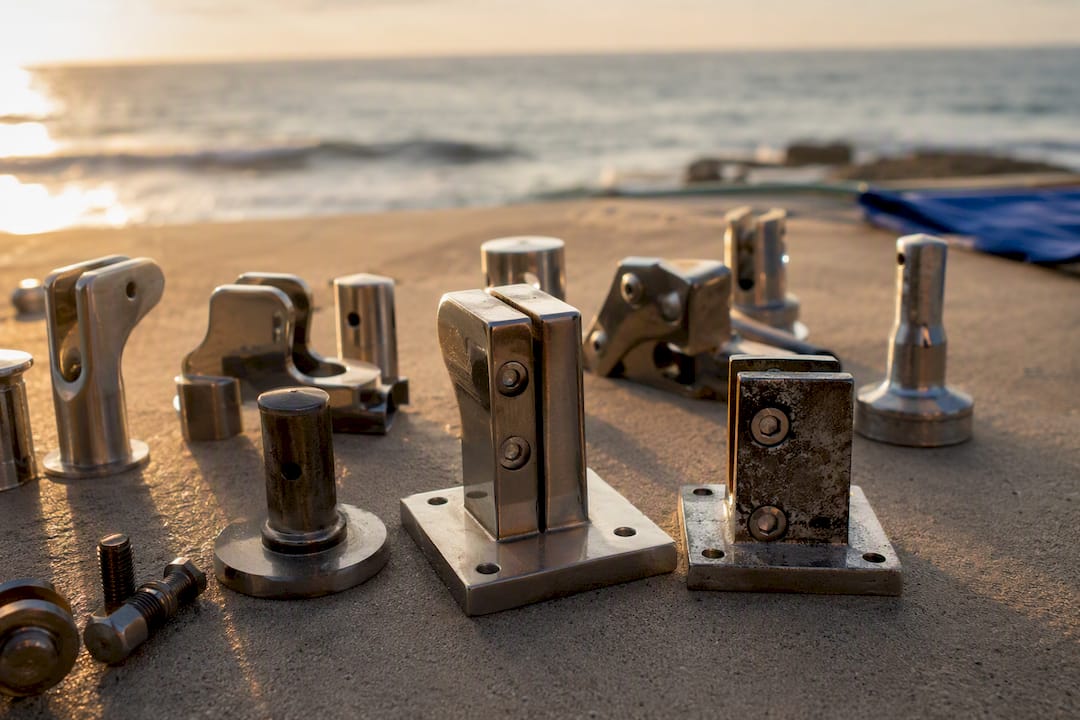
Grade matters more than most spec sheets suggest. Standard 304 stainless resists rust reasonably well inland, but coastal chloride exposure eats through its passive layer faster than owners expect. Step up to 316, and you get added molybdenum that meaningfully improves pitting resistance. For splash zones, exposed fasteners, or anything within a few hundred feet of breaking waves, duplex 2205 offers a materially higher pitting resistance rating (PREN) than either 304 or standard 316, at a strength premium worth paying on structural hardware.
Aluminum forms its own protective oxide layer, which works well in open, well-rinsed areas but struggles in splash zones and tight crevices where salt lingers. For housings, trim, and non-structural parts, engineered polymers like Delrin sidestep the metal-corrosion problem entirely.
Design details that pay off over years:
- Round or chamfered edges instead of tight seams that trap brine
- Sloped surfaces and weep holes so water can’t pool
- Fastener heads oriented to shed water, not collect it
- Minimal metal-to-metal contact where dissimilar alloys meet
Protective Coatings and Finishes: Practical Choices for Different Assets
Coating choice depends on the asset’s exposure and how much field maintenance it will realistically get. Powder coat gives a durable, attractive finish for railings and railing hardware but needs a clean substrate and proper edge coverage to avoid early failure at cut edges. Epoxy primer with a polyurethane topcoat handles structural steel well, especially where UV resistance matters alongside salt resistance. Hot-dip galvanizing remains a reliable choice for structural steel that can’t be easily recoated, as the zinc layer provides sacrificial protection before the base metal corrodes.
A few practical notes:
- Factory-applied coatings consistently outperform field-applied touch-ups on cut edges and welds
- Any scratch through a coating needs prompt touch-up with a matched product, not a generic spray paint
- Zinc-rich primers work well as a base layer under topcoats on high-risk steel components
Looking ahead, self-healing coatings built on metal-organic frameworks and nanoparticle-enhanced zinc-alloy systems show real promise for extending service life on marine steel, though cost and commercial availability still limit widespread use today.
Routine Maintenance: An Executable Schedule for Rinsing, Inspection, and Touch-Ups
Corrosion prevention lives or dies on consistency, not intensity. Coastal homeowners who rinse regularly routinely get longer service life out of exposed metal than those who wait for visible rust, and the fix costs almost nothing compared to replacement.
A schedule that actually gets followed:
- Weekly: Rinse exposed coils, railings, and hardware with low-pressure fresh water to remove salt buildup before it deliquesces.
- Monthly: Walk the property and visually check for early pitting, tea-staining on stainless, or discoloration at welds and fasteners.
- Quarterly: Lubricate moving hardware and touch up any coating nicks or scratches you’ve spotted.
- Annually: Do a closer inspection, including fastener torque checks and photos of vulnerable areas to track changes year over year.
Pro Tip: Photograph the same three or four trouble spots every quarter. Side-by-side comparisons catch early tea-staining long before it’s visible in a single glance.
Skip abrasive pads or acidic cleaners on coated or polished surfaces. They strip the protective layer faster than the salt air would on its own.
Humidity Control and Protecting Enclosed Equipment
A standard 60% to 65% RH target, common in general HVAC and electronics guidance, isn’t always low enough near the coast. If magnesium chloride is present in deposited salt, it can reach deliquescence and start conducting at roughly 33% RH, well below what most enclosure specs assume.
For anything with exposed electronics, sealed IP65 or higher enclosures paired with active RH control exclude salt aerosol entirely and prevent the brine film from forming in the first place.
Practical retrofits worth budgeting for:
- Self-regenerating desiccant systems for continuous coastal loads, since silica gel saturates and stops working without regular swapping
- Sealed enclosures over ventilated ones for control panels, communications gear, and sensitive HVAC controls
- Drip loops and gasket checks on outdoor cabinets to keep intrusion points closed
Galvanic Corrosion: Avoidance and Sacrificial Protection
Dissimilar metals in contact create a galvanic couple, and salt water is an excellent conductor that speeds the reaction dramatically. Aluminum touching stainless steel, or steel fasteners in an aluminum frame, corrodes far faster at the contact point than either metal would alone.
Simple isolation measures prevent most of this:
- Insulating washers and bushings anywhere dissimilar metals meet
- Fasteners matched to the base material, not whatever happens to be on hand
- A dielectric coating or sealant applied at every direct contact point
Where isolation isn’t practical, sacrificial zinc anodes protect the more valuable metal by corroding first. Operational marine programs replace these zincs on a scheduled cadence rather than waiting for visible depletion, treating them as a cheap, expected consumable.
Concrete and Embedded Rebar: Resisting Chloride Ingress
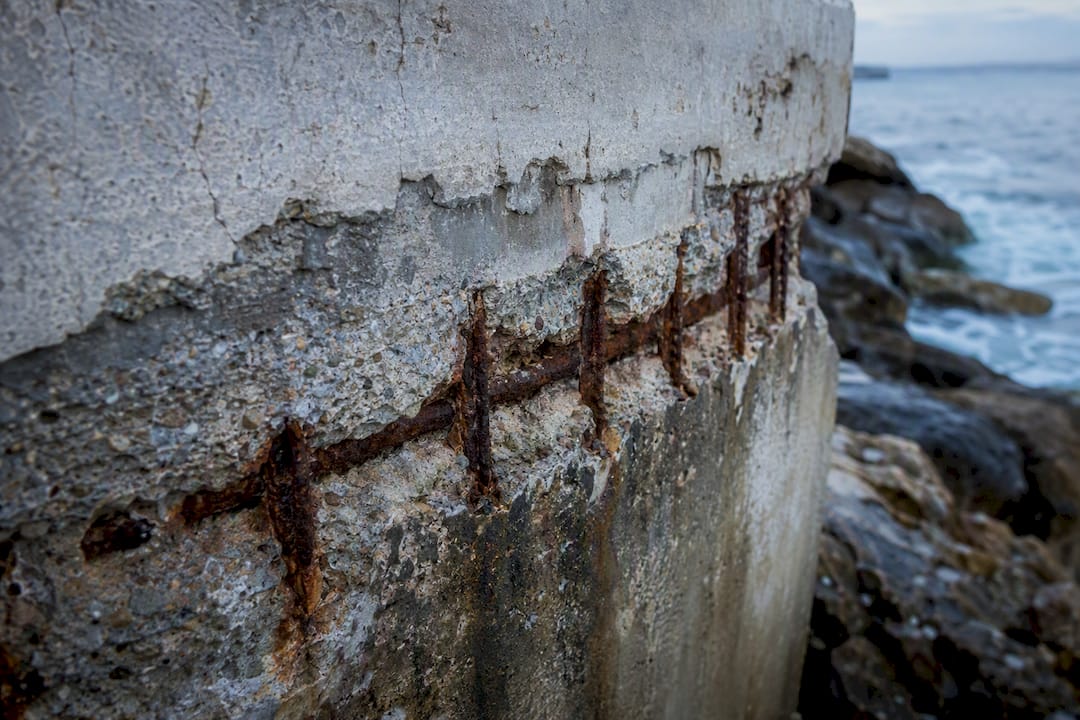
Chloride ions migrate through concrete cover over years, and once they reach embedded rebar, corrosion expands the steel and cracks the surrounding concrete from the inside. Deeper cover and a lower water-to-cement ratio slow that migration significantly. Epoxy-coated or galvanized rebar, along with corrosion-inhibiting admixtures like calcium nitrite, add another layer of defense in new construction. Schedule a structural inspection at the first sign of surface staining, hairline cracking, or spalling near the coastline.
How to Prioritize Interventions: Quick Triage and Budget Choices
Not every fix delivers the same return. Rinse-first assets like HVAC coils and railings need almost no budget, just consistency, and they buy the most time per dollar spent. Protective coatings sit in the middle: a moderate upfront cost that extends component life by years. Full material replacement with 316 or duplex stainless is the long-term fix but makes sense mainly when existing components are already failing or under-specified for their exposure.
- Rinse and inspect first, always, regardless of budget
- Coat or recoat components showing early wear before pitting sets in
- Replace with corrosion-resistant materials once repair costs approach replacement costs
- Bring in a specialist assessment when structural elements or expensive equipment are involved
Glass Railing Store Recommendations for Coastal Railing Systems
Exterior glass railings live in exactly the conditions that punish standard hardware, so 316 and 2205 duplex stainless connectors and posts hold up far longer than 204 or economy-grade fittings that show tea-staining within a season. Rinse panels and hardware weekly, check fastener torque monthly, and touch up any coating nicks before they spread. Glassrailingstore’s coastal durability guidance covers spec choices in more depth, and planning support is available for anyone specifying a new coastal installation.
Why Specification Beats Reaction Every Time
Most corrosion damage isn’t a maintenance failure. It’s a specification failure that maintenance can only slow down, not fix. Choosing the right stainless grade, coating system, and fastener compatibility before installation avoids years of touch-ups that never quite solve the underlying mismatch. Front-loading that decision costs more on day one and less on every day after.
— Fuanne
Get Marine-Grade Railing Hardware Built for Coastal Exposure
Glassrailingstore is the direct source for the corrosion-resistant materials this guide recommends, not just advice about them. Its tempered glass panels and marine-grade connectors, including the 90-degree and wall-mount styles, come in the stainless grades and finishes built to resist tea-staining and pitting in salt air, instead of the standard hardware most suppliers default to.

If you’re specifying a new deck, balcony, or pool fence near the coast, Glassrailingstore’s planning team can help match connector style, glass thickness, and finish to your exposure level before you order. Request a quote through the square caprail corner connector or straight connector product pages, or reach out directly for a full materials recommendation on your project.
Sources
For deeper detail on the science and standards behind this guide, see the USGS overview of coastal salt exposure and ISO 9223 corrosivity categories, the deliquescence research behind humidity thresholds, the Ocean Observatories Initiative’s field-tested anti-corrosion tactics, and advanced coating research from Nature Communications. Property teams managing exterior conduits or raceways may also find this UV-resistant PVC pipe guide useful for nonmetal alternatives.
- Atmospheric Chemistry and Physics (2015) — relevant deliquescence analysis
- Nature Communications / s41529 (2025) — review of advanced corrosion protection technologies
- Ocean Observatories Initiative (2024) — practical anti-corrosion tactics