

How to Remove Hard Water Stains From Glass: Step-by-Step
For most hard water stains on glass, a 1:1 distilled white vinegar and water soak, left on for 10–30 minutes, then scrubbed gently and rinsed, removes the mineral film without any special equipment. Start there. If that doesn’t cut it, here’s where to go next:
- Light buildup (fresh or thin film): Lemon juice or a citric acid solution, 10–15 minutes dwell
- Medium buildup (cloudy, visible haze): Baking soda paste, gentle circular scrub, rinse with vinegar
- Heavy or calcified scale: CLR, Bar Keepers Friend, or a commercial descaler per label instructions
- One rule before anything: Test your chosen cleaner on a small, hidden spot first. Never use abrasive scrubbing pads that can scratch glass permanently.
Key Takeaways
For most hard water stains on glass, a vinegar soak with adequate dwell time removes the mineral film — escalate to Bar Keepers Friend or CLR only when vinegar fails after two full attempts, and squeegee daily to prevent recurrence.
| Point | Details |
|---|---|
| Start with vinegar | A 1:1 vinegar-water spray, 10–30 minutes dwell, handles most light to medium mineral stains. |
| Escalate to BKF or CLR | Bar Keepers Friend and CLR dissolve heavy calcified scale that vinegar can’t shift; follow label safety steps. |
| Dwell time beats scrubbing | Letting acid sit 15–30 minutes breaks mineral bonds more effectively than vigorous scrubbing. |
| Squeegee daily | Wiping glass after every use prevents mineral buildup and dramatically reduces deep-clean frequency. |
| Glassrailingstore for replacement | Permanently etched railing or balcony glass should be replaced with code-compliant tempered panels available at Glassrailingstore. |
Table of Contents
- What hard water stains are — and when they become permanent
- Before you start: safety checks and what you’ll need
- Ranked methods for removing mineral deposits from glass
- How to choose the right method for your stain
- How to tell if a stain is permanent — and what to do next
- Prevention: the habits that keep glass clean long-term
- Expert tips from glass installers and specialists
- What the escalation process actually feels like
- When cleaning isn’t enough: replacement options from Glassrailingstore
- Sources
What Hard Water Stains Are — and When They Become Permanent
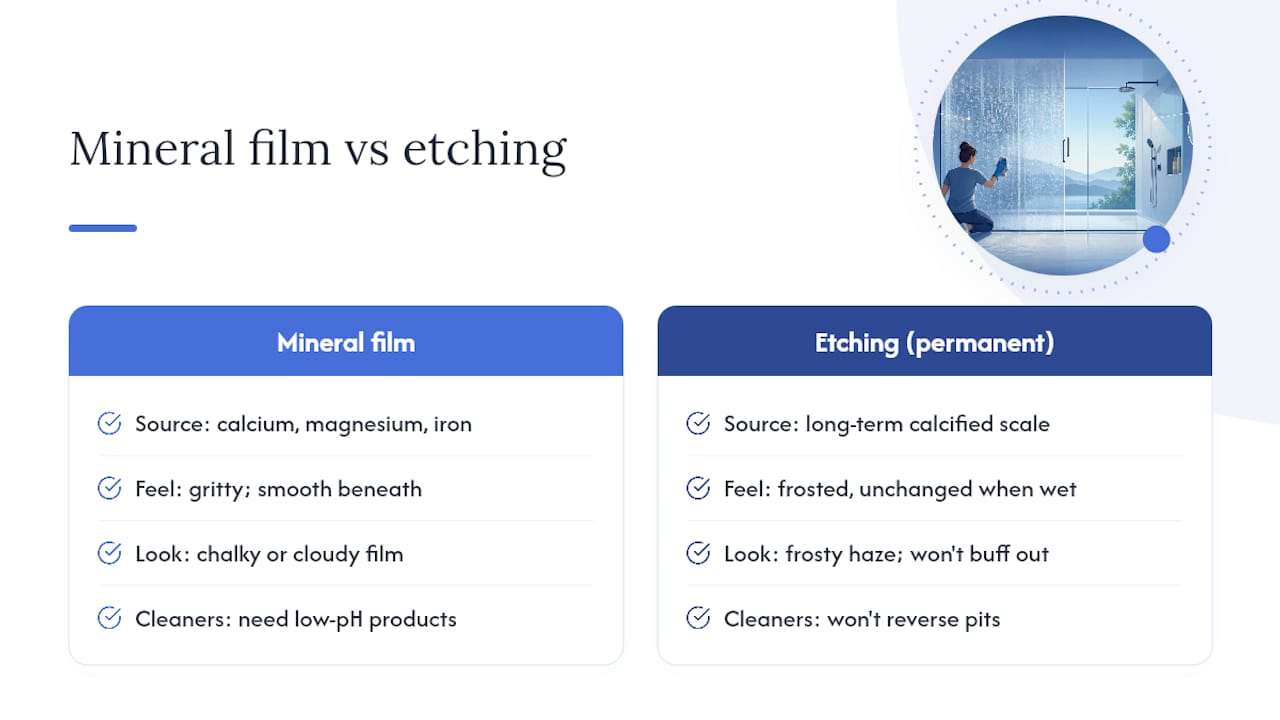
Hard water carries dissolved calcium, magnesium, and iron. Every time water sits on glass and evaporates, those minerals stay behind as a chalky or cloudy film. Repeat that cycle over weeks or months and the deposits build into thick, calcified scale that ordinary glass cleaners can’t touch. Products like Windex are simply too mild for mineral deposits — they lack the low pH needed to break the chemical bond between minerals and glass.
The more serious problem is etching. When mineral scale sits long enough, it doesn’t just coat the glass surface — it chemically pits it. Once that happens, the damage is permanent. No cleaner reverses a pit in the glass itself. That’s the real reason to act early.
Pro Tip: Run a dry fingertip across the cloudy area. A removable mineral film feels slightly rough or gritty but smooth underneath. Etching feels like tiny pits or a frosted texture that remains unchanged when wet. If you see a haze that won’t buff out even after cleaning, you’re likely past the film stage. Stop using harsh acids immediately — they won’t help and may worsen the surface.
Before You Start: Safety Checks and What You’ll Need
Most of what you need is already under the kitchen sink. Gather these before you start:
- Distilled white vinegar (or cleaning vinegar for stronger concentration)
- Spray bottle
- Microfiber cloths and a non-scratch sponge
- Baking soda
- Rubber gloves and safety glasses
- Squeegee
- Magic Eraser (melamine sponge)
- Bar Keepers Friend (powder or liquid)
- CLR or similar commercial descaler
A few safety points that matter: never mix vinegar (an acid) with bleach or any bleach-based cleaner — the combination produces chlorine gas. Work in a ventilated space, especially with commercial products. Acids like vinegar and CLR will damage natural stone surfaces like marble or travertine, so keep them away from stone tile surrounds. And always test in an inconspicuous corner — a lower edge of the shower door or a side panel — before treating the full surface.
Ranked Methods for Removing Mineral Deposits From Glass
These go from gentlest to strongest. Start at the top and escalate only if the previous step doesn’t work after a full dwell time.
Method 1: Diluted Vinegar Spray (Light Stains)
Mix equal parts distilled white vinegar and water in a spray bottle. Spray the glass generously, let it sit for 10–30 minutes, then scrub with a non-scratch sponge using gentle circular motions. Rinse thoroughly and squeegee dry. Warm vinegar works faster — microwave it for 30 seconds before mixing, or soak paper towels in warm vinegar and press them flat against the glass to hold contact. Total time: 20–40 minutes. Cost: under $2.
Method 2: Baking Soda Paste (Medium Stains)
Mix three parts baking soda with one part water to form a thick paste. Spread it over the stained area and let it sit for 5–10 minutes. Scrub gently with a damp non-scratch sponge, then rinse with a vinegar spray to neutralize any residue and add a final acid rinse. The baking soda provides mild abrasion that lifts deposits without scratching glass when you keep the pressure light. Total time: 20–30 minutes. Cost: under $1.
Method 3: Full-Strength Vinegar Soak (Stubborn Medium Stains)
Skip the dilution. Soak paper towels in undiluted cleaning vinegar and press them flat against the glass. Leave them for 20–30 minutes, rewetting if they dry out. Scrub, rinse, and squeegee. The extended contact time does most of the work — dwell time matters more than scrubbing harder. Total time: 35–50 minutes. Cost: $2–$4.
Method 4: Bar Keepers Friend or CLR (Heavy/Calcified Scale)
For scale that vinegar can’t shift, Wirecutter’s hands-on testing found that stronger chemistry like Bar Keepers Friend (oxalic acid) or specialty descalers consistently outperforms gentle home remedies on long-neglected buildup. Wet the glass, sprinkle Bar Keepers Friend, and work it into a paste with a damp sponge. Let it sit 1–2 minutes (no longer — oxalic acid can etch if left too long), scrub gently, and rinse completely. For CLR, follow label directions exactly: apply, wait the stated time, rinse thoroughly. Wear gloves and safety glasses, ventilate the space, and never use either product on stone. Total time: 20–40 minutes. Cost: $5–$12.
Method 5: Melamine Sponge (Magic Eraser) and Mechanical Aids
A Magic Eraser works through micro-abrasion — its fine structure cuts through mineral film without liquid chemistry. Wet it, wring it out, and rub the stained area with light pressure. It’s effective but abrasive, so skip it on coated or treated glass surfaces. A soft-bristle drill brush attachment can help on large shower doors with heavy buildup, but keep the speed low and the pressure minimal. Total time: 10–20 minutes. Cost: $2–$8.
Dwell Times and Cost at a Glance
| Method | Dwell time | Total time | Estimated cost |
|---|---|---|---|
| Diluted vinegar spray | 10–30 min | 20–40 min | Under $2 |
| Baking soda paste | 5–10 min | 20–30 min | Under $1 |
| Full-strength vinegar soak | 20–30 min | 35–50 min | $2–$4 |
| Bar Keepers Friend | 1–2 min | 20–40 min | $5–$10 |
| CLR or commercial descaler | Per label | 20–40 min | $8–$12 |
| Magic Eraser / melamine sponge | None | 10–20 min | $2–$8 |
Comparison: Which Method Fits Your Situation
| Method | Effectiveness | Risk to glass | Best for |
|---|---|---|---|
| Diluted vinegar | Light buildup | Very low | Fresh film, weekly maintenance |
| Baking soda paste | Light to medium | Low (gentle abrasion) | Cloudy haze, soap scum mix |
| Full-strength vinegar soak | Medium | Low | Stubborn film, shower doors |
| Bar Keepers Friend | Medium to heavy | Low to moderate | Calcified scale, neglected glass |
| CLR / descaler | Heavy calcification | Moderate (follow label) | Long-term buildup, windows |
| Magic Eraser | Light to medium | Moderate on coated glass | Quick spot treatment |
Pro Tip: If a method only partially works, don’t immediately jump two steps up the ladder. Repeat the same method with a longer dwell time first — an extra 15 minutes of acid contact often finishes what a short soak started. Escalate only when a full second attempt still leaves visible scale.
How to Choose the Right Method for Your Stain
Matching the method to the stain saves time and protects the glass. Here’s how to read what you’re dealing with:
- Light stain: A faint haze or water spots that appeared recently. The glass looks dull but not cloudy. Start with diluted vinegar — it’ll likely handle it in one treatment.
- Medium stain: A white or gray cloudy film that’s been building for weeks. You can feel slight texture when you run a finger across it. Try full-strength vinegar first, then baking soda paste if vinegar alone doesn’t clear it.
- Heavy stain: Thick, chalky, or crusty deposits. The glass may look nearly opaque in spots. Go straight to Bar Keepers Friend or CLR, following all safety steps.
- Possibly etched: The haze doesn’t change when wet, feels pitted rather than rough, and doesn’t respond to any cleaning. Stop cleaning and read the next section.
The decision flow is simple: if the stain is recent, start gentle. If it’s been sitting for months, skip to medium or strong. If cleaning makes no visible difference after two full attempts, you’re likely dealing with etching, not scale.
How to Tell if a Stain Is Permanent — and What to Do Next
Run this quick check: clean the area as best you can, dry it completely, then hold a flashlight at a low angle across the glass surface. Removable scale catches the light as a cloudy or chalky layer sitting on top. Etching shows as a frosted or matte texture that’s part of the glass itself — it won’t reflect light the same way the surrounding glass does, and it won’t change when you breathe on it or wet it.
If you confirm etching, your options narrow:
- DIY polishing kits: Products like Cerium Oxide glass polishing compounds can reduce the appearance of light surface etching. They require a buffing pad and patience, and results vary. Expect to spend $20–$50 and an hour or more of effort. They work best on very shallow etching.
- Professional glass polishing: A glazing professional can polish out moderate etching using commercial-grade compounds and equipment. Cost typically runs $100–$300 depending on panel size and severity. Not all etching is repairable this way.
- Full panel replacement: Deep etching, structural damage, or panels in safety-critical locations (railings, pool fences, balconies) usually warrant replacement. For railing and glazing applications, tempered safety glass is code-required in most jurisdictions — a polished-but-weakened panel is not a compliant substitute.
Prevention: The Habits That Keep Glass Clean Long-Term
The single most effective thing you can do costs nothing: squeegee the glass after every shower or rinse. Regular maintenance — squeegeeing daily and doing a vinegar rinse weekly — cuts deep-cleaning frequency dramatically and keeps etching risk near zero.
A practical maintenance schedule:
- After every use: Squeegee water off the glass, then wipe the edges and frame with a dry microfiber cloth.
- Weekly: Spray with diluted vinegar, let it sit 5 minutes, rinse, and squeegee dry.
- Monthly: Apply a water-repellent product like Rain-X to the glass surface. It causes water to bead and sheet off, which means far fewer minerals left behind when it evaporates. Protective glass films and coatings work on the same principle for larger or commercial glazing.
- Annually: Inspect seals, frames, and hardware for mineral buildup and clean those zones gently with a soft brush.
For homes in areas with very hard water (much of the Southwest, Midwest, and parts of the South), a whole-house water softener is worth considering. Installation runs $800–$2,500 depending on system size, but it eliminates the mineral problem at the source rather than treating its effects on every glass surface in the house. For renters, a showerhead filter ($20–$50) won’t solve everything but does reduce mineral load meaningfully.
For glass railings specifically, the preventive measures for exterior glass differ slightly from shower glass — sprinkler overspray and weather cycles create their own buildup patterns, and a water-repellent coating applied twice a year makes a real difference.
Expert Tips From Glass Installers and Specialists
Dwell time is the variable most homeowners underestimate. Scrubbing harder on mineral scale that hasn’t been chemically loosened just risks scratching the glass. Let the acid sit and do its job — 15–30 minutes of contact time breaks mineral bonds that 5 minutes of scrubbing won’t touch. This applies to vinegar, citric acid, and commercial descalers alike.
Never use acid-based cleaners on coated or treated glass without checking the manufacturer’s spec first. Some factory hydrophobic coatings are acid-sensitive, and a vinegar soak can strip them. If your glass has a factory treatment, use a pH-neutral cleaner for routine maintenance and reserve acid only for serious buildup after confirming compatibility. Abrasive pads — steel wool, rough scrubbing pads, anything that scratches — are off the table entirely on any glass with a surface treatment. See Glassrailingstore’s guide to protecting glass from scratches for specifics on coated panels.
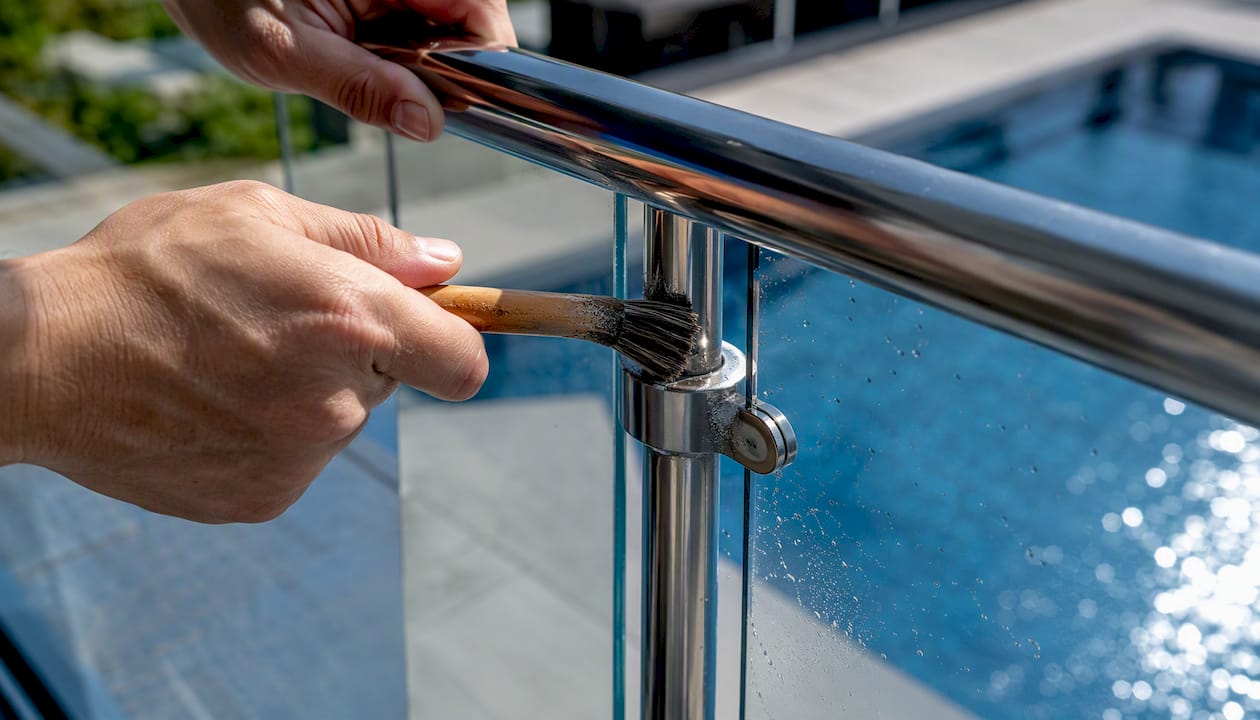
Hardware and trim are where minerals concentrate most. On shower doors and glass railings, the seal between the glass edge and the frame traps water and builds scale faster than the open panel face. Clean those zones with a soft toothbrush or detail brush, dry them thoroughly after cleaning, and check for corrosion on metal hardware. Trapped moisture at metal-to-glass junctions accelerates both mineral buildup and corrosion — a quick dry after cleaning prevents both.
What the Escalation Process Actually Feels Like
Most people start with vinegar because it’s what they have, and for recent stains it works well. The first time you try it on a shower door that’s been neglected for six months, though, you’ll notice it lifts some of the haze but leaves a stubborn ring or patch. That’s normal. The answer isn’t to scrub harder — it’s to rewet the vinegar, cover it with paper towels to hold contact, and wait another 20 minutes. A second full treatment with proper dwell time clears most of what the first pass missed.
Stubborn scale needs time and repeated treatments, not force. If you’ve done two full vinegar soaks and still see heavy buildup, that’s when Bar Keepers Friend earns its place. The chemistry is stronger, the result is faster, and the risk is still manageable if you follow the label. The drill brush and Magic Eraser are useful for large surface areas where hand-scrubbing gets tiring, not for breaking through scale that chemistry hasn’t already loosened.
When Cleaning Isn’t Enough: Replacement Options From Glassrailingstore
If etching has permanently damaged your glass panels — especially on a deck railing, balcony, or pool fence — cleaning is no longer the answer. Glassrailingstore carries code-compliant tempered glass replacement panels designed for exactly this situation, along with the full range of connectors and hardware needed for a clean reinstall.

Tempered safety glass matters here beyond aesthetics. Building codes in most U.S. jurisdictions require tempered or laminated glass in railing and glazing applications — a polished but structurally compromised panel doesn’t meet that standard. Glassrailingstore’s panels are manufactured to those specs, and the site’s planning resources and support team can help you identify the right panel size, connector type, and hardware for your specific installation. Browse replacement panels and hardware at Glassrailingstore, or reach out for a quote on your project.
Sources
- How to Remove Hard Water Stains From Glass
- How To Remove Hard Water Stains From Glass (Even The Cloudy White Spots)
- How to Remove Hard Water Stains From Every Surface | Family Handyman
- I Tried Everything to Clean a Glass Shower Door … Even a Drill | Reviews by Wirecutter
- How to Clean Glass Shower Doors & Hard Water Stains
- How to get rid of water stains
Recommended
- Hard Water Stains on Glass Railings: Expert Removal Tips – The Glass Railing Store
- Removing Stubborn Stains from Glass Railings Without Damaging the Surf – The Glass Railing Store
- Glass Railing Cleaning Guide: Expert Tips for Spotless Results – The Glass Railing Store
- Stainless Steel Tea Staining: Removal and Coastal Spec Guide – The Glass Railing Store