

Heat Effects on Glass Railings: What Actually Happens Outdoors
Heat causes glass to expand slightly, softens some laminate interlayers at high temperatures, and concentrates stress wherever shading, rigid fixings, or trapped moisture create uneven heating. None of that makes glass railings unsafe. It makes the spec matter.
The immediate fix is straightforward:
- Require laminated safety glazing built from heat-strengthened or fully tempered layers, not monolithic tempered glass alone.
- Choose your interlayer deliberately: EVA behaves more consistently across temperature swings than standard PVB or resin interlayers.
- Detail hardware so glass can move: slotted fasteners, flexible gaskets, and correct edge clearance, not a rigid clamp fighting thermal expansion.
Building codes already treat glazed guards as hazardous locations, which is why laminated plus heat-treated glazing is the default for elevated railings, not an upgrade.
Key Takeaways
Laminated safety glazing with heat-strengthened or tempered layers, movement-capable hardware, and requested heat-soak testing together prevent nearly all heat-related railing failures.
| Point | Details |
|---|---|
| Specify laminated, not monolithic tempered | Laminated construction with heat-strengthened or tempered layers meets IBC guard requirements and prevents fragment fall-out. |
| Choose EVA interlayers for wide temperature swings | EVA holds residual load capacity more consistently than resin interlayers from −20°C to +60°C. |
| Detail hardware for movement | Slotted fasteners, correct torque, and flexible gaskets prevent edge stress cracking at fixings. |
| Request heat-soak on high-risk panels | Heat-soak testing screens out nickel-sulfide failures before installation, and must be requested, not assumed. |
| Source compliant panels from Glassrailingstore | Glassrailingstore’s tempered laminated panels support heat-soak requests and code-referenced test certificates. |
Table of Contents
- How Heat and Temperature Swings Change Glass Performance
- How Hardware and Framing React to Heat, and What That Means for Glass
- Can Extreme Heat Cause Thermal Shock in Glass Railings?
- What Do Building Codes Require for Heat-Exposed Glass Railings?
- Design and Installation Practices That Reduce Heat-Related Risk
- How to Spot Heat-Related Damage During Routine Inspection
- Evidence-Based Specification Notes for Spec Writers
- An Editor’s Note on Getting This Right the First Time
- Get Laminated Tempered Panels Built for Real Heat Exposure
- Primary Sources for Further Reading
- Sources
How Heat and Temperature Swings Change Glass Performance
Glass expands when it heats and contracts when it cools, and the trouble starts when one part of a panel does that faster than the part next to it. A railing panel with a shaded bottom edge and a sun-blasted top face is heating unevenly in real time, and that differential is what drives most heat-related stress in outdoor glazing, rather than the average temperature by itself, as explained in this resource on thermal comfort in residential buildings.
Not all glass responds the same way:
- Annealed glass has no heat treatment and breaks into large, sharp shards. Codes generally exclude it from guards entirely.
- Tempered glass is heat treated to be four to five times stronger at the surface, but when it fails, it fails all at once into small pieces, with nothing holding it in the opening.
- Heat-strengthened glass sits between the two, more resistant to thermal stress than annealed but not as brittle-fracture-prone as full tempering.
- Laminated glass bonds two or more layers with an interlayer, so even if one layer cracks, the assembly stays intact in the frame.
Lab testing on temperature-dependent laminated glass behavior found that as panel temperature rises toward +60°C, deflection increases and the ultimate load the panel can carry before failure decreases. The same testing found EVA interlayers hold their residual load capacity more consistently than resin-based interlayers across a range from −20°C to +60°C. That gap matters most in climates where railings swing from winter cold to summer glare, which is most of the country.
How Hardware and Framing React to Heat, and What That Means for Glass
Metal and glass do not expand at the same rate, and that mismatch is where a lot of avoidable damage starts. Aluminum expands roughly twice as fast as glass under identical heat, and stainless steel isn’t far behind. Bolt a glass panel rigidly into a metal channel or pocket base with no room to move, and the panel absorbs the difference at its edges, exactly where glass is weakest.
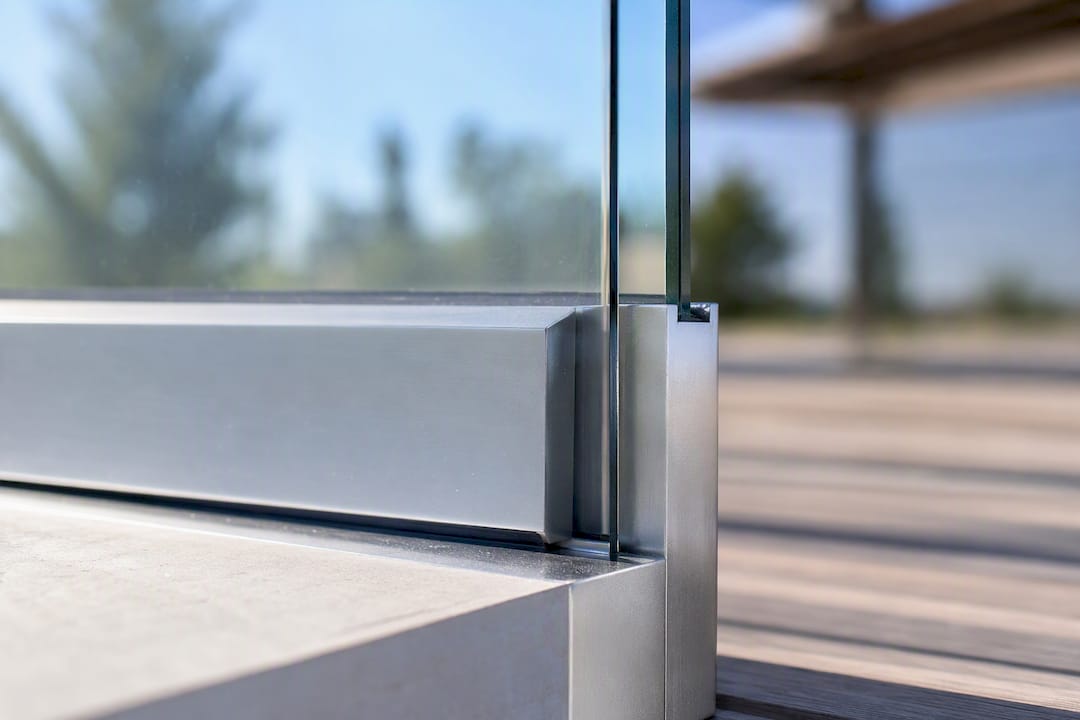
Edge stress from restrained thermal movement shows up in a few predictable ways: hairline edge cracks that start small and creep, chipped corners at point fixings where a bracket was torqued too tight, and stress cracking at the base of pocket-mounted systems where drainage channels trap heat and moisture together.
Good detailing avoids most of this:
- Use slip plates or setting blocks at the base of pocket systems so the panel isn’t gripped rigidly.
- Specify oversized slots at bolted connections rather than tight-tolerance holes.
- Use flexible EPDM or silicone gaskets rated for outdoor UV and heat exposure, not generic rubber.
- Follow manufacturer torque specs on point fixings. Overtightening a stainless standoff is one of the most common installation errors on hot-climate jobs.
Pro Tip: If you’re inspecting an installed panel and the edge gasket looks compressed flat with no give, that’s a sign it was overtightened during installation, and it’s worth loosening and reseating before a hot summer turns it into a crack.
Can Extreme Heat Cause Thermal Shock in Glass Railings?
Yes, and it happens faster than most homeowners expect. Thermal shock occurs when one part of a panel heats or cools much faster than an adjacent part, and the resulting stress exceeds what the glass can absorb. A railing panel that’s half shaded by a patio umbrella, half exposed to direct afternoon sun, or one sitting near a reflective pool surface bouncing extra heat back onto the glass, is a textbook setup for it.
This is different from a slow seasonal swing. Thermal shock is a rapid, localized event, and it’s one of the reasons heat-soak testing exists at the factory level.
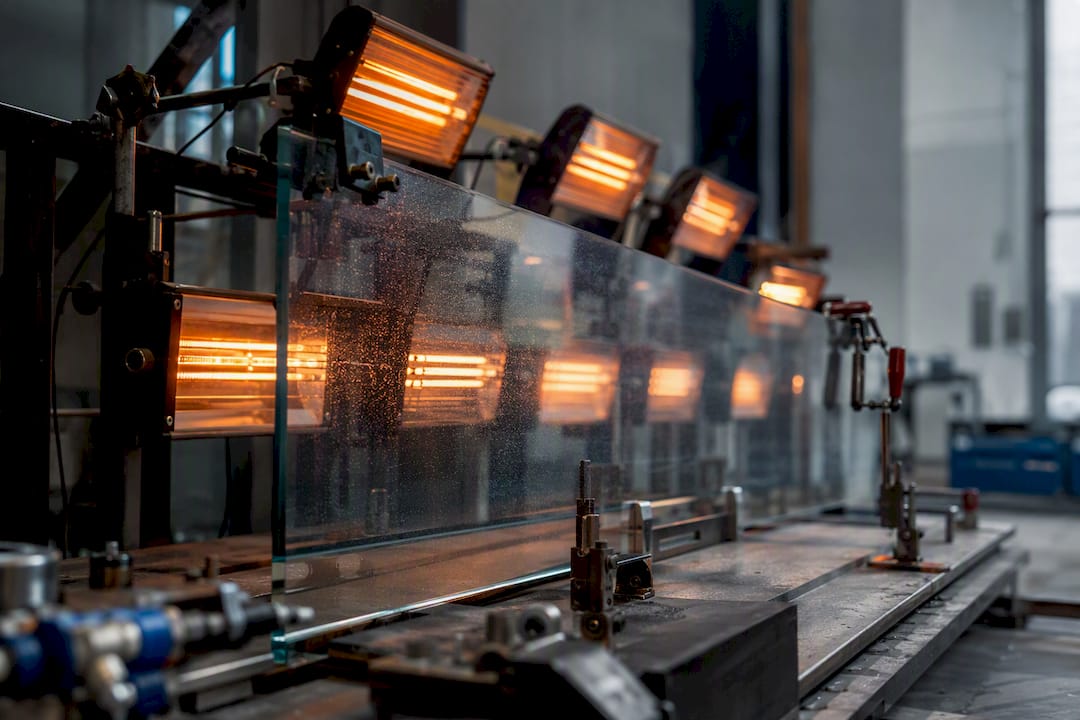
Heat-soaking is a factory process that intentionally stresses high-risk tempered panels before they ever leave the plant, screening out units prone to spontaneous failure from nickel-sulfide inclusions. It’s not something you can retrofit after installation.
Nickel-sulfide inclusions are microscopic impurities that can cause a fully tempered panel to shatter without warning, sometimes years after installation, often triggered by heat. Heat-soak testing forces that failure at the factory instead of on someone’s deck.
Request heat-soak testing whenever a panel is elevated, safety-critical, and exposed to direct sun for extended periods. It’s not standard on every tempered order. You have to ask for it, and it should be noted on the purchase order.
What Do Building Codes Require for Heat-Exposed Glass Railings?
The International Building Code treats all glazing in guards and handrails as a hazardous location, regardless of climate. That classification exists because the code’s real concern isn’t heat resistance in isolation. It’s what happens to people nearby if the panel fails, whatever the cause.
In practice, that means:
- Elevated guards generally require laminated safety glazing built with heat-strengthened or fully tempered layers, not monolithic tempered glass alone.
- Even though tempered glass is strong, code intent is to prevent falling fragments if a panel breaks. That’s why laminated construction is the compliant default, not an optional upgrade.
- Test certificates from the manufacturer, referencing the relevant ANSI Z97.1 or 16 CFR 1201 safety glazing standards, should be kept on file for inspection.
- Reference the code section directly in project specs rather than describing performance loosely. “Laminated safety glazing, heat-strengthened per IBC Chapter 24” reads clearly to a plan reviewer.
A limited exception exists for panels with no walking surface below them within a defined distance, but for nearly every deck, balcony, and stair railing application, treat laminated plus heat-treated as the baseline.
Design and Installation Practices That Reduce Heat-Related Risk
Most heat-related failures trace back to a decision made months before installation, not a freak weather event. Get the specification right and the installation follows naturally.
- Select glass thickness and construction by exposure. South-facing and reflected-heat locations (near pools, light-colored decking) warrant laminated construction with heat-strengthened layers over monolithic tempered.
- Match interlayer to climate. In regions with wide seasonal swings, EVA interlayers offer more consistent load performance than standard PVB across temperature extremes.
- Build in movement allowance. Every fastener, gasket, and pocket detail should assume the panel will expand and contract seasonally, not just settle once and stay put.
- Protect exposed edges. Interlayer edges exposed to direct sun and moisture degrade faster; edge sealant and proper drainage in pocket systems matter more than most installers assume.
- Control installation torque. Point-fixing hardware should be torqued to manufacturer spec, checked again after the first hot season once thermal cycling has occurred.
Pro Tip: Walk the installation again after its first real heat wave, not just at handoff. Thermal cycling reveals loose hardware and compressed gaskets that a cool-weather inspection will miss entirely.
Commissioning in hot weather has one added wrinkle: glass installed at 95°F will contract measurably once temperatures drop, so gaps and reveals that look tight in August can open up by November. Specify clearances for the full range, not the install-day conditions.
How to Spot Heat-Related Damage During Routine Inspection
Regular inspection catches heat damage long before it becomes a safety issue, and it doesn’t require special tools.
- Check edges closely for hairline cracks or small chips, especially near brackets and pocket bases. Thermal cracks often start at an edge and run in a straight or slightly curved line.
- Press gently on gaskets and check for hardening, cracking, or flattening. UV and heat both degrade rubber and silicone over years.
- Test fittings for looseness, particularly stainless standoffs that have gone through several hot and cold cycles.
- Increase inspection frequency for south and west-facing panels, pool-adjacent installations catching reflected heat, and coastal sites where salt air accelerates gasket and hardware wear alongside thermal stress.
A hairline edge crack with no fragment displacement can often wait for a scheduled repair. Any crack that’s spreading, any panel with visible bowing, or any loose fitting on a railing over a walking surface needs a temporary barrier and prompt replacement, not a wait-and-see approach.
Evidence-Based Specification Notes for Spec Writers
Writing defensible spec language means citing the actual mechanism, not just the product name.
- Interlayer choice: Lab testing on temperature-dependent laminated glass behavior found EVA interlayers retain more residual load capacity across −20°C to +60°C than resin/PVB interlayers, making EVA the stronger default for high-exposure guards.
- Heat treatment: Specify laminated construction with heat-strengthened or fully tempered layers for all elevated guards, consistent with IBC Chapter 24’s hazardous-location classification.
- Heat-soak: Add a line item requiring heat-soak testing on tempered layers for safety-critical elevated applications, and confirm it’s documented on the purchase order and test certificate, not assumed as standard.
- Bond quality: Four-point bending studies show that stronger interlayer bonding and appropriate interlayer thickness increase residual load capacity and reduce temperature sensitivity during fracture, so bond quality deserves its own line in the spec, not just glass type.
Comparing laminated versus tempered options side by side before finalizing a spec sheet saves a change order later.
An Editor’s Note on Getting This Right the First Time
Most of the heat-related failures Glassrailingstore hears about didn’t come from bad glass. They came from good glass installed with the wrong hardware detail, or a spec that skipped heat-soak on a panel that genuinely needed it. That gap between material quality and installation discipline is where almost every preventable problem lives.
If you’re drafting a spec, our code compliance guide and glass railing spec reference cover the details worth getting right before you order.
— Fuanne
Get Laminated Tempered Panels Built for Real Heat Exposure
Glassrailingstore stocks tempered laminated panels designed for the exact conditions this article covers: sun-exposed decks, pool surrounds, and elevated guards where code compliance and heat performance both matter.

You can order the 46 inch tempered glass panel built to standard guard heights, request heat-soak testing on your order, and get technical datasheets and test certificates before you finalize a spec. If you’re not sure which interlayer or thickness fits your climate and exposure, our team can walk through the options with you, and for deeper detail on weather performance, our guide on weatherproofing glass railings through seasonal extremes covers what to expect year over year. Request a quote today and put the exact spec language from this article into your purchase order.
Primary Sources for Further Reading
- IBC Chapter 24: Glass and Glazing
- Temperature-dependent laminated glass study
Sources
- International Building Code (IBC) — Chapter 24: Glass and Glazing
- Temperature dependent load bearing capacity of laminated glass panes
Recommended
- Weatherproof Outdoor Glass Railings: Beauty Meets Durability – The Glass Railing Store
- Can Glass Railings Withstand Extreme Weather Conditions? – The Glass Railing Store
- The Science Behind How Glass Railings Resist Impact – The Glass Railing Store
- Weatherproofing Glass Railings: Ensuring Durability Through Seasons – The Glass Railing Store