

Recover 6 Inches Per Foot: Fascia vs Top Mount Railing for Homeowners
Fascia mount is usually the better call when you want maximum usable deck space, clean sightlines, and a glass or stainless cable railing system, but only if the edge structure can take the added load. Top mount is usually the smarter, cheaper choice when your deck edge is thin, unreinforced, or original to an older build, or when budget and speed matter more than reclaiming floor space. Either way, the trade-off comes down to floor space versus edge reinforcement cost, and no decision should get finalized until someone has actually looked at the substrate.
TL;DR:
- Fascia-mount systems reclaim roughly 6 inches of usable deck space per linear foot, which can make a significant difference on narrow balconies or small decks.
- Fascia mounting provides better sightlines and a floating appearance for glass railings, especially in view-focused spaces, but requires a structurally sound edge to handle lateral forces safely.
- Top-mount installations are typically quicker, cheaper, and more forgiving on older or unreinforced edges, making them suitable for budget-conscious or existing decks with unknown framing.
- Reinforcing the deck edge is essential for fascia mount to prevent structural failure, adding cost and complexity if the rim joist or concrete edge is compromised.
- Buyers notice unobstructed views and sleek finishes, with fascia-mounted glass railings enhancing resale appeal, though proper documentation of reinforcement increases confidence during inspections.
Table of Contents
- Fascia Mount vs Top Mount Railing: What Each Term Actually Means
- Fascia Mount vs Top Mount: The Trade-Offs That Actually Matter
- How Much Deck Space Does Fascia Mount Actually Recover?
- Why Fascia Mount Demands a Stronger Edge
- What Drives Installation Time and Cost
- A Quick Checklist Before You Choose a Mount
- Matching Products to Mounting Method
- Does the Mounting Method Affect Resale Value?
- An Honest Take on Choosing Between the Two
- Get a Quote Built Around Your Mounting Method
- Sources
- FAQ
Fascia Mount vs Top Mount Railing: What Each Term Actually Means
The industry uses more precise language than “fascia” and “top mount,” and it helps to know it before you start calling contractors.
Top-mount (also called surface-mount) means the post sits on a base plate bolted directly to the deck surface, the same way a fence post sits on a concrete footing. Fascia-mount (side-mount) means the bracket bolts to the vertical face of the rim joist or slab edge instead, so the post never touches the walking surface at all. Both approaches show up constantly in railing mounting method guides, which break the category into three broad types: top-mount, fascia/side-mount, and core-drill.
Glass railing systems add a few more specific fixings worth knowing:
- Spigots — round or square posts that clamp the glass panel from below, typically bolted through a base plate (top-mount) or bracket (fascia-mount).
- Base channels — a continuous U-shaped track that the glass panel slides into, spreading load along the entire run rather than at discrete points.
- Standoffs — through-glass fasteners used mostly on frameless systems where the panel needs a mechanical grip beyond the base.
- Core-drilling — boring a hole into concrete to set a post or spigot below grade, common on poured slabs and pool decks.
The physics is simple even when the hardware isn’t: top-mount sends load straight down into the deck framing below the post. Fascia-mount sends load sideways and slightly upward, pulling on the edge of the joist or slab. That single difference explains almost everything else in this comparison.
Fascia Mount vs Top Mount: The Trade-Offs That Actually Matter
Here’s how the two methods stack up on the things homeowners actually care about when they’re standing on their deck trying to decide.
- Usable space. Fascia mount wins outright. Moving posts off the deck surface and onto the edge reclaims floor area you were losing to baseplates and post footprints.
- Sightlines and appearance. Fascia mount again, especially with glass panels. Posts disappear below the top plane, and from a few feet back the railing reads as a floating pane rather than a fenced-in perimeter.
- Typical cost. Top-mount is generally cheaper because it needs only a sound surface and standard anchors. Fascia-mount costs climb fast once reinforcement or custom brackets enter the picture.
- Waterproofing risk. Fascia-mount protects a waterproofed deck surface better, since it avoids drilling through membranes that a top-mounted baseplate would penetrate.
- Maintenance. Both need periodic checks, but for different reasons: top-mount base seals can fail and let water into the framing below, while fascia-mount brackets need inspection for corrosion or loosening at the anchor points.
A few special cases deserve their own line. On commercial decks and rooftop bars, every square foot of reclaimed floor space translates into more seating or foot traffic, so fascia mount’s space advantage compounds into real revenue. On historic decks with unknown or deteriorated framing, top-mount is often the only responsible choice until an engineer signs off on the edge condition. And on any deck with a waterproof membrane roof deck assembly underneath, fascia mount is frequently the deciding factor precisely because it doesn’t touch that membrane.
Glass and cable systems tend to gravitate toward fascia mounts for a reason: both rely on unobstructed sightlines to do their job, and a post sitting in the middle of the walking surface undercuts the entire point of a frameless look.
How Much Deck Space Does Fascia Mount Actually Recover?
The commonly cited rule of thumb is that fascia-mounted railing recovers about 6 inches of usable floor per linear foot compared to a top-mounted system on the same run. That number sounds small until you run it across a real deck.
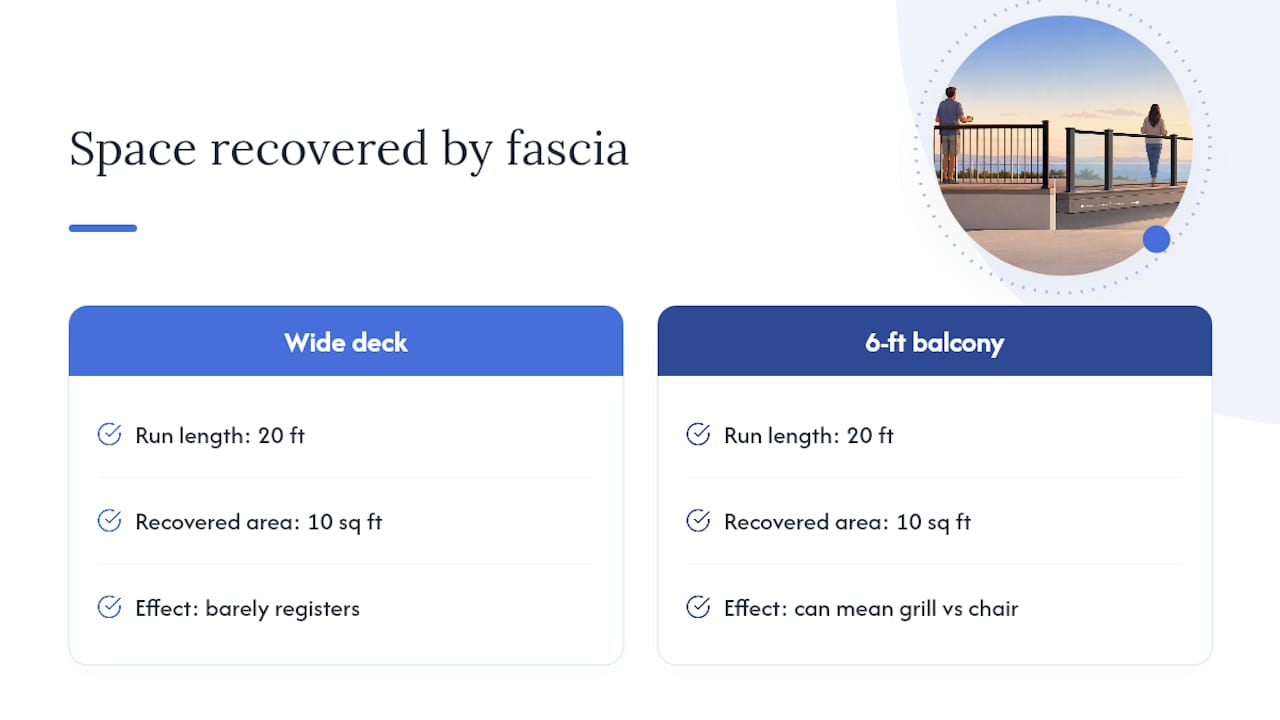
Moving posts off the deck surface can recover several square feet of usable floor space over typical railing runs, which may be significant on narrow balconies or commercial patios.
On a wide suburban deck with 20 feet of clearance to the yard, 10 recovered square feet barely registers. On a 6-foot-wide condo balcony, that same 10 square feet can be the difference between fitting a grill and a chair or fitting nothing at all.
Glass amplifies the perceived gain beyond the raw square footage. Because the panel has no visible post interrupting the top plane, the eye reads the whole deck as open rather than segmented by a rail. That’s a visual effect on top of the physical one, and it’s why designers push fascia mount hardest on narrow, view-critical spaces where every inch of both floor and sightline counts.
Why Fascia Mount Demands a Stronger Edge
The load path is the whole story here, and it’s worth understanding before you fall in love with a floating glass rail you can’t actually install.
Top-mount transfers load straight down through the base plate into whatever framing sits directly under the post: a joist, a beam, or a slab. That’s a forgiving path because most deck framing is built to carry downward loads already. Fascia-mount introduces lateral and pull-out forces at the rim joist or slab edge, a location that was rarely engineered to resist a person leaning on a railing.
That’s why fascia-mount installations often require reinforcement that a top-mount job skips entirely. Common fixes include:
- Sistering or blocking the rim joist with additional lumber to spread the load.
- Bolting a steel angle or plate along the edge to stiffen thin or aging framing.
- Thickening or replacing the rim joist entirely on older wood-framed decks.
- Repairing spalled or cracked concrete edges before drilling anchors on slab or podium decks.
Warning signs that an edge isn’t ready for fascia mounting include visibly spalled or crumbling concrete, a rim joist that flexes when pushed, or a thin topping slab over structural concrete. Any of those should stop the project until someone qualified takes a look.
Pro Tip: Ask any contractor quoting a fascia-mount glass railing for the anchor pull-out test data or engineering letter for the specific bracket they’re proposing. A bracket rated for one substrate type won’t necessarily perform the same on another.
Most residential top-mount jobs don’t trigger a permit review beyond the standard deck guardrail requirements. Fascia-mount jobs on commercial buildings, multifamily properties, or any structure where the edge condition is questionable usually do, and that’s the point where a structural designer or your local building inspector needs to get involved before hardware gets ordered.
What Drives Installation Time and Cost
Cost on either mounting method depends far more on substrate condition than on a flat per-foot rate, and the two methods diverge sharply once reinforcement enters the equation.
- Edge reinforcement is the single biggest cost swing for fascia mount. A sound rim joist costs nothing extra; a rotten or undersized one can add substantial framing work before a bracket ever gets installed.
- Custom brackets for non-standard fascia thickness or unusual railing materials add both material cost and lead time compared to stock top-mount base plates.
- Waterproofing details matter most where fascia mount is chosen specifically to protect a membrane. Flashing and sealant work around the bracket penetrations add labor hours.
- Coring labor applies mainly to concrete and slab decks, where drilling accurate, code-compliant holes takes specialized equipment and experience.
- Finish work — patching, painting, or matching decking around posts — tends to run higher for top-mount since the post interrupts the visible surface in more places.
Top-mount installation is generally quicker and more forgiving for the same reason it’s cheaper: shimming a base plate covers for minor framing inconsistencies that would stop a fascia-mount job cold.
A competent DIYer with basic tools can handle a straightforward top-mount install on sound wood framing. Fascia mount on glass or cable systems, especially anything involving edge reinforcement, concrete coring, or waterproofing tie-ins, is where hiring a specialized trade or getting an engineered detail stops being optional.
A Quick Checklist Before You Choose a Mount
Walk your deck with this list before you call anyone for quotes.
- Measure actual usable width. Under 8 feet, the fascia mount’s space gain starts to matter a lot.
- Inspect the rim joist or slab edge for rot, spalling, or flex. Any sign of weakness pushes toward reinforcement or top-mount.
- Check for a waterproof membrane underneath. If one exists, fascia mount protects it; top-mount risks puncturing it.
- Decide how much you value unobstructed sightlines, especially with glass or cable rail.
- Set a budget band before quoting. Reinforcement costs can shift a project significantly.
As a rough mapping: three or more “yes” answers to edge soundness, view priority, and membrane presence point toward fascia mount. Three or more “yes” answers to unknown framing, tight budget, or an older deck with no documentation point toward top-mount.
Matching Products to Mounting Method
Product lines map directly onto these two mounting approaches. Framed and semi-frameless panels typically pair with either top-mount base plates or fascia brackets depending on the frame profile, while frameless glass systems using spigots and base channels lean heavily toward fascia mounting to get that clean, uninterrupted top plane.
Before ordering hardware for a fascia mount project, request the bracket’s anchor specifications, any available pull-out test reports, and installation drawings showing exact bolt patterns for your fascia thickness. Guides on surface mounting for glass railings and wood deck attachment walk through what documentation to have on hand for either method.
Does the Mounting Method Affect Resale Value?
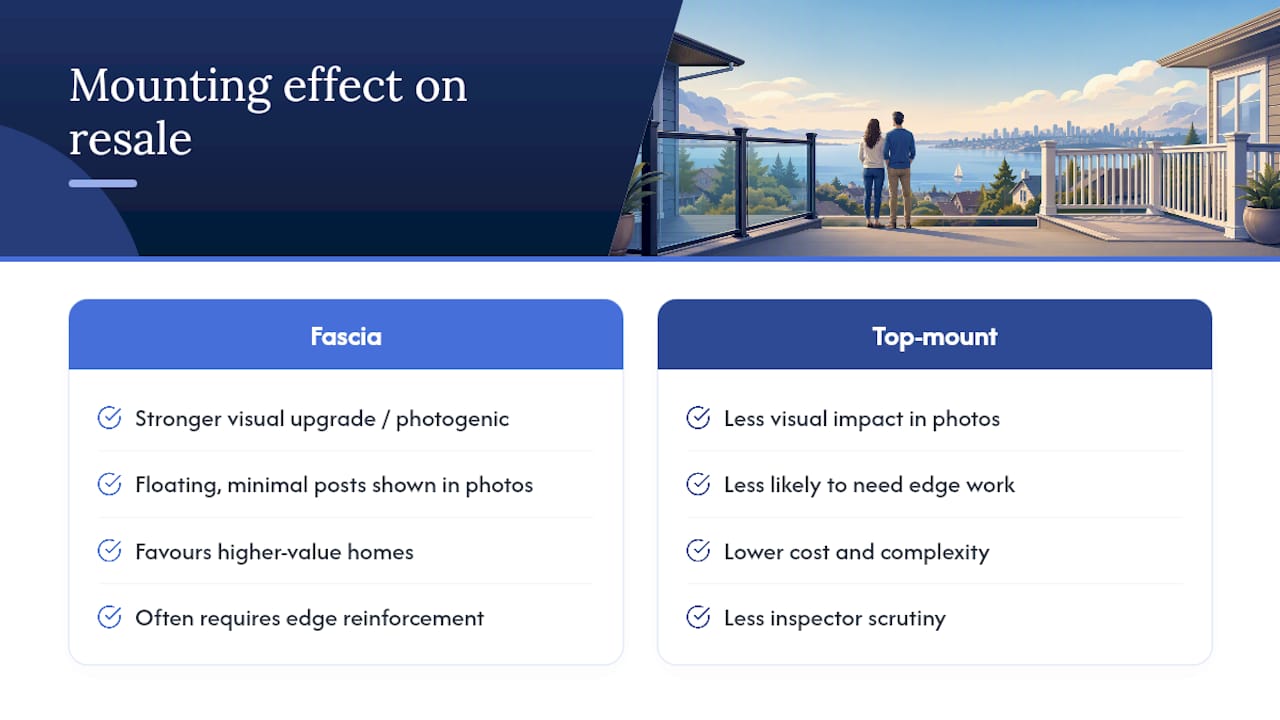
Buyers don’t ask “is this top-mount or fascia-mount” during a walkthrough, but they absolutely notice the results. A deck with unobstructed sightlines and no posts breaking up the floor plane reads as more finished and more expensive, even to someone who couldn’t name the hardware behind it.
Real estate listings that show glass railings with a floating, minimal-post look tend to photograph better, and photos are what get a listing clicked on before anyone ever walks through the door. That’s a real advantage for fascia-mounted glass on decks and balconies attached to higher-value homes, where the railing is essentially a visible design feature rather than a background safety element.
The flip side matters too. A visibly reinforced edge, patched concrete, or an obviously retrofitted bracket detail can raise questions during an inspection, even when the work was done correctly. Buyers and their inspectors tend to scrutinize anything that looks like a structural modification, so documentation of the reinforcement work, permits pulled, or an engineer’s sign-off becomes part of the resale story whether you planned for it or not.
Top-mount railing doesn’t carry the same scrutiny because it rarely requires edge modification, but it also doesn’t deliver the same visual upgrade. For a straightforward rental property or a starter home, that trade-off often favors top-mount’s lower cost and lower complexity. For a home where the deck or glass balcony railing is a genuine selling feature, the aesthetic case for fascia-mounted glass is hard to ignore, provided the edge work was done right and documented.
An Honest Take on Choosing Between the Two
Fascia mount earns its reputation on narrow decks, premium glass installations, and any project where the view is the whole point, but only when the edge is genuinely sound. Top-mount deserves more respect than it gets. On an older deck with unknown framing, on a tight budget, or on a project that just needs a safe, code-compliant rail without a renovation attached to it, top-mount is the sensible default, not the compromise.
When the edge condition is uncertain, err toward engineering review and a permit check rather than guessing. Walk the deck, check the joist, and get a straight answer before you fall for a floating glass rail your framing can’t support.
— Fuanne
Get a Quote Built Around Your Mounting Method
Glassrailingstore sells the same framed, semi-frameless, and frameless glass railing systems whether your project calls for top-mount or fascia-mount hardware, so you’re not stuck choosing a supplier based on which mounting style they happen to stock. Framed systems run $100 to $130 per linear foot, semi-frameless runs $165 to $250 per linear foot, and DIY glass panel kits run $60 to $130 per linear foot, all detailed on the glass railing cost page.

If your deck edge checks out and you’re leaning toward a frameless fascia-mounted look, request a frameless glass railing quote and ask design support for the bracket specs and anchor documentation your contractor or inspector will want to see. Nationwide shipping and a support team that answers planning questions before you order make it easier to get the mounting decision right the first time.
Sources
- 3 Reasons to Use Fascia Mounted Railing on Your Deck Project - gb&d
- 4 Advantages of Fascia-Mounting Your Railing System - Bay Area Cable Railing
Always confirm final specs with a structural designer or your local building inspector before ordering hardware.
FAQs
1. What Does Fascia Mount Mean?
Fascia mount means the railing bracket bolts to the vertical face of the deck’s rim joist or slab edge instead of sitting on top of the deck surface. It’s also called side-mount, and it keeps posts off the walking plane entirely.
2. What Is the Top Rail of a Railing Called?
The top rail is simply called the handrail or top rail, the horizontal piece that caps the posts or glass panels and is the part people actually grip. It’s separate from the mounting method, which refers to how the posts or panels attach to the deck structure below.
3. What Type of Porch Railing Is Best?
There’s no single best type; it depends on your porch’s edge condition, budget, and desired look. A sound, reinforced edge with a view worth preserving favors fascia-mounted glass or cable rail, while an older porch with unknown framing usually favors a top-mounted wood or metal rail for simplicity and lower cost.
4. What Type of Deck Railing Is the Most Secure?
Security depends on correct installation and adequate reinforcement more than on the material or mounting method itself. A properly engineered fascia-mount system on a sound edge and a properly anchored top-mount system on solid framing are both secure; the risk comes from skipping reinforcement or anchor verification, not from the mounting style itself.