

Top pool fence safety features every homeowner needs
Choosing a pool fence sounds straightforward until you realize it sits at the intersection of life safety, local code compliance, and the visual appeal of your outdoor space. Get it wrong and you face fines, liability, or worse. Get it right and your backyard becomes both beautiful and genuinely secure. This guide walks you through the must-have features of a compliant, effective pool fence, backed by research and field-tested insights, so you can make a confident, informed decision rather than guessing at what “safe enough” looks like.
Table of Contents
- Core safety criteria for pool fences
- Self-closing and self-latching gates
- Isolation fencing: Why four-sided fences matter
- Aesthetics and ongoing compliance: Hidden safety risks
- Why most pool fences miss the mark: Lessons from field experience
- Upgrade your pool fence for safety, compliance, and style
- Frequently asked questions
Key Takeaways
| Point | Details |
|---|---|
| Minimum height matters | Pool fences must meet height and gap standards to be effective and legal. |
| Gates are a weak link | Self-closing and self-latching gates prevent most access failures and are required by code. |
| Isolation fencing prevents accidents | Four-sided fences greatly reduce drowning risk and protect young children. |
| Inspection is ongoing | Seasonal checks are essential as terrain and hardware change over time. |
| Smart design enhances safety | Modern materials let you combine aesthetics and compliance with no compromise. |
Core safety criteria for pool fences
To understand what features actually matter, let’s start with the fundamental safety criteria every pool fence should meet.
The physical dimensions of your fence are not suggestions. They are the first and most measurable line of defense between a curious toddler and open water. The ISPSC barrier envelope covers four core dimensions: height, limited openings, climb resistance, and bottom and top clearance control. Each one closes a specific vulnerability.
Here is what the baseline numbers look like under the 2021 International Swimming Pool and Spa Code (ISPSC):
| Requirement | Minimum standard |
|---|---|
| Barrier height (exterior side) | 48 inches |
| Maximum gap size (sphere test) | 4 inches |
| Horizontal footholds (lower zone) | None within 45 inches |
| Bottom clearance | 2 inches maximum |
These numbers exist because drowning prevention modeling consistently shows that small access gaps and climbable surfaces are the two most exploited weaknesses in residential pool barriers.
Key safety criteria to verify before and after installation:
- Height: Measured on the exterior (pool side) of the fence, not from inside the yard
- Gap size: Every opening must fail the 4-inch sphere test, meaning a 4-inch ball cannot pass through
- Climb resistance: No horizontal rails, decorative lattice, or footholds within the lower 45 inches
- Bottom clearance: Ground to fence bottom must stay at or below 2 inches, even after settling
- Top clearance: Overhead obstructions like tree branches or furniture must not reduce effective barrier height
When comparing materials, the differences become clear quickly. Learn more about how glass vs. wood or metal barriers perform across these criteria over time. Glass, for example, has no horizontal rails to climb and no gaps that widen with age.
Pro Tip: After any major storm or landscaping project, walk the perimeter of your pool fence with a tape measure. Ground settling and new mulch layers are the two most common reasons a fence quietly falls out of compliance between inspections.
For a deeper look at how these standards apply to your specific project, review the building code standards that apply to glass railing and pool barrier installations.
Self-closing and self-latching gates
Beyond the barrier itself, gates are the most commonly overlooked weak spot in pool fence safety.
A gate is not just a door. It is the single point in your barrier that opens and closes dozens of times a week, handled by kids, guests, and contractors who may not understand the stakes. Compliant pool barriers require self-closing and self-latching gates with specific latch positioning and outward swinging away from the pool. That outward swing matters because it means a child pushing against the gate from the pool side cannot accidentally open it.
Here is a step-by-step checklist for evaluating your gate hardware:
- Swing direction: The gate must swing away from the pool, not toward it
- Self-closing mechanism: A spring-loaded or gravity hinge must return the gate to closed position without any manual help
- Self-latching function: The latch must engage automatically every single time the gate closes, not just most of the time
- Latch height: The release mechanism must be at least 54 inches from the ground, or placed on the pool side of the fence where a child cannot reach through to access it
- Hardware material: Stainless steel or powder-coated aluminum resists the corrosion that causes latching failures over time
- Periodic testing: Push the gate open and walk away. If it does not close and latch on its own within three seconds, the hardware needs adjustment or replacement
“A fence is only as secure as its gate.”
This is not a cliché. It is the single most important thing to remember about pool safety. A perfectly built 6-foot barrier with a broken latch is functionally no barrier at all.
Pro Tip: Choose hardware designed for high resistance to corrosion and UV exposure. Marine-grade stainless steel hardware is the gold standard for pool environments because it holds its mechanical function even after years of chlorine exposure and direct sun.
For reliable hardware options, explore gate latch choices and corner gate latches designed specifically for pool environments. If you are building from scratch, gate panel options pre-drilled for hinges, latches, and floor locks simplify installation and reduce alignment errors.
Isolation fencing: Why four-sided fences matter
Once you have chosen compliant materials and hardware, the fence’s placement is just as critical to safety.
Most homeowners think about the fence as a visual boundary around the pool. But the real question is: what does the fence isolate the pool from? A three-sided fence that uses the back wall of your house as the fourth side still leaves a major access point. Anyone walking out a sliding glass door or back patio door goes directly into the pool area without crossing a barrier.
Four-sided isolation fencing surrounds the pool on all sides, separating it from the house as well as the yard. The difference in safety outcomes is dramatic.
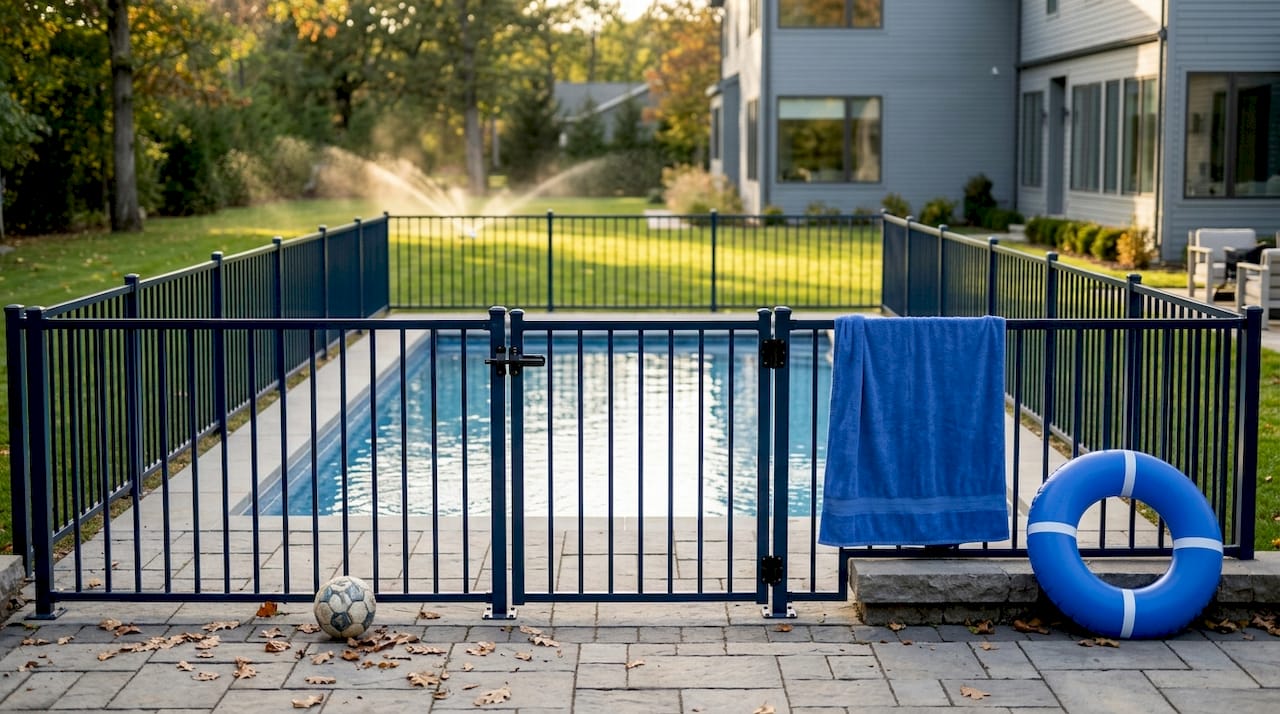
| Fence type | Odds ratio for child drowning |
|---|---|
| Four-sided isolation fencing | 0.17 (83% reduction) |
| Three-sided perimeter fencing | Baseline (no meaningful reduction vs. unfenced) |
| No fencing | 1.0 (reference) |
An odds ratio of 0.17 means a child in a yard with four-sided fencing is roughly 83% less likely to drown compared to a yard without it. That is not a marginal improvement. That is a fundamental change in risk.
The numbers behind this are sobering. BMJ Injury Prevention modeling estimates that proper use of swimming pool isolation fencing could prevent an estimated 51 drowning deaths per year among children under 5 in the United States alone. When combined with other safety assumptions, that figure rises to an estimated 348 preventable drowning deaths per year nationwide.
Key points about isolation fencing placement:
- The fence must physically separate the pool from any door or window that opens to the pool area
- Doors in the house that lead directly to the pool zone must be alarmed or have self-closing, self-latching hardware equivalent to gate standards
- The fence should not share a boundary with a deck or patio that is accessible from inside the home without crossing the barrier
For a visual understanding of how isolation fencing is positioned relative to pool and home layouts, visualizing pool fencing with 3D rendering tools can help you plan before you build.
Aesthetics and ongoing compliance: Hidden safety risks
Safety does not end with installation. Appearance and maintenance are ongoing factors in real-world performance.
This is the part most homeowners do not think about until something goes wrong. A fence that was perfectly compliant on installation day can quietly drift out of compliance over the following months. The most common security failures are not design flaws. They happen because the installed barrier stops closing and latching reliably, or because the bottom clearance and opening geometry shift as the yard settles, mulch builds up, or gate hardware wears.
Common hidden compliance risks to watch for:
- Mulch and soil buildup: Adding fresh mulch around fence posts can raise the ground level enough to create a foothold or reduce bottom clearance violations
- Decorative additions: Planters, trellises, or decorative panels added near the fence can create climbable surfaces that were not there at inspection
- Grass growth: Thick turf near the fence base can effectively close the bottom clearance gap, but it can also create an uneven surface that lifts the fence unevenly over time
- Hardware wear: Spring hinges lose tension. Latch mechanisms corrode. Both failures are invisible until the gate stops working
- Ground settling: Post footings shift over years, especially in freeze-thaw climates, which can tilt panels and change gap dimensions
Material choice plays a big role in how much maintenance you will actually do. Wood warps, splits, and creates gaps that were not in the original design. Metal can rust and weaken at connection points. Tempered glass panels, by contrast, do not warp or corrode, which means the geometry you install is the geometry you keep.
For property managers or homeowners in regulated jurisdictions, understanding local code specifics helps you stay ahead of inspection cycles rather than scrambling to fix issues after the fact.
Pro Tip: Build a seasonal inspection checklist and walk your pool fence every spring and fall. Check bottom clearance with a tape measure, test the gate latch five times in a row, look for new footholds, and document what you find. This takes less than 20 minutes and gives you a defensible record if a compliance question ever comes up.
Why most pool fences miss the mark: Lessons from field experience
Here is an uncomfortable truth: most pool fence failures are not caused by homeowners who ignored safety. They are caused by homeowners who installed a compliant fence, checked the box, and never looked at it again.
The code is a starting point, not a finish line. A fence that passes inspection on day one can fail within 18 months if nobody is watching. Spring hinges lose their return force. Latch strikes shift as posts settle. Mulch gets added. A decorative pot gets placed next to the fence because it looks nice. None of these feel like safety decisions in the moment. All of them add up.
What field experience consistently shows is that the gap between “compliant at installation” and “compliant right now” is wider than most homeowners realize. Inspectors check at one point in time. You live with the fence every day. That means the ongoing responsibility is yours, not the inspector’s.
The gold standard is not just professional installation. It is professional installation combined with owner-led seasonal checks. These two things together catch the problems that neither party would catch alone. An installer cannot predict how your specific soil will settle or how your landscaper will mulch next spring. But you can walk the fence line with a tape measure twice a year and catch those issues before they become accidents or fines.
Another overlooked factor is the psychological effect of a visible, well-maintained fence. A glass barrier that is clean, upright, and clearly intact sends a signal to every adult in the yard that this space is managed and monitored. A sagging, rusted, or visibly worn fence sends the opposite signal. Safety culture in your household starts with what the fence looks like and how seriously you treat it.
For those navigating regional rules, regional compliance insights can clarify what your jurisdiction requires beyond the national baseline.
Upgrade your pool fence for safety, compliance, and style
Ready to act on what you have learned? The right pool fence does not force you to choose between safety and aesthetics. Modern glass railing systems deliver both, with tempered glass panels that meet code requirements, marine-grade hardware that holds up in pool environments, and a clean look that keeps your sightlines open.

At Glass Railing Store, you will find everything you need to build or upgrade a compliant, beautiful pool barrier. Start with the glass railing compliance guide to confirm what your project requires, then browse code-compliant glass panels built to meet barrier height and strength standards. Pair them with reliable gate latches engineered for self-latching performance in outdoor conditions. Whether you are planning a new installation or addressing gaps in an existing fence, the products and resources are here to help you get it right the first time.
FAQs
1. How high should a pool fence be to meet 2026 standards?
Most codes require a pool fence to be at least 48 inches high on the exterior side, and some local jurisdictions require even greater heights for additional protection. Always verify with your local building department since state and municipal codes can exceed the national baseline.
2. What type of pool fencing is most effective at preventing accidents?
Four-sided isolation fencing that fully separates the pool from the home is the most effective design for reducing accidental access and drowning risk. Three-sided fencing that uses the house wall as the fourth boundary provides significantly less protection.
3. How often should safety features like gates and hardware be checked?
Inspect gates and hardware at least twice a year and after any major weather event to ensure continued compliance and reliable function. The most common compliance failures involve hardware wear and ground settling that develop gradually between formal inspections.
4. Can beautiful pool fences also be compliant and safe?
Yes. Modern tempered glass panels combine clean, open aesthetics with full code compliance when installed and maintained correctly. Glass also eliminates common compliance risks like horizontal footholds and warping gaps that affect wood and metal alternatives.
Recommended
- Why glass barriers beat wood and metal for outdoor safety – The Glass Railing Store
- Nebraska Building Code for Glass Railings: Safety & Compliance Guide – The Glass Railing Store
- Nevada Building Code for Glass Railing – The Glass Railing Store
- Montana Building Code for Glass Railings – The Glass Railing Store
- Fixings in building safety: essential guide for secure structures – Aussie Nails and Fasteners Warehouse