

40–80% Less Wind with Glass Windscreens for Decks, Plus Safety Specs
Yes, a glass windscreen for deck spaces is one of the few upgrades that solves wind exposure without blocking the reason you built the deck in the first place: the view. Expect roughly a 40–80% cut in wind speed depending on panel height, plus real costs for tempered glass and anchoring. Start by mapping your protected zone, then check structural requirements before ordering panels from a suitable supplier.
TL;DR:
- Frameless tempered glass panels offer the best unobstructed view but are more expensive and require proper structural support to handle wind loads.
- Wind protection effectiveness depends heavily on panel height and placement, with 48-inch panels creating a calm zone of about 12 to 20 feet downwind.
- Corner and staggered panel configurations outperform straight runs, especially on decks exposed to shifting wind directions, improving overall wind reduction.
- Structural considerations, including anchor capacity and local guardrail height rules, are critical to prevent failure, especially on elevated decks.
- Regular cleaning and hardware checks, preferably with marine-grade materials, extend the lifespan and weatherproofing of outdoor glass windscreens.
Table of Contents
- What Types of Glass Windscreens Work Best for a Deck?
- How Much Wind Does a Glass Barrier Actually Block?
- Where Should You Place Panels for Maximum Coverage?
- What Glass and Hardware Specs Actually Matter for Safety?
- Should You Install a Deck Windscreen Yourself or Hire a Pro?
- How Do You Keep a Glass Windscreen Clean and Weatherproof?
- Lessons From Planning Glass Windscreen Projects
- Get Panels, Hardware, and a Plan From Glass Railing Store
- Sources
What Types of Glass Windscreens Work Best for a Deck?
Frameless tempered glass panels dominate the deck market for one simple reason: they disappear. Clamp mounted or set into a channel base, these panels give you an edge to edge view with nothing but polished glass between you and the yard. They cost more than framed alternatives, but for anyone prioritizing sightlines over budget, frameless panels win outright.
Framed or glazed systems trade a sliver of view for forgiveness. Rails and posts carry the structural load instead of the glass alone, which makes these systems easier to retrofit onto an existing deck railing and more tolerant of minor installation errors.
If your wind exposure changes with the seasons, a retractable or motorized vertical sliding system might make more sense than a fixed panel. These let you raise glass on a blustery afternoon and lower it for an open feel on calm evenings, a setup increasingly common in European wind protection products and gaining traction domestically.
Renters and seasonal deck owners have a fourth option worth considering:
- Frameless clamp mounted panels for maximum view, permanent installations
- Framed rail systems for easier retrofits and lower installation risk
- Retractable or motorized panels for variable, on demand wind control
- Freestanding or planter mounted units for renters or temporary seasonal setups
That last category, glass set into weighted planter bases or portable frames, needs zero permanent attachment. You lose some wind blocking efficiency compared to anchored systems, but you gain the ability to move or remove the barrier entirely.
How Much Wind Does a Glass Barrier Actually Block?
Standard railing height barriers, in the 36 to 42 inch range, typically cut ground level wind speed by about 40 to 60%.
The numbers that matter for planning: A 48 inch panel creates a calm zone extending roughly 12 to 20 feet downwind, based on the common rule that protected distance runs about 3 to 5 times panel height. Go full height, typically 8 to 10 feet, and that comfortable zone can stretch further depending on exposure and surrounding turbulence.3–5× height
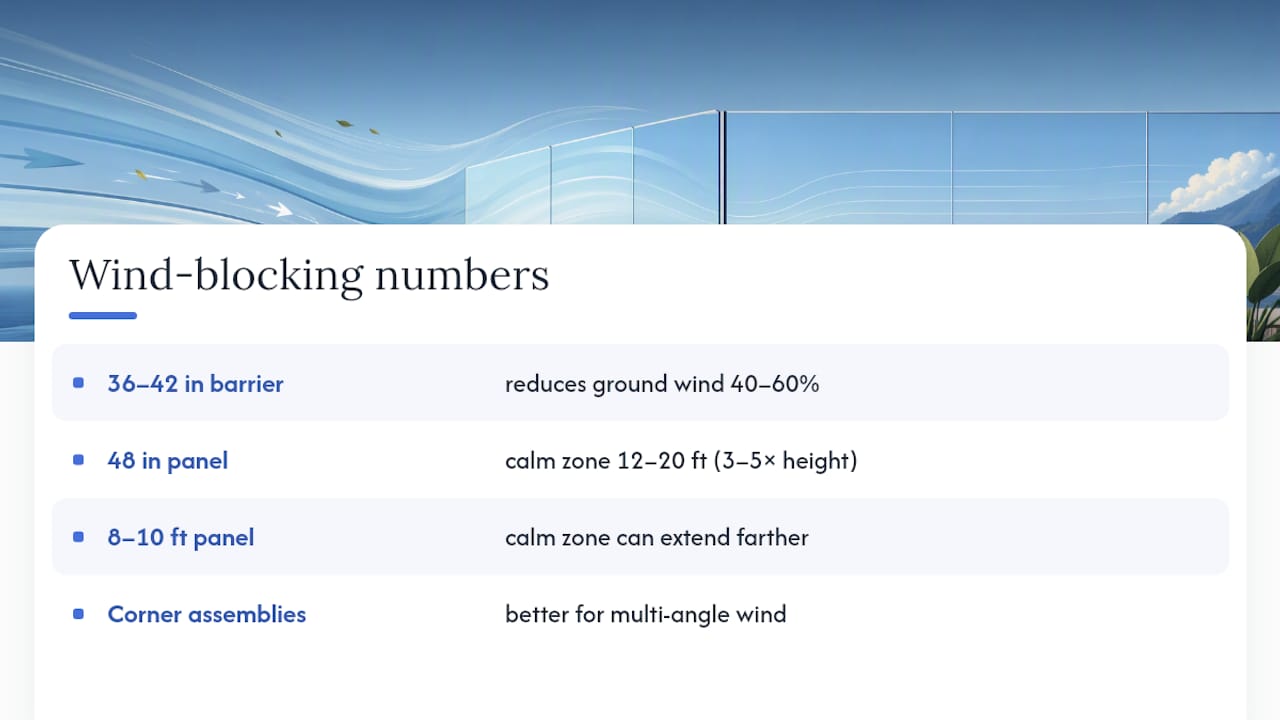
Placement matters as much as height. A panel facing directly into prevailing wind performs differently than one angled off a corner, and corner assemblies tend to outperform a single long straight run because they block wind shifting from two directions rather than one. If your deck catches wind from multiple angles across the day, a corner configuration is usually the smarter build.
Where Should You Place Panels for Maximum Coverage?
Start by mapping your actual seating or dining zone rather than the deck’s full perimeter. Wind protection is most valuable where people sit still for an hour, not where they walk through for five seconds.
From there, work through these placement decisions:
- Panel height follows directly from the protected zone math. Want 15 feet of calm space for a dining table? A panel around 48 inches gets you there.
- Corner returns and staggered runs reduce turbulence better than one continuous wall of glass, especially on decks exposed to shifting wind direction.
- Setback and clearance from stairs, doors, and grills need checking against local code before you finalize a layout.
- Rooftop and elevated decks face higher wind loads than ground level installations, which almost always means an engineer needs to review anchor points before installation.
That last point deserves emphasis. A design that works fine on a ground floor patio can be structurally inadequate three stories up, where wind speed and uplift forces increase substantially.
What Glass and Hardware Specs Actually Matter for Safety?
Tempered safety glass is the standard for outdoor windscreens, and for good reason: as explained in The luxury of glass interior doors — One Day Doors & Closets, it’s engineered to shatter into small, relatively harmless fragments rather than sharp shards if it breaks. Thickness varies by application, with heavier structural runs using thicker glass than decorative or lower profile sections.
Hardware choice matters just as much as the glass itself:
- Marine grade stainless steel hardware resists corrosion in coastal or high humidity climates far better than standard steel.
- Aluminum channel systems offer a lighter, often more budget friendly base mount option for ground level decks.
- Post mounted systems distribute load differently than channel systems and suit certain deck framing setups better.
Load engineering is where a lot of installations quietly go wrong. Wind load on a glass panel transfers directly into the deck framing and anchor points, and outdoor balustrade systems on elevated structures require verified anchor capacity, not a guess. If you’re mounting anything above a single story or on a structure with any question marks about framing strength, bring in a structural engineer before ordering glass.
Pro Tip: Before you buy a single panel, pull up your local guardrail height requirements and confirm your deck framing can handle lateral wind load, not just static weight. Most retrofit headaches trace back to skipping this step.
Glass Railing Store maintains a building code reference page covering guardrail height rules and other checkpoints worth reviewing before you finalize a design.
Should You Install a Deck Windscreen Yourself or Hire a Pro?
Three mounting approaches dominate deck windscreen installation, and each has different implications for your existing framing:
- In-deck channel systems require cutting into the deck surface to set a base channel, which usually demands more precise framing underneath but produces a cleaner, more integrated look.
- Surface-mounted base shoes bolt directly onto the deck surface without cutting into it, making them the more forgiving option for retrofits onto composite or existing wood decking.
- Post-mounted systems rely on vertical posts anchored into the framing, spreading load differently and often suiting corner or return configurations better than a straight channel run.
Hire a professional when you’re dealing with elevated installations, any structural reinforcement, or a jurisdiction that requires code inspection sign off. DIY installation can work for ground level, surface-mounted setups on solid existing framing, particularly composite decking with straightforward attachment points.
Budget conservatively. Material costs, glass thickness, hardware grade, panel count, and whether you need custom cuts for corners all move the price. Labor adds a separate line item, and elevated or structurally complex jobs cost more than a simple ground floor run. When comparing quotes, make sure every bid specifies glass thickness, hardware material, and whether structural inspection is included, so you’re comparing equivalent work rather than apples to oranges.
How Do You Keep a Glass Windscreen Clean and Weatherproof?
Glass windscreens hold up well outdoors, but only with basic seasonal attention. Skip ammonia-based cleaners, which can degrade certain hardware finishes over time, and stick to mild soap and water or a dedicated glass cleaner for regular upkeep.
- Clean panels every few weeks during high pollen or dust seasons to prevent mineral buildup and water spotting.
- Inspect hardware and seals twice a year, checking for loosening, corrosion, or gasket wear.
- In coastal climates, rinse salt spray off hardware more frequently since it accelerates corrosion even on stainless steel.
- In freeze-thaw climates, check anchor points each spring for movement caused by ground shifting over winter.
Warranty coverage and expected service life vary by manufacturer and hardware grade, so check the specifics before you buy. Choosing marine grade hardware over standard steel from the start typically extends service life more than any cleaning routine can compensate for later. Glass Railing Store’s guide to weatherproofing outdoor glass railings covers maintenance specifics in more depth.
Lessons From Planning Glass Windscreen Projects
The most common mistake isn’t picking the wrong glass. It’s underestimating what the framing underneath needs to handle. A panel that looks fine on paper can fail an inspection, or worse, work loose over a season, if the anchor points weren’t matched to actual wind load rather than just static weight.
Engaging a supplier or engineer before you order glass saves real money. Reworking a channel mount after the fact costs far more than getting the framing specification right upfront. Readers ready to move forward should start with deck attachment guidance and accurate measurements before requesting a quote.
— Fuanne
Get Panels, Hardware, and a Plan From Glass Railing Store
Suppliers provide components this whole planning process points toward: tempered glass panels, in-deck channel hardware, and the connectors that make corner returns and staggered runs actually work in the field. Products typically meet consistent safety and thickness standards as discussed earlier, so you’re not guessing whether a panel matches spec.

Some suppliers offer planning support and quotes for those who want a second set of eyes on their layout before ordering. If you’re outfitting a straight run, the 46 inch tempered glass panel covers a common railing height configuration. Planning a corner assembly instead? Pair panels with a 90 degree connector to build the return that InfinityGlass’s research shows outperforms a single straight wall of glass. Wholesale pricing and shipping options may be available for larger projects. Contact suppliers directly to get assistance with your deck’s wind protection specifications.
Sources
- Wind fence types and effects — WeatherSolve
- Tempered glass panels: types, uses & installation tips — Fab Glass and Mirror