

Pass Inspection: 48 inch & 4 inch U.S. Glass Pool Fence Code Checklist
Most U.S. jurisdictions enforce a minimum barrier height around 48 inches, a 4-inch sphere test for openings, a bottom clearance generally limited to a few inches, and self-closing, self-latching gates. Glass panels must meet safety glazing standards under CPSC 16 CFR 1201 Category II. Some states, including California, Arizona, and Nevada, have higher barrier height requirements, commonly around 60 inches. Before you order glass or schedule an installer, call your city or county building department and get the exact code section in writing.
TL;DR:
- Most U.S. jurisdictions require a minimum barrier height of 48 inches, but California, Arizona, and Nevada often set it at 60 inches.
- The standard 4-inch sphere test for openings applies mainly to joints and gaps, with glass panels typically passing due to solid construction, but ground clearance and gate requirements remain strict.
- Glass panels must meet CPSC Safety Glazing standards, carry a permanent etched marking, and have hardware that supports self-closing and self-latching features, with spacing and thickness tailored to specific site conditions.
- Verifying local codes involves calling the building department with your specific address, requesting written code citations, and confirming measurement points before ordering or installing.
- Proper documentation, including manufacturer specs, photos, and engineered drawings, is essential for inspection, insurance, and sale disclosures, especially in states with stricter rules like California.
Table of Contents
- What Federal Rules and Model Codes Set the Baseline for Glass Pool Fence Code in the U.S.A.
- What Are the Exact Height, Gap, and Gate Measurements Inspectors Check?
- What Glazing Standards and Hardware Rules Apply to Glass Panels?
- Which States Have Stricter Rules, and How Do You Confirm Your Local Code?
- How Do You Document Your Glass Pool Fence Installation for Inspection?
- Does a Non-Compliant Fence Affect Your Insurance or Home Sale?
- How Glassrailingstore Supports Code-Compliant Glass Pool Fence Projects
- What the Research Actually Tells You to Prioritize
- Where to Source Compliant Glass Panels and Hardware
- Sources
- FAQ
What Federal Rules and Model Codes Set the Baseline for Glass Pool Fence Code in the U.S.A.
There’s no single national pool fence law. What exists instead is a layered system: federal guidance that shapes expectations, model codes that most states adopt in some form, and local amendments that often override both. Understanding that hierarchy is the fastest way to figure out what actually applies to your project.
At the top sits the Safety Barrier Guidelines for Residential Pools published by the Consumer Product Safety Commission. These guidelines recommend a 48-inch minimum barrier height, a 4-inch sphere test for any gap or opening, a maximum bottom clearance of 4 inches (reduced to 2 inches over non-solid surfaces like grass), and gates that close and latch themselves. The CPSC guidelines are advisory. They carry no force of law on their own, but they’re the document nearly every state and municipal code writer references when drafting actual statutes. If your local code sounds oddly familiar to something you read on a federal safety site, that’s why.
Congress backed that guidance with teeth in 15 U.S.C. §8005, the Minimum State Law Requirements provision. This statute directs states to maintain pool barrier laws that “effectively isolate the swimming pool from access to the home” and requires them to weigh devices like self-closing, self-latching gates and safety covers. It doesn’t hand down a specific height number. What it does is establish a floor: a state law that ignores the barrier concept entirely would fail to meet this federal expectation. That’s part of why virtually every state now has some form of pool barrier statute on the books, even the ones that leave enforcement to counties and cities.
Below the state layer, most jurisdictions build their actual enforceable numbers from the International Building Code (IBC) or International Residential Code (IRC), sometimes with local amendments layered on top. These model codes get updated every few years by the International Code Council, and states adopt specific editions on their own schedule, which is why a code cycle from one state can lag several years behind its neighbor. Where fencing materials themselves are concerned, inspectors frequently point to ASTM standards, particularly ASTM F1908 for plastic pool fencing and F2286 for removable mesh barrier systems, though glass barriers are typically governed separately through architectural glazing rules rather than these mesh-specific standards.
Here’s the practical takeaway for anyone pricing out a glass pool fence:
- The CPSC numbers are the “default assumption” most contractors quote, but they’re not automatically the law where you live.
- Your state’s pool safety statute (often embedded in its health and safety code, building code, or a dedicated swimming pool act) is the binding minimum.
- Your city or county can raise that minimum further through local ordinance, and many do.
- IBC/IRC and ASTM references usually enter the picture through your state’s adopted building code edition, not as freestanding federal law.
Before you spend a dollar on glass panels, pull up your state’s pool barrier statute by name and then call your local building department to ask which code edition and any local amendments apply to your address. That two-part check takes maybe twenty minutes and saves you from ordering panels cut to the wrong height.
What Are the Exact Height, Gap, and Gate Measurements Inspectors Check?
Inspectors don’t grade on intent. They measure, and a barrier that’s compliant in spirit but off by an inch on paper will fail. Here are the numbers that actually get checked with a tape measure.
Height. The CPSC baseline of 48 inches is the number you’ll see most often, and it’s the floor in a large share of U.S. jurisdictions. But plenty of local codes push higher, landing anywhere in the 48 to 54-inch range, and a handful of states go further still. California, Arizona, and Nevada commonly require 60 inches, and California’s statute spells this out directly in Health and Safety Code §115923. Height is measured from finished grade on the side of the barrier away from the pool, not from the pool deck side, which matters enormously on sloped lots.
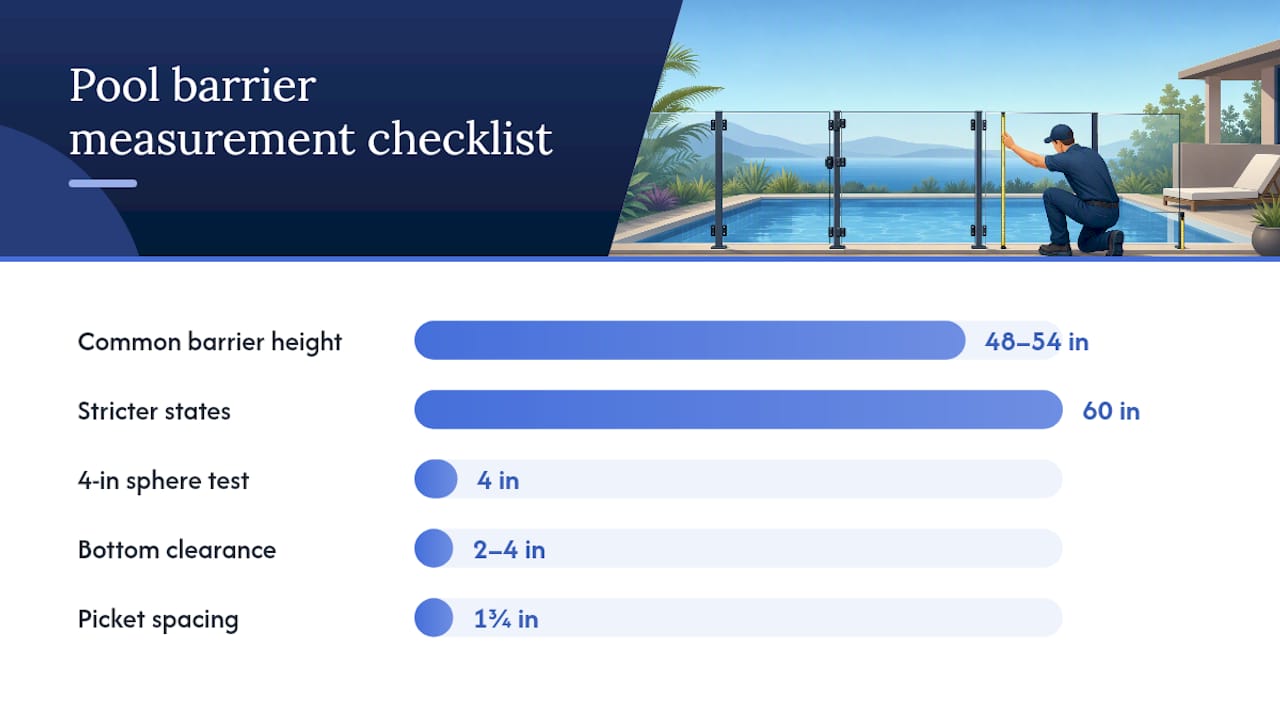
The 4-inch sphere test. This is the single most cited number in pool barrier code, and for good reason: it’s the test the CPSC guidelines use to define “too big an opening.” If a 4-inch diameter sphere can pass through any gap in the barrier, gate, or between the bottom of the barrier and the ground, the barrier fails. For glass panel fencing this mostly comes down to the space between adjacent panels and between the panel edge and the post or spigot. It rarely comes up as an issue with solid glass itself, since a single tempered panel obviously has no gap at all, but it becomes the deciding factor at every joint and seam.
Other gap metrics. The 4-inch sphere test isn’t universal for every barrier component. Vertical members on some picket-style barriers are held to a tighter 1¾-inch spacing standard, and chain link fencing without slats often needs to meet a 1¼-inch mesh opening requirement. Glass fence systems rarely trigger these secondary tests since the barrier is a solid pane, but if your project mixes glass panels with a picket or mesh gate section, both standards can apply to different parts of the same fence.
Bottom clearance. The gap between the bottom rail or panel edge and the ground typically runs 2 to 4 inches, with the tighter 2-inch limit usually reserved for non-solid surfaces like grass, gravel, or soil where a gap can widen as the ground settles or erodes. On concrete decking, 4 inches is more commonly allowed. This is one of the most frequently failed items on reinspection, because installers set clearance correctly on install day and nobody accounts for a few months of soil settling underneath a post footing.
Gate rules. Every code variant expects the gate to close and latch on its own. Common requirements include:
- The gate swings away from the pool, not toward it.
- It self-closes from any open position, and inspectors commonly test this from a 6-inch opening.
- It self-latches without the person needing to touch the latch by hand.
- The latch release mechanism sits high enough that a small child can’t reach it, typically in a 54 to 60-inch range measured from the ground on the pool side, though several states specify their own exact number.
Statistic worth remembering: the CPSC’s own guidelines pin the bottom clearance ceiling at 4 inches on solid surfaces and tighten it to 2 inches on non-solid ground, a distinction plenty of DIY installers miss entirely when they install on a grass perimeter instead of pavers.
Measure at more than one point along a run of glass fencing, especially on a lot with any slope. A panel that reads 48.5 inches at one post and 47.75 inches at the next because the ground dips slightly is a real failure point, and it’s an easy one to catch before an inspector does if you check every third or fourth post rather than just the first one.
What Glazing Standards and Hardware Rules Apply to Glass Panels?
Glass carries its own layer of code on top of the general barrier rules, and this is where a lot of otherwise well-built fences trip up on inspection day.
The controlling standard is CPSC 16 CFR 1201, the federal regulation governing architectural glazing in hazardous locations. Pool barrier glass needs to meet Category II performance under this standard, which governs how the glass behaves under impact. Tempered safety glass rated for this category is the standard choice for pool fence panels, and it’s what you’ll find specified across compliant glass railing and fencing systems. The American National Standards Institute maintains a parallel standard, ANSI Z97.1, that many local codes reference alongside or interchangeably with the CPSC requirement.
Every compliant panel needs a permanent etched marking identifying the manufacturer and the standard it meets. This isn’t optional paperwork. Building departments and, in states like California, real estate inspectors treat that etched mark as the primary evidence of compliance during both permit inspection and property transfer. A panel without a visible, permanent mark is a common reason inspections stall, even when the glass itself is genuinely rated safety glazing.

On thickness, the industry doesn’t work off a single universal number. Frameless glass panels supported by base-mounted spigots commonly run in a heavier range than framed panels that get lateral support from a top rail, since the frameless design puts more structural load on the glass itself. The right thickness for your project depends on panel height, wind exposure, and the spacing between support points, so treat published thickness ranges as a starting point and confirm the final spec against your manufacturer’s engineering documentation and your local building code before you order.
Gap standards apply just as strictly to glass as to any other barrier material:
- Panel-to-panel gaps and panel-to-post gaps both need to stay under the 4-inch sphere test threshold.
- Bottom clearance between the panel edge and the ground follows the same 2 to 4-inch rule as other barrier types, tighter on non-solid surfaces.
- Gate openings in a glass fence run need to meet the same self-closing, self-latching standard as any other pool gate, and hardware selection matters here. A glass interior door uses similar hinge and latch mechanics to what you’ll see on a compliant glass pool gate, and getting that hardware right the first time avoids a callback.
Spigot and clamp spacing is a practical installation question the code itself rarely answers with a specific number, since it depends on glass thickness, panel height, and wind load for your region. As a rough field rule, many installers space base spigots every 24 to 36 inches for standard-height frameless panels, but that’s a starting assumption, not a substitute for engineering. Anywhere your project involves unusual height, heavy wind exposure, or a panel run longer than a few sections, request engineered spacing calculations rather than relying on rule-of-thumb spacing.
Pro Tip: Ask your glass supplier for the etched-mark spec sheet and a photo-documented panel log at delivery, before installation day. It’s far easier to catch a mismarked or wrong-category panel sitting in your driveway than after it’s set in spigots and grouted.
One question that comes up constantly: does the metal hardware need to be grounded or earthed? For most residential glass pool fence installations, the answer is no, not as a pool-barrier code requirement. Grounding and earthing are electrical code concepts that come into play when metal hardware is bonded into an electrical system, such as when a fence post sits near pool equipment bonding grids or lighting circuits. That’s a separate concern from barrier compliance, governed by your local electrical code and the National Electrical Code’s pool-specific bonding requirements, not by the fence height and gap rules discussed here. If your installation involves any hardware near pool equipment, lighting, or bonding grids, follow your electrician’s guidance and the manufacturer’s install instructions rather than assuming glass fence hardware needs grounding by default.
Which States Have Stricter Rules, and How Do You Confirm Your Local Code?
Every state has some form of pool barrier law, but the specific numbers shift enough from one zip code to the next that “the code” is really shorthand for “whatever your local building department enforces this year.” Municipal and county codes routinely exceed state minimums, and PoolSafely’s guidance on state pool safety laws makes the same point directly: local ordinance language, not just the state statute, governs what an inspector actually checks. Home-rule authority in many states lets cities and counties tighten requirements without waiting on the legislature.
A few states illustrate just how far that variance can run:
California sets one of the strictest bars in the country. HSC §115923 requires a 60-inch minimum barrier height in many enclosure scenarios, mandates self-closing and self-latching gates, and requires safety glazing meeting the CPSC Category II standard for any glass barrier component. California layers a second obligation on top through Business and Professions Code §7195, which triggers pool safety disclosure requirements at the time of a property sale. If you’re building or selling a home with a glass pool fence in California, that disclosure requirement means your compliance documentation matters well beyond the initial inspection. Anyone working in this market should read through the California-specific glass railing code guide before finalizing a spec, since it walks through how these state provisions interact with local building department practice.
Texas tends to push latch height requirements higher than the federal baseline in several municipalities, particularly around larger metro building departments, even where the overall barrier height sits closer to the 48-inch national norm.
Florida handles a lot of its pool barrier enforcement at the county level, and several counties require what’s called layered protection, meaning a perimeter barrier plus a second line of defense such as a pool alarm or door alarm on the house itself, on top of the fence requirement.
Arizona and Nevada both commonly require 60-inch minimum heights similar to California, reflecting how common private pools are in both states and how aggressively their legislatures have written pool safety law relative to states where residential pools are less universal.
None of that variance is something you can guess your way around. Here’s the verification process that actually works, in order:
- Look up your state’s pool barrier statute by name. Most states embed this in a health and safety code, a building code section, or a dedicated swimming pool safety act. Search for the statute number, not just “pool fence law [state],” since generic searches surface outdated blog posts more often than the actual current text.
- Call your city or county building department directly. Ask specifically which code edition is currently adopted (IBC 2021, IRC 2018, or whatever cycle applies) and whether any local amendments raise the height, gap, or gate requirements above the state minimum.
- Request the code citation in writing on your permit application. Don’t rely on a verbal answer from a front-desk clerk. Get the section number attached to your permit file so there’s no ambiguity if a different inspector shows up for the final walkthrough than the one who reviewed your plans.
- Ask for exact measurement expectations if anything feels ambiguous. Some departments will tell you exactly where they measure height from, whether they check bottom clearance at multiple points, and what tolerance they allow.
Local building departments carry the final word on interpretation, which is why one municipal permitting page from Minnetonka, Minnesota is worth reading as an example of how granular these local requirements can get, right down to specific measurement points and required inspection sequencing. Every city runs its own version of that same detailed page, and finding yours before you order glass is worth the phone call.
If you’re working with a contractor, ask them directly which code section they’re building to, not just “code compliant” as a general phrase. A contractor who can cite the actual statute number and local amendment is one who has actually checked, rather than assumed the CPSC baseline applies everywhere.
How Do You Document Your Glass Pool Fence Installation for Inspection?
A compliant glass pool fence isn’t just a matter of getting the panels right. It’s a matter of proving it, both to the inspector standing in your yard and to anyone who reviews the property years later. Treat the process as a sequence, not a single install day.
Before installation begins, confirm the exact code your jurisdiction has adopted, secure the necessary permits, and if your local department requires it for glass barrier systems, obtain engineered drawings from your glass supplier or a licensed engineer showing panel thickness, spigot spacing, and load calculations for your specific site conditions.
During installation, work through these checks in order:
- Verify finished grade height at every post location before setting panels, since grade often varies more across a yard than installers expect.
- Measure panel height at multiple points along each run, not just at the first and last post.
- Confirm the 4-inch sphere test passes at every panel-to-panel joint, panel-to-post connection, and the gate opening.
- Measure bottom clearance at several points, checking it against the tighter 2-inch standard if any section sits over grass, gravel, or soil rather than solid decking.
- Test the gate’s self-closing action from a 6-inch open position and confirm it latches every time without manual assistance.
- Verify the latch release height meets your jurisdiction’s required range and that the gate swings away from the pool.
- Walk the full perimeter checking for climbable hardware, meaning any horizontal rail, spigot, or bracket a child could use as a foothold to scale the barrier.
Documentation to compile before you call for final inspection:
| Document | Why It Matters |
|---|---|
| Manufacturer glazing spec sheet | Proves the glass meets CPSC 16 CFR 1201 Category II or ANSI Z97.1 |
| Etched panel photos | Shows the permanent safety marking on each individual panel |
| Shop drawings | Confirms spigot spacing and layout match engineered specs |
| Signed engineer letter (if required) | Satisfies jurisdictions that require structural sign-off for frameless glass |
| Photo log with measurement callouts | Creates a dated record of height, gap, and clearance at time of install |
After the inspection, correct any deficiencies immediately while your installer is still on site rather than scheduling a separate repair visit. Once the fence passes, archive the entire packet, permit, photos, spec sheets, and engineer letter, somewhere you can retrieve it in minutes. That packet becomes valuable again the moment you sell the house, file an insurance claim, or need to prove compliance after a code update changes the local requirement. If your yard has an irregular shape or unusual grade change, the installation guide for irregular pool shapes walks through how to handle measurement checkpoints when a straight run isn’t an option.
Does a Non-Compliant Fence Affect Your Insurance or Home Sale?
A barrier that looks fine but doesn’t match code creates two kinds of exposure most homeowners don’t think about until it’s too late: insurance risk and liability risk, and both get worse the longer noncompliance sits undocumented.
Homeowners insurance underwriters increasingly look at pool safety features when writing or renewing a policy, and the Insurance Information Institute’s guidance on pools and homeowners insurance notes that insurers weigh barrier compliance directly in how they assess risk. A fence that doesn’t meet the standard your policy assumes can complicate a claim after an incident, even where the fence itself wasn’t the direct cause. Some insurers will ask for documentation of your barrier’s compliance outright before issuing or renewing coverage on a property with a pool.
Premises liability exposure runs on a separate track from insurance and applies even in places without an especially strict local statute. In a civil suit following a pool-related injury, a plaintiff’s attorney will look for any gap between what code required and what was actually built. Documentation, the same photo log and spec sheets you compiled during installation, becomes the difference between a quick resolution and a drawn-out dispute over what your fence actually looked like on the day of the incident.
Real estate transactions add a third layer, most visibly in California, where BPC §7195 requires specific pool safety disclosures at the time of sale. A buyer’s inspector checking barrier height, gap spacing, and glazing markings against that disclosure requirement is exactly the scenario where your archived compliance packet pays for itself. Even outside California, buyers increasingly ask about pool safety compliance directly, and sellers who can hand over a complete packet close faster than those who can’t answer basic questions about their fence.
The practical mitigation here is simple to describe and easy to skip if you’re in a hurry: keep every piece of documentation from the original install, pull a corrective permit if you’re retrofitting an older noncompliant fence rather than doing the work quietly, and call your insurer before making any major change to an existing barrier so you know how it affects your coverage before, not after, the work is done.
How Glassrailingstore Supports Code-Compliant Glass Pool Fence Projects
Some glass railing and fencing systems are built around safety glazing and hardware standards this article covers. Panels and hardware that meet CPSC 16 CFR 1201 Category II safety glazing standards include etched-mark evidence inspectors look for and structural hardware installers need, addressed at the sourcing stage rather than improvised on site.
That matters for the two groups reading this article. Homeowners get panels that arrive with the documentation an inspector or a future buyer will ask for. Contractors and builders get consistent spigot and connector hardware they can spec into a project without guessing at compatibility between different manufacturers’ systems. Both benefit from planning resources that map product selection to the measurement and gap rules covered in the previous sections, including guidance drawn from the complete building code compliance guide covering glazing markings and engineering documentation.
If you’re mid-project and need specifics beyond what a catalog page shows, request shop drawings or a spec sheet directly through the site’s planning services before you finalize an order. That’s a faster way to catch a spacing or thickness mismatch than discovering it after the panels arrive. For projects with unusual layouts or structural questions, the frameless glass railing ordering and structural checklist covers the kind of pre-order questions that save a return shipment.
What the Research Actually Tells You to Prioritize
The conventional advice on glass pool fence code treats “48 inches, 4-inch sphere test” as the whole answer, and that’s where most homeowners get burned. Those are the CPSC’s advisory numbers, not a nationwide law, and treating them as gospel is exactly how someone in California or Arizona ends up ordering 48-inch panels for a jurisdiction that requires 60.
What actually matters most is the two-part verification most people skip: pulling the state statute by name and getting your local building department’s amendments in writing before you order glass. That habit costs twenty minutes. Skipping it costs a reorder, a failed inspection, or worse, a disclosure problem years later at closing.
The documentation piece is the most underrated part of this whole process. Homeowners treat the etched glass mark and the photo log as bureaucratic afterthoughts. Insurers and real estate attorneys treat them as the entire case. Build the paper trail at install time. It’s far cheaper than reconstructing it later.
— Fuanne
Where to Source Compliant Glass Panels and Hardware
There are suppliers offering code-ready hardware along with panels meeting CPSC 16 CFR 1201 Category II safety glazing standards with permanent etched markings inspectors and real estate attorneys ask for, often paired with marine-grade stainless steel hardware designed for outdoor durability.

For spigot-based installations, the Adjustable Connector for Glass Railing solves a problem a lot of DIY installers run into: matching panel spacing to the 4-inch sphere test without custom-fabricating brackets on site. It adjusts to fine-tune panel alignment after the posts are set, which is exactly the kind of flexibility that saves a reinstall when your finished grade isn’t perfectly level.
If you’re still finalizing a spec, request a quote or download shop drawings before you order panels. Glassrailingstore’s planning support can confirm spacing and hardware compatibility against your local code requirements, so you’re not guessing at spigot placement the week before your inspection. Head to the Adjustable Connector for Glass Railing product page to check pricing and request a quote for your project.
Sources
- Safety Barrier Guidelines for Residential Pools (CPSC)
- 15 U.S.C. §8005 - Minimum State law requirements (U.S. Government Publishing Office)
FAQ
What Is the Code for a Pool Fence?
There’s no single national code, but most jurisdictions require a barrier at least 48 inches tall with openings small enough to block a 4-inch sphere, a bottom clearance of 2 to 4 inches, and a self-closing, self-latching gate. Confirm your exact state and local requirements before building, since numbers vary by jurisdiction.
Does a Glass Pool Fence Need to Be Earthed?
No, not as a pool barrier code requirement in most residential installations. Grounding becomes relevant only when metal hardware ties into an electrical bonding system near pool equipment, which falls under electrical code rather than fence barrier code.
What Is the Recommended Spigot Spacing for a Glass Pool Fence?
Many installers space base spigots every 24 to 36 inches for standard-height frameless panels, but this varies with glass thickness, panel height, and wind exposure. Request engineered spacing calculations from your supplier for anything beyond a standard low-height installation.
How Wide Is a Glass Pool Fence Gate?
Gate width itself isn’t fixed by most codes, but the gate must open away from the pool, self-close from at least a 6-inch open position, self-latch automatically, and have its latch release set at a height, typically 54 to 60 inches, that a small child can’t reach.
Do I Need a Permit to Install a Glass Pool Fence?
In nearly every U.S. jurisdiction, yes. Contact your local building department before installation to confirm permit requirements and get the applicable code section documented on your permit application.