

Choosing the Right Glass Gate Hinges for Outdoor and Pool Use
For most outdoor and pool glass gates, a marine-grade soft-close or self-closing hinge is the safest, longest-lasting choice, paired with tempered glass drilled to the hinge maker’s exact template. Before buying, confirm four things: glass thickness (usually 8mm to 12mm), the gate’s weight and width, the mounting style your post or wall requires, and a corrosion-resistant grade like 316 stainless. Glassrailingstore supplies holed tempered panels and matching hardware built to those specs.
TL;DR:
- Ensuring the glass is drilled to the hinge maker’s exact template before fabrication prevents costly installation errors and fitting mismatches.
- Soft-close hydraulic hinges provide more consistent, safety-compliant closure for pool gates compared to spring hinges, which can slam or weaken over time.
- Marine-grade stainless steel, particularly 316 or 2205 duplex, is essential for long-term corrosion resistance in salt or chlorinated environments, with finishes affecting maintenance needs.
- Proper gate dimensions, weight ratings, and matching hole templates are critical for durability and safe operation, especially for larger or heavier glass panels.
- Ordering hardware and glass from the same supplier with verified templates reduces the risk of misaligned holes and ensures a reliable, safe, and maintenance-friendly gate system.
Table of Contents
- What Types of Glass Gate Hinges Work Best?
- How Corrosion-Resistant Do Pool Gate Hinges Need to Be?
- What Glass Thickness and Weight Limits Should You Check?
- How Do You Install and Adjust Glass Gate Hinges?
- How Do You Choose the Right Glass Gate Hinge?
- Why Do Glass Gate Hinges Loosen or Fail Over Time?
- Where Glassrailingstore Fits Into Your Hinge Project
- What Hardware Do You Need Alongside Glass Gate Hinges?
- What Safety Features Matter Most on Pool Gates?
- What Certifications Should Pool Gate Hardware Meet?
- How Do Sun and Temperature Affect Hinge Material Choice?
- What Do Glass Gate Hinges Typically Cost?
- An Honest Look at What Actually Matters Here
- Ready to Order Templates or Holed Glass Panels?
What Types of Glass Gate Hinges Work Best?
Not every hinge belongs on a pool fence, and the type you pick determines how the gate behaves every single time someone walks through it. Two families dominate the outdoor and pool market, and they solve different problems.
Soft-close hydraulic hinges use an internal damper to slow the gate’s final few inches of travel, so it settles into the latch instead of slamming. Vendors like Polaris Hinge build these with quick-adjust caps that let you dial in closing speed after installation, and many models come in retrofit-friendly versions that match common hole spacings from older spring hinges. For pool gates specifically, this matters because most safety codes require gates to latch fully every time, without a person having to push them shut.
Self-closing spring hinges rely on mechanical tension instead of hydraulics. They’re simpler, generally cheaper, and easier to retrofit onto existing glass, but the closing force can vary with temperature and age, and they tend to swing harder than a damped hinge. A spring hinge that’s been tightened to overcome a heavy gate can also slam, which defeats the purpose on a pool enclosure.
Mounting style is the other variable that shapes your options:
- Glass-to-glass hinges connect two panels directly, common on frameless gate designs where the gate and adjacent panel share a sightline.
- Glass-to-post hinges anchor to a metal or composite post, giving more structural support for heavier gates.
- Glass-to-wall hinges bolt into masonry or framing, useful when the gate sits at the end of a run rather than between two panels.
Single-acting hinges swing one direction only and suit most pool gates, since codes typically require the gate to swing outward, away from the pool. Double-acting hinges swing both ways and show up more in interior or decorative applications, where clearance on both sides isn’t a safety issue. Before ordering, measure your swing radius against nearby steps, planters, or furniture. A gate that opens 90 degrees needs real clearance, and interior door hinge logic doesn’t always translate directly to a heavier, thicker glass panel outdoors, as general hinge-swing guidance for interior doors points out.
How Corrosion-Resistant Do Pool Gate Hinges Need to Be?
Chlorine and salt air are the two fastest ways to ruin cheap hardware, and the alloy you choose determines how many years you get before pitting shows up around the screws.
316 stainless steel is the standard baseline for marine-grade hardware, and it holds up well in most residential pool environments. 2205 duplex stainless goes a step further, combining higher strength with better resistance to chloride stress cracking, and some manufacturers position it specifically for extreme coastal or heavily chlorinated conditions, as seen on hinge listings from GlassParts. The trade-off is cost and availability. Duplex hardware typically costs more and comes from a narrower set of suppliers, so it makes the most sense when you’re near open saltwater or running a high-chlorine commercial pool rather than a standard backyard setup.
Finish matters almost as much as alloy. A polished finish looks sharp out of the box but shows water spots and fingerprints faster, while a satin or brushed finish hides everyday grime and tends to age more gracefully outdoors.
- Polished stainless: highest shine, more visible maintenance needs.
- Satin/brushed stainless: subtler look, easier to keep clean between washes.
- Powder-coated options: available on some hardware, but check the coating’s own salt-spray rating separately from the base metal.
If your project sits within a few miles of the coast, it’s worth reading Glassrailingstore’s coastal hardware spec guide before finalizing an order, since the right grade there can be the difference between hardware that lasts one season and hardware that lasts fifteen. General guidance on outdoor stainless hardware selection covers the same trade-offs for non-coastal builds.
What Glass Thickness and Weight Limits Should You Check?
Getting the dimensions wrong is the single most common reason DIY gate installs stall halfway through. Here’s what to confirm before you order anything.
- Match glass thickness to the hinge model. Most hinges built for gates accept 8mm, 10mm, or 12mm tempered glass, and the two aren’t interchangeable within a single hinge without a spacer kit. Suppliers like DIYGlass list separate variants for each thickness, so double check the listing before assuming “glass hinge” means one universal fit.
- Check the weight rating against your actual gate size. Weight capacities on standard glass gate hinges generally fall within a range suitable for typical residential gates, though this varies by model and manufacturer. Retrofit-style hinges are often rated to support medium-weight gates and widths common in pool fencing, based on typical product specifications from various suppliers. A taller or wider gate than that usually needs a heavier duty hinge pair or a third hinge for support.
- Request the hole template before the glass gets tempered. Tempered glass can’t be drilled after the tempering process without shattering it, so the exact hole diameter and spacing has to be locked in at the fabrication stage. Manufacturers commonly supply these templates alongside the hinge purchase.
- Verify hole spacing matches between hinge panel and gate panel. A mismatch here is one of the most frequent installation headaches, especially when mixing hardware from different suppliers on the same gate.
- Leave gap allowance for expansion and adjustment. A few millimeters of clearance around the latch side gives you room to fine tune alignment later without re-drilling anything.
How Do You Install and Adjust Glass Gate Hinges?
Installation order matters more with glass than with wood or metal doors, because there’s no room to correct a drilling mistake after the fact. Get the sequence right and the rest of the job goes smoothly.
- Order glass to the hinge manufacturer’s template, not a generic hole pattern. This single step prevents the most expensive mistake in the entire project: a $400 tempered panel that can’t be used because the holes are off by a few millimeters. Glassrailingstore’s installation walkthrough covers how to coordinate glass ordering with hardware selection before fabrication begins.
- Mount the hinge panel first, whether that’s a post, wall, or fixed glass panel, and confirm it’s plumb before moving on. Everything downstream depends on this being square.
- Fit the gate panel to the hinge using the manufacturer’s specified torque on the mounting bolts. Overtightening stainless fasteners on glass hardware can crack fittings or strip threads.
- Align the gate so it sits parallel to the fixed panel with even reveal on both sides, then check that it swings through its full arc without catching on decking, tile, or coping stones.
- Set the closing speed using the quick-adjust ratchet cap on soft-close models, or the tension screw on spring hinges. Interchangeable dampers, a feature on several soft-close lines, let you swap in a stronger or weaker damper if the default speed doesn’t suit a heavier gate.
- Test the latch engagement at least a dozen times before calling the job done. A gate that latches on the first nine tries and misses the tenth is a liability around a pool, not a minor annoyance.
Retrofitting an old spring hinge into a soft-close model brings its own pitfalls. Hole spacings that look close enough rarely are, hole diameters can differ by a millimeter or two between brands, and glass ordered years ago may not match the thickness a new hinge line expects. Wind load is easy to overlook too. A tall gate on an exposed deck catches more wind than the same gate tucked against a house wall, and that extra force works against a spring hinge’s tension setting over time.
Pro Tip: Before ordering replacement glass for a retrofit, measure the existing hole spacing yourself and send photos to your supplier rather than relying on the hinge model number alone. Manufacturers occasionally revise hole patterns between production runs, and a numbered match on paper doesn’t always mean a physical match in your hands.
How Do You Choose the Right Glass Gate Hinge?
Run through this checklist before placing an order, whether you’re buying a single pair of hinges or specing hardware for a whole pool enclosure.
- Confirm glass thickness and request the matching hole template before glass goes to the tempering oven.
- Verify the hinge’s weight rating against your gate’s actual height, width, and glass thickness combined, not just its square footage.
- Choose a corrosion grade suited to your environment. 316 stainless covers most residential pools; 2205 duplex earns its higher price near saltwater or heavy chlorination.
- Decide between soft-close and spring action based on how much control you want over closing force and how often the gate gets used.
- Confirm mounting style compatibility with your existing posts, walls, or adjoining glass panels before ordering hardware.
When you’re evaluating suppliers, ask direct questions: Do they provide a cutout template with the order? Do they publish cycle testing or durability data for the hinge model? What finish options exist beyond standard satin stainless? What does the warranty actually cover, and for how long?
Treat vague answers as a warning sign. A supplier that can’t produce a hole template, won’t specify an alloy grade, or has no marine-grade option in its lineup probably isn’t set up for pool or coastal installations, even if the hinge looks fine in a photo.
Why Do Glass Gate Hinges Loosen or Fail Over Time?
Even good hardware needs upkeep, and most failures trace back to a handful of predictable causes.
- Loosening fasteners from vibration and repeated use, especially on gates that see heavy foot traffic.
- Stiffness from salt residue or grime building up inside the hinge barrel, which slows the swing and stresses the damper.
- Damper failure on soft-close models, usually showing up as a hinge that no longer slows the gate near the latch.
- Misalignment after ground settling or seasonal temperature swings that shift post positions slightly.
- Squeaking, which is almost always a lubrication issue rather than a structural one.
Basic maintenance is simple: rinse the hinge with fresh water every few weeks if it’s near a saltwater pool or the coast, wash with a mild detergent monthly, dry thoroughly, and apply a manufacturer-recommended lubricant to moving parts. Check fastener torque twice a year.
Replace the hinge when corrosion has visibly worked through the finish rather than sitting on the surface, when a damper fails repeatedly after adjustment, or when the hinge no longer holds its rated weight without sagging.
Where Glassrailingstore Fits Into Your Hinge Project
Glassrailingstore stocks holed tempered glass panels cut to standard hinge templates, along with the stainless steel hardware, connectors, and mounting brackets needed to finish a pool or deck gate correctly. That combination matters because ordering glass and hardware from separate sources is where most hole-spacing mismatches happen.
To get a template or quote, have your gate’s rough opening width, glass thickness preference, and mounting style (post, wall, or glass-to-glass) ready before reaching out. Detailed installation guidance walks through what information a fabricator needs before cutting begins, and customer support can confirm hole spacing against the hinge model you’re planning to use. For nonstandard gate sizes, custom panel ordering covers dimensions outside the standard catalog.
What Hardware Do You Need Alongside Glass Gate Hinges?
A hinge alone doesn’t make a functional gate. Several complementary parts determine whether the finished installation actually performs the way you expect.
Strike plates and latches need to match the hinge’s closing force. A soft-close hinge paired with an undersized strike plate can still fail to catch reliably, especially on windy days. Gaskets and seals at the hinge barrel keep grit and pool water out of the internal mechanism, extending damper life considerably in chlorinated environments. Mounting brackets matter most on glass-to-post or glass-to-wall setups, where the bracket’s own corrosion resistance should match the hinge, not just the visible hardware. A wall connector rated for the same alloy grade as your hinge avoids the mismatch of dissimilar metals corroding against each other.
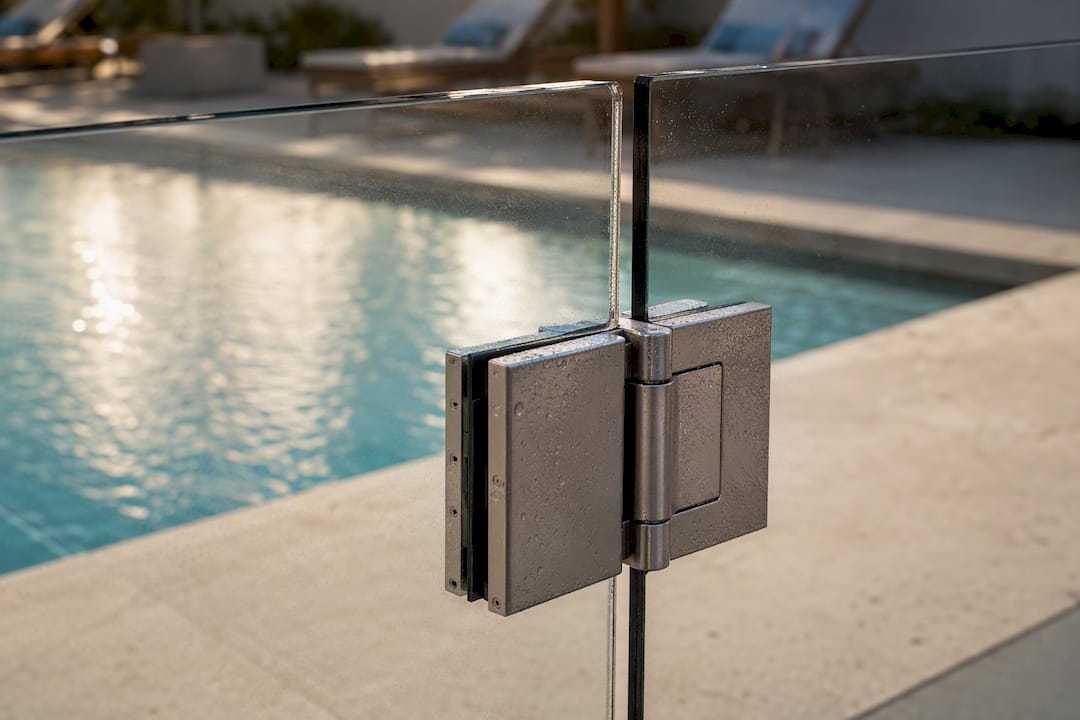
Caprail connectors come into play on gates that share a top rail with adjoining fixed panels, and straight caprail connectors need to align with the hinge panel’s height so the whole run reads as one continuous line rather than a visible step. If your layout includes an angled turn near the gate, a 90 degree connector or a 180 degree connector keeps that transition clean.
Buying hinges and accessories from mismatched sources is a common way projects end up with a strong hinge bolted to a bracket that corrodes two years faster.
What Safety Features Matter Most on Pool Gates?
A pool gate hinge does more than hold glass in place. It’s part of a safety system meant to keep the gate closed and latched every single time, particularly around young children.
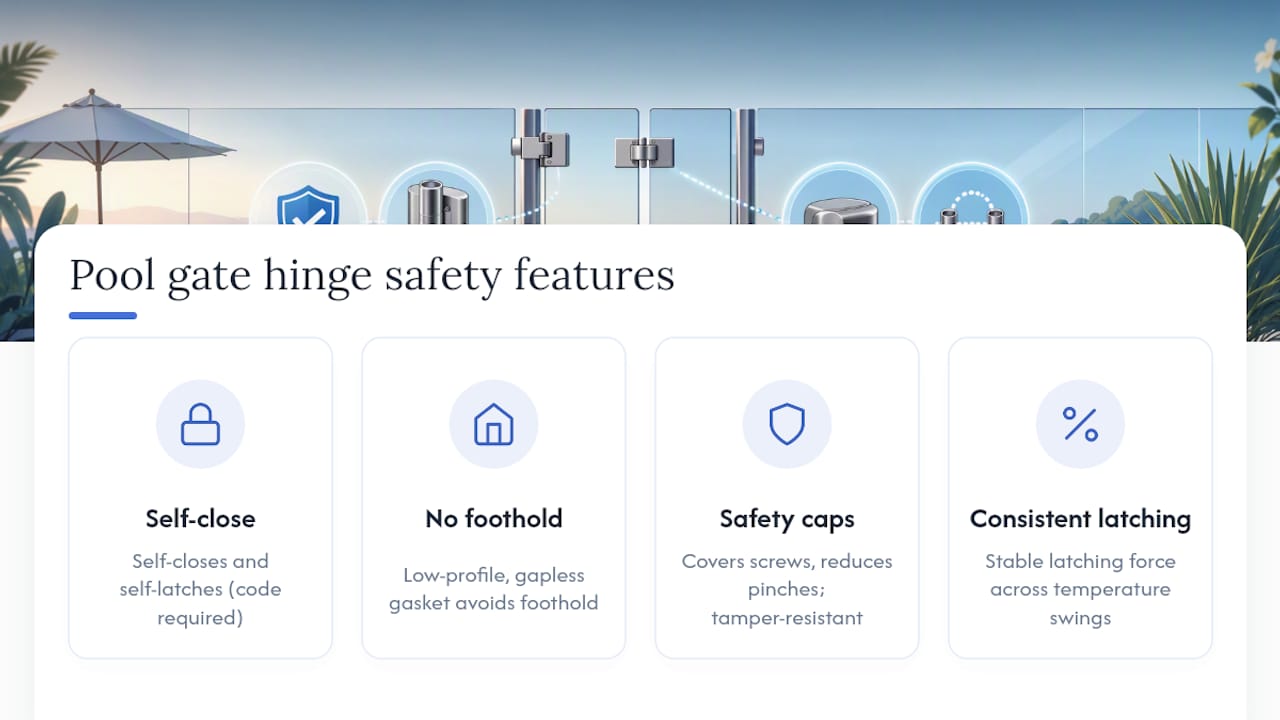
Soft-close and self-closing action is the baseline feature, since most residential pool codes require the gate to self-latch without anyone touching it. Beyond that, several product-level details separate hardware built for pools from hardware that just happens to work on glass.
Non-foot-hold gaskets matter because pool safety standards generally prohibit horizontal members or gaps a child could use as a foothold to climb over the gate or fence. Hinge hardware with a low-profile, gapless gasket design avoids creating an accidental foothold at the hinge barrel itself, a detail highlighted on hinge listings from Polaris Hinge.
Safety caps cover exposed screw heads and mechanism housings, reducing the chance of pinched fingers and giving the hardware a cleaner, tamper-resistant look. Consistent latching force across temperature swings keeps the gate from drifting into a “mostly closed but not latched” state, which is often more dangerous than an obviously open gate because it looks secure at a glance.
None of these features replace a proper self-latching mechanism positioned high enough to be out of a small child’s reach. Hardware choice supports the safety system; it doesn’t substitute for correct gate height and latch placement.
What Certifications Should Pool Gate Hardware Meet?
Outdoor and pool glass hardware sits at the intersection of two standards bodies most homeowners have never heard of, but contractors and inspectors check regularly.
ASTM International publishes material and performance standards that cover tempered glass strength and stainless steel hardware composition, including the alloy specifications that separate a true 316 stainless fitting from a cheaper substitute labeled loosely as “stainless.” ANSI standards intersect with pool barrier requirements, particularly around self-closing and self-latching mechanisms for pool enclosures, which most local building codes reference directly.
Local pool safety codes vary by jurisdiction, but they commonly require self-closing, self-latching gates that open away from the pool, with the release mechanism mounted high enough to be out of reach for young children. Before finalizing hardware, check your specific municipal or state pool barrier code rather than assuming a national standard covers every detail, since enforcement and exact height requirements differ by location.
Ask suppliers whether their hinges have documented cycle testing behind the self-closing claim. A hinge that closes reliably out of the box but degrades after a few thousand cycles doesn’t meet the spirit of a pool safety requirement, even if it technically self-closes on day one.
How Do Sun and Temperature Affect Hinge Material Choice?
Corrosion gets most of the attention in outdoor hardware discussions, but heat and UV exposure quietly work against glass gate hinges in ways that are easy to underestimate.
UV exposure degrades gaskets, seals, and any plastic or rubber components inside a hinge assembly faster than it affects the metal housing itself. A hinge that looks structurally fine after five years in direct sun can still have a brittle, cracked gasket that lets grit into the damper mechanism. Choosing hardware with UV-stabilized seals, where the manufacturer specifies it, extends the useful life of the whole assembly.
Temperature extremes change how hydraulic dampers behave. Cold weather can thicken the damping fluid inside a soft-close hinge, slowing its response or making the closing action feel sluggish, while intense heat can do the opposite and speed it up. Spring hinges respond to temperature too, since metal tension shifts slightly as it expands and contracts across a hot afternoon and a cool night.
For gates in climates with wide seasonal swings, that’s a reason to favor hinges with adjustable tension or interchangeable dampers over fixed-tension hardware, since you can recalibrate the closing speed seasonally rather than living with a gate that slams in summer and drags in winter. Dark-colored finishes also absorb more heat than lighter satin stainless, which can matter marginally for hardware mounted in full afternoon sun.
What Do Glass Gate Hinges Typically Cost?
Price ranges track closely with the two variables covered earlier: hinge type and alloy grade.
Basic self-closing spring hinges in standard 316 stainless tend to sit at the lower end of the market, making them a reasonable choice for budget-conscious residential projects where the gate sees light use. Soft-close hydraulic hinges cost more per pair because of the internal damper mechanism, but that premium buys smoother, more consistent closing action and generally longer service life under repeated cycling.
Upgrading to 2205 duplex stainless adds further cost on top of either hinge type, reflecting both the raw material price and narrower manufacturing availability. That upgrade makes the most financial sense on coastal properties or commercial pools where hardware replacement labor costs would otherwise eat up the savings from cheaper hinges within a few years.
Beyond the hinge itself, budget for the holed tempered glass panel, matching latch and strike plate, and any brackets or connectors needed for your mounting style. Buying glass and hardware together from one supplier, rather than sourcing each piece separately, tends to reduce the risk of a costly hole-spacing mismatch discovered after the glass has already been tempered.
An Honest Look at What Actually Matters Here
Most advice on glass gate hardware focuses on the hinge itself, as if picking the right model number solves the problem. It doesn’t. The template decision, made before the glass ever reaches a tempering oven, determines more about how a gate performs over the next decade than the brand of hinge bolted to it.
Conventional buying guides also oversell alloy grade as the single lever that matters most. Metallurgy counts, and 2205 duplex genuinely outperforms 316 in harsh chloride conditions. But a properly sealed 316 hinge on a well-templated gate will outlast a premium duplex hinge installed with mismatched holes and no gasket protection. Prioritize the fabrication and template step first, then optimize alloy and closing mechanism for your specific environment.
If there’s one thing worth doing differently than most homeowners do, it’s ordering glass and hardware from the same source, with a confirmed template in hand before cutting starts. That single decision prevents the most expensive and most common mistake in this entire category.
— Fuanne
Ready to Order Templates or Holed Glass Panels?
Once you know your hinge type, alloy grade, and mounting style, the next step is straightforward: get the exact numbers down before you contact a supplier. Have your gate’s width and height, preferred glass thickness (8mm, 10mm, or 12mm), and mounting style (glass-to-glass, glass-to-post, or glass-to-wall) ready. Glassrailingstore builds holed tempered panels to those specs rather than asking you to drill glass after the fact, which sidesteps the single most common and most expensive mistake in this entire process.

Browse pre-holed tempered glass panels built to standard hinge templates, or start with a custom glass railing order if your gate falls outside standard dimensions. For gates needing wall-mounted hardware, matching wall connectors are available alongside the panels. Reach out with your measurements and preferred hinge style, and request a template before ordering glass so the hardware and panel arrive ready to install together, not as two separate guesses that have to be reconciled on site.
Recommended
- Self-Closing Gate Hardware: A Homeowner’s Guide – The Glass Railing Store
- Choosing Outdoor Glass Panels: A 2026 Homeowner’s Guide – The Glass Railing Store
- Tempered Glass Panels for Decks: Why Material Choice Matters – The Glass Railing Store
- Weatherproof Outdoor Glass Railings: Beauty Meets Durability – The Glass Railing Store