

Deck Lighting Ideas That Transform Your Outdoor Space
Your deck becomes a completely different place after the sun goes down — whether that’s a good thing or a wasted opportunity depends entirely on your lighting. The right deck lighting ideas don’t just keep you from tripping on the stairs. They set the mood, define the space, keep your guests comfortable, and actually extend how many hours a day you use your outdoor living area. This guide covers everything from fixture types and power options to layout planning and smart controls, so you can make decisions based on your real needs rather than guessing in the hardware store.
Table of Contents
- Key takeaways
- 1. Deck lighting ideas: what to get right before you buy anything
- 2. Recessed deck lights for a clean, built-in look
- 3. Post cap lights for perimeter definition
- 4. Step lights for stair safety
- 5. String lights for ambient overhead glow
- 6. Railing lights integrated into the railing system
- 7. Solar-powered accent lights for easy installation
- 8. Comparing deck lighting options side by side
- 9. How to plan your deck lighting layout
- 10. Transformer selection: the part most homeowners get wrong
- My honest take on deck lighting after years of outdoor design work
- Light up your deck with the right railing to match
- FAQ
Key Takeaways
| Point | Details |
|---|---|
| Layer your lighting | Combining ambient, task, and accent lights prevents glare and creates a more usable, attractive deck after dark. |
| Go low-voltage LED | LED lighting for decks cuts energy use by up to 70% and works well with DIY-friendly low-voltage systems. |
| Size your transformer correctly | Never load a transformer beyond 80% capacity, which protects the system and leaves room for future fixtures. |
| Light every stair riser | Every stair riser or stringer should have lighting to prevent nighttime falls, which are among the most common deck accidents. |
| Check IP ratings | Outdoor deck lights should carry an IP65 rating or higher to handle weather reliably over the long term. |
1. Deck Lighting Ideas: What to Get Right Before You Buy Anything
Good deck lighting starts with a few decisions that happen before you pick a single fixture. Skipping these is how homeowners end up with a dim, uneven setup that costs more to fix than it would have to plan correctly.
Power source options
- Low-voltage (12V or 24V DC): The most popular choice for residential decks. Low-voltage systems are typically permit-exempt when plugged into GFCI-protected outdoor outlets, making them genuinely DIY-friendly. They pair perfectly with modern LEDs.
- Solar: No wiring at all, which is great for remote corners of a deck. The trade-off is unreliable brightness on cloudy days or in shaded yards.
- Line-voltage (120V): Much brighter and more dependable, but line-voltage lighting requires professional installation per NEC codes. Best reserved for situations where high output is genuinely necessary.
Durability ratings matter more than you think. Fixtures for outdoor use should carry an IP65 rating or higher to resist water and dust reliably. If your deck is exposed to rain or direct hose spray, IP67 is worth the small extra cost.
Smart controls are not a luxury. Smart transformers with timers and photocells automatically turn lights on at dusk and off at dawn, so you never leave them burning all night accidentally.
Pro Tip: Before buying any fixtures, sketch your deck to scale and mark every stair, railing post, seating area, and task zone. This prevents the most common mistake: buying too few lights and ending up with dark patches.
Recessed lights sit flush with the deck surface or inside stair risers, which makes them nearly invisible during the day. They are among the most popular creative deck lighting solutions for modern decks because they add light without adding visual clutter.
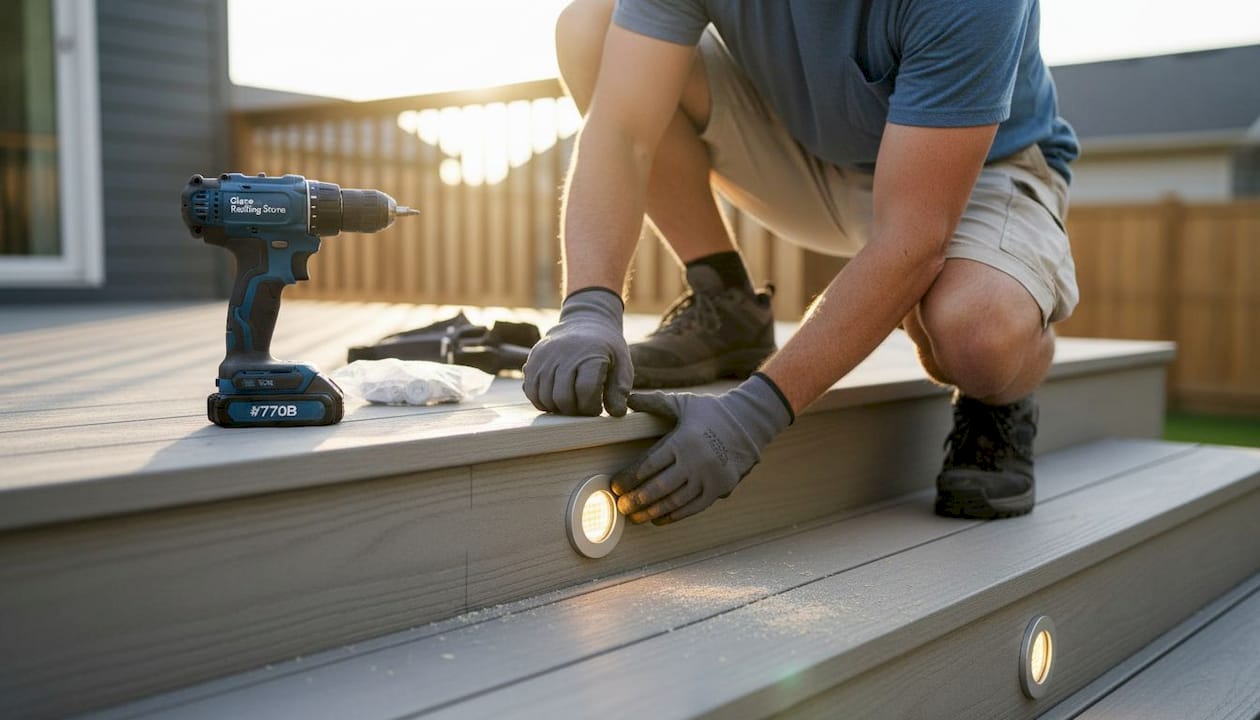
The catch is installation. Recessed deck lights require joist modification done carefully to avoid compromising structural integrity. You should notch no more than one-sixth of the joist depth and drill holes no larger than one-third of the depth. If you are not comfortable with that, hire a professional for the cutout work even if you handle the wiring yourself.
For the cleanest result, go with low-profile LED puck lights. They draw very little wattage, generate almost no heat, and last for years without bulb replacement.
Post cap lights sit on top of railing posts and push light downward and outward along the perimeter of your deck. They are one of the easiest outdoor deck lights to install since most simply attach to a standard 4x4 or 6x6 post top and connect to your low-voltage system.
Beyond the practical benefit of marking the deck edge, they do something subtle but important: they tell your guests exactly where the deck ends. That matters especially on elevated decks. Post cap lights also work beautifully with glass railings because the unobstructed panels reflect and diffuse the glow rather than blocking it.
Pro Tip: Choose post cap lights with a downward-facing beam rather than an omnidirectional bulb. Downward light reduces glare for seated guests and focuses illumination where you actually need it.
This is non-negotiable. Poor lighting placement is a leading cause of deck accidents, and stairs are the number one trouble spot. Every stair riser or stringer needs a light source. No exceptions.
Step lights built into the riser face or along the stringer are the best deck lights for this purpose. They cast light across the tread at foot level, which is exactly where it needs to be. Overhead lighting from above actually creates shadows on the treads, which is worse than useful.
You can find stair riser lights that integrate directly into composite decking profiles, making them completely flush. For wood decks, surface-mount lights with small footprints work just as well. Pair these with safe stair railing installation for a stairway that looks sharp and performs safely at night.
String lights remain one of the most affordable deck lighting options for good reason. A single run from a post to the house creates instant warmth and a sense of enclosure that no recessed light can replicate.
The key is using weatherproof commercial-grade string lights rather than the cheap holiday variety. Look for rubber or silicone-coated sockets and either shatterproof bulb covers or solid LED filament bulbs. Edison-style LED bulbs give you the vintage incandescent look with a fraction of the energy draw.
For a more structured overhead look, run parallel strands across the deck on a grid pattern anchored to posts or a pergola. This creates a soft ceiling of light that works perfectly for entertaining, and it transforms the space visually even when the lights are off.
Railing lights embed directly into the top cap or posts of your railing, producing a linear glow along the perimeter. They are particularly effective with glass panel railings, where the light bounces through the tempered glass and creates a soft, even illumination across the deck surface.
Most railing-integrated LED strips run on low-voltage systems, which means you can add them to an existing transformer without a permit. They are also easy to control with a dimmer, so you can shift from bright and practical to soft and atmospheric with the same fixture.
7. Solar-Powered Accent Lights for Easy Installation
Solar lights are genuinely useful in specific situations. They work well as accent lights in planters, along railings, or in low-traffic areas where you want a soft decorative glow without running wire. They cost nothing to operate once installed.
Where they fall short is in heavily shaded yards or climates with frequent overcast days. Consistent sun exposure is what determines consistent brightness with solar. For primary lighting on stairs or task areas, solar is not reliable enough to depend on. Use it as a supplement, not a foundation.
| Feature | Solar | Low-voltage LED | Line-voltage |
|---|---|---|---|
| Installation | DIY, no wiring | DIY-friendly, low-voltage wiring | Professional required (NEC codes) |
| Permit required | No | Usually no, with GFCI outlet | Yes, in most jurisdictions |
| Brightness | Low to moderate | Moderate to high | High |
| Energy cost | Free (sun) | Very low | Higher |
| Weather reliability | Varies with sun | Excellent | Excellent |
| Lifespan | 2 to 5 years (battery) | 10 to 25 years (LED) | 10 to 20 years |
| Best use | Accent, supplemental | Primary deck lighting | Commercial or high-output needs |
Combining LED lighting with efficient transformers can reduce energy use by up to 70% compared to older incandescent systems, which makes low-voltage LED the clear winner for most residential decks on both performance and cost.
A layout plan prevents the two most common mistakes: too little light in the wrong places and too much light creating uncomfortable glare. Here is a practical process to follow:
- Map your zones. Divide your deck into three zones: stairs and pathways (safety), perimeter and railings (ambient), and task areas like grills or dining tables (functional). Each zone needs different fixture types.
- Space stair lights consistently. Every riser needs coverage. For pathway and perimeter lighting, space fixtures 6 to 8 feet apart for an even glow without hot spots.
- Layer your heights. Use low step lights, mid-height railing lights, and overhead string lights together. Layering different lighting types reduces shadows and glare while making the space feel intentional rather than improvised.
- Size your transformer with room to grow. Add up the total wattage of all fixtures, then choose a transformer where that total equals no more than 80% of its rated capacity. For example, a 150W transformer should run no more than 120W of actual load.
- Account for voltage drop. Fixtures at the far end of a long wire run receive less voltage and appear dimmer. Multi-tap transformers solve this by letting you connect distant fixtures to a higher voltage tap, typically 13V to 15V, to maintain uniform brightness across the system.
- Add automation. A timer or photocell means your lights come on at dusk and shut off on schedule without any manual effort.
Pro Tip: Small fixture size does not equal low wattage. Always check the manufacturer’s spec sheet for actual wattage before adding a fixture to your load calculation. A compact spotlight can draw 20W and throw off an entire transformer’s budget.
The transformer is the brain of your low-voltage deck lighting system, and most homeowners underestimate how much it matters. Choosing one that is too small causes flickering and premature failure. Choosing one that is the wrong type causes an entirely different problem.
Older magnetic transformers have minimum load requirements that make them incompatible with modern low-wattage LEDs. If your total fixture load falls below that minimum, the transformer will not operate correctly. Modern electronic transformers with “no minimum load” specifications are the right choice for any LED-based deck lighting system.
Look for a transformer with multiple taps, built-in timer and photocell capability, and a waterproof enclosure rated for outdoor mounting.
I’ve watched homeowners spend weeks choosing the perfect deck furniture and then light the whole thing with four recessed lights and call it done. The result is always a deck that feels like a parking garage at night.
What I’ve learned is that deck illumination ideas don’t need to be complicated to be effective. You need three things: safety coverage on every stair and pathway, an ambient layer around the perimeter, and at least one warm overhead source above the seating area. That’s the minimum. Everything else is personal preference.
Where I’ve seen the most frustration is with transformer sizing. People buy a 150W transformer and immediately load it to full capacity, then wonder why one zone flickers or why the transformer burns out in two years. The 80% rule for transformer loading is not optional, and building in that headroom also means you can add fixtures later without starting over.
My strongest advice: choose LED over everything else, buy a transformer with timer and photocell built in, and do not skip stair lighting to save money. The safety payoff on that last point alone makes it worth every dollar.
— Fuanne
Great deck lighting deserves a railing system that complements it rather than competing with it. At Glassrailingstore, frameless glass railing panels let your lighting do more work. Light from step fixtures and railing LEDs passes through tempered glass instead of being absorbed by wood or metal, which means better coverage from fewer fixtures.

If you’re planning a full deck upgrade, the custom stair glass railing options from Glassrailingstore pair exceptionally well with integrated stair and railing lights. Every product meets safety standards you can verify through Glassrailingstore’s engineering testing documentation. For professional installation support, Glassrailingstore’s certified installer network connects you with experts who understand both building codes and how lighting and railings work together on a finished deck.
FAQs
1. What type of lighting is best for a deck?
Low-voltage LED lighting is the best choice for most residential decks. It is energy efficient, DIY-friendly, long-lasting, and available in a full range of fixture types from step lights to string lights.
2. Do I need a permit for deck lighting?
Low-voltage systems operating at 12V or 24V DC are generally permit-exempt when connected to a GFCI-protected outdoor outlet. Line-voltage (120V) installations require a permit and professional installation under NEC codes.
3. How do I prevent dark spots on my deck at night?
Layer multiple fixture types at different heights: step lights at floor level, railing or post cap lights at mid-height, and string lights or overhead fixtures above the seating area. Spacing perimeter lights 6 to 8 feet apart also helps fill in gaps.
4. What IP rating should outdoor deck lights have?
Outdoor deck lights should carry a minimum IP65 rating for reliable resistance to rain and dust. For fully waterproof applications near pools or in high-moisture areas, IP67 provides an additional margin of protection.
5. How do I choose the right transformer size for deck lighting?
Add up the total wattage of all your fixtures and choose a transformer where that load does not exceed 80% of the rated capacity. This protects the transformer from overheating and leaves room for additional fixtures without requiring a full system replacement.
Recommended
- Why glass barriers beat wood and metal for outdoor safety – The Glass Railing Store
- Boost curb appeal and value with glass railings – The Glass Railing Store
- How to install deck railing for a safe, stylish deck – The Glass Railing Store
- Tempered glass advantages: enhance safety and design outdoors – The Glass Railing Store