

Balcony Glass Systems Explained: Safety, Design, and Compliance
Most homeowners shopping for balcony railing glass focus almost entirely on looks. Will it match the deck? Will it keep the view open? Those are fair questions, but they miss the bigger picture. A balcony glass system is first and foremost a safety barrier, and the choices you make about glass type, hardware, and installation have direct legal consequences. This guide breaks down exactly what these systems are, how the different glass types perform under real stress, what building codes actually require, and what to watch for before you buy.
Table of Contents
- What is a balcony glass system?
- Types of glass used in balcony systems: Toughened vs. laminated
- Code requirements and compliance for balcony glass systems
- Key considerations for choosing a balcony glass system
- Why most property owners underestimate balcony glass safety and compliance
- Explore certified, code-compliant balcony glass solutions
- Frequently asked questions
Key Takeaways
| Point | Details |
|---|---|
| Complete safety system | A balcony glass system is a coordinated assembly engineered for fall protection, not just looks. |
| Glass type matters | Toughened and laminated glass have distinct safety roles and post-break behaviors. |
| Code compliance is essential | All systems must meet specific height and load requirements as defined by local building codes. |
| Expert installation advised | Professional help ensures your system is compliant, safe, and long-lasting. |
What is a Balcony Glass System?
A balcony glass system is far more than a decorative panel bolted to a railing. According to an engineered guard/barrier assembly definition widely accepted in the construction industry, these systems use specified glass types, most commonly tempered and laminated safety glass, engineered to function as a fall barrier and resist defined structural loads. That means every single component works together as a system, not as separate decorative pieces.
You’ll hear several terms used interchangeably in the industry: glazed balcony, glass balustrade, glass guard rail, and glass panel railing. They all refer to the same basic concept. What varies is the configuration, the framing style, and the glass specification. Understanding that distinction matters because swapping one component without considering how it interacts with the rest can compromise the entire system’s performance.
Core components of a balcony glass system:
- Glass panels: The primary barrier element, most commonly tempered, laminated, or tempered-laminated glass
- Posts and standoffs: Structural supports that anchor the glass to the balcony structure
- Top rail or cap rail: A horizontal element running along the top of the panels for grip and structural continuity
- Base channels or clamps: The hardware that holds the glass at the bottom or sides
- Connectors and fasteners: Hardware that ties all components together and transfers loads to the structure
Here’s a quick reference for common system configurations:
| System type | Frame style | Best use case | Glass typically used |
|---|---|---|---|
| Fully framed | Posts and top/bottom rails | High-traffic commercial | Tempered |
| Semi-frameless | Posts only, no bottom rail | Residential decks | Tempered or laminated |
| Frameless | Standoffs or base channel | Premium views, modern homes | Tempered or laminated |
| Structural glass | No visible hardware | High-end architectural | Laminated or laminated tempered |
Beyond the components themselves, the system must be engineered as a unit. Check out glass railing code essentials to understand how these assemblies are evaluated for code compliance. The engineering behind load resistance is where many DIY installations fall short, often invisibly, until something goes wrong.
Types of Glass Used in Balcony Systems: Toughened vs. Laminated
The glass type is probably the single most important safety decision in any balcony glass system. Two types dominate: toughened (tempered) glass and laminated glass. They behave very differently when they break, and that difference has serious real-world consequences.
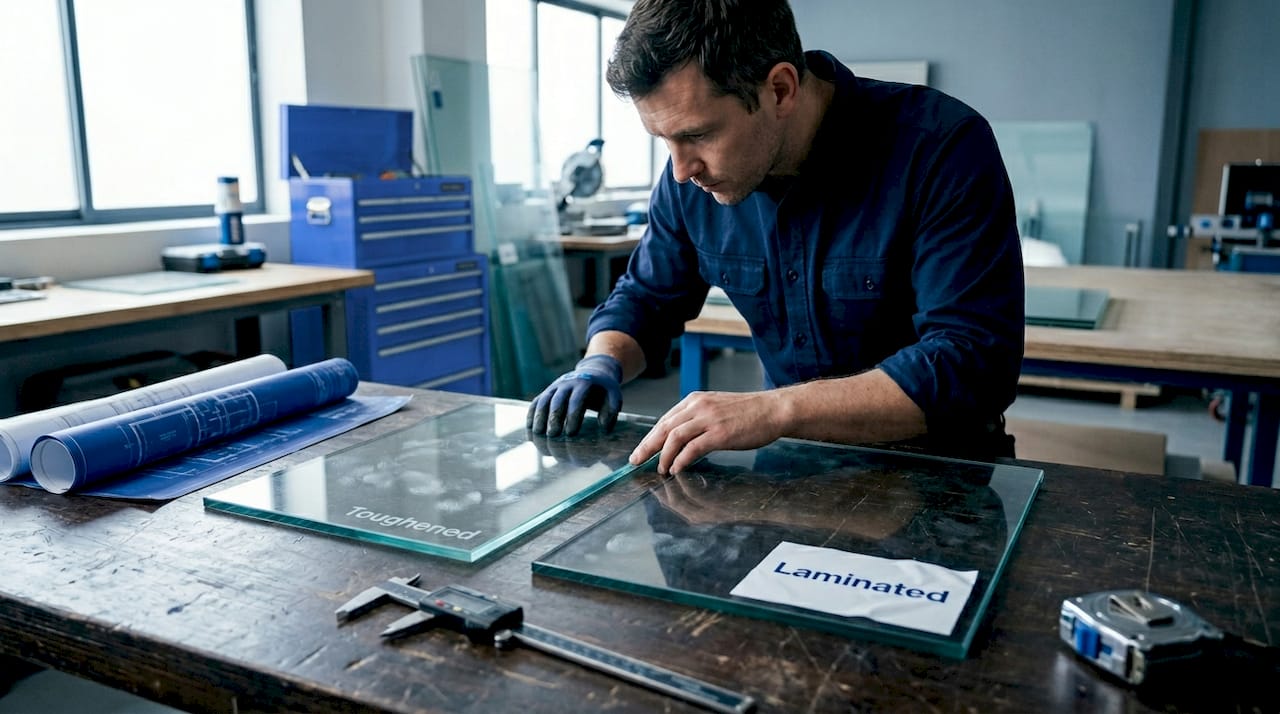
Toughened glass is produced by heating standard annealed glass and then rapidly cooling it, which puts the outer surfaces under compression. This process makes it four to five times stronger than ordinary glass under normal loads. When it does break, it fragments into small, relatively blunt pieces rather than large shards. That’s good for reducing injury. The problem is that once toughened glass breaks, it loses its structural integrity immediately. The entire panel collapses, and the barrier is gone.
Laminated glass uses two or more glass layers bonded together with a polymer interlayer, most commonly PVB (polyvinyl butyral). When laminated glass breaks, the fragments stick to the interlayer and the panel stays in place. The barrier function is largely maintained even after the glass is damaged. As laminated glass performance research confirms, this characteristic makes it the preferred choice for applications where falling debris or sudden barrier loss poses a significant risk.
Here’s a side-by-side comparison:
| Property | Toughened glass | Laminated glass |
|---|---|---|
| Strength (vs. annealed) | 4 to 5 times stronger | Comparable or slightly higher |
| Break pattern | Small blunt fragments | Fragments held by interlayer |
| Barrier after breakage | Lost immediately | Mostly retained |
| Falling debris risk | Higher | Lower |
| Cost | Lower | Higher |
| Preferred application | Lower-risk residential | High-risk, overhead, elevated |
For balcony applications, many architects and engineers specify laminated tempered glass, which combines both processes. You get the strength of tempered glass and the post-break integrity of laminated glass. This is increasingly becoming the standard for elevated balconies and commercial projects.
“Laminated glass is often preferred where retaining fragments in-plane after damage reduces the risk of falling debris, while toughened glass fractures differently.” This is a distinction that can mean the difference between a recoverable incident and a fatal fall.
Pro Tip: If your balcony is more than two stories above grade, seriously consider laminated or laminated tempered glass regardless of what the minimum code requires. The extra cost is minimal compared to the liability exposure of a panel that disappears when it breaks.
You can learn more about how these materials are evaluated through engineering and testing methods, including the specific load protocols used to verify performance.
Here’s where many property owners get themselves into trouble. They buy a system that looks great, hire someone to install it, and assume it’s compliant. Often, it isn’t. Building codes set specific minimum requirements for balcony glass systems, and ignorance of those requirements is not a legal defense when something goes wrong.
In the United States, balcony glass railings are governed primarily by the International Building Code (IBC) and the International Residential Code (IRC), along with state and local amendments. California, for example, has a detailed interpretation document for glass panel railings under the 2025 CBC. That document makes clear that balcony glass railings must meet minimum guarding heights and load resistance requirements, verified through either a design method or a test method.
The key requirements you need to understand:
- Minimum height: In most US jurisdictions, the guard rail must be at least 42 inches high for commercial applications and 36 inches for residential, measured from the walking surface. Some jurisdictions require 42 inches for all applications regardless of occupancy.
- Load resistance: Glass panels must resist both a concentrated load (typically 200 pounds applied at any point on the top rail) and a distributed horizontal load (50 pounds per linear foot for commercial, less for residential).
- Glass specification: Safety glazing is required in all guard and railing applications. This means either tempered, laminated, or a combination of both.
- Infill testing or engineering: The glass panel itself must be verified through either an engineering calculation (design method) or physical testing (test method) to confirm it can handle the required loads at the specified thickness and span.
- Documentation: A compliant system needs documentation, including engineering drawings, glass certifications, and in some cases a third-party test report.
For a deeper understanding of regional compliance requirements, review the code requirements for glass railings and the specific California standards for balcony glass if you’re building or remodeling in that state.
Why does this matter so much? A non-compliant balcony glass system can expose you to serious liability if someone is injured. Beyond that, it can fail a building inspection, delay your project, and require expensive remediation. Insurance policies can also be voided if a claim arises from a non-compliant installation. The compliance path isn’t bureaucratic red tape. It’s the mechanism that ensures the system will actually hold up when someone pushes against it.
Key Considerations for Choosing a Balcony Glass System
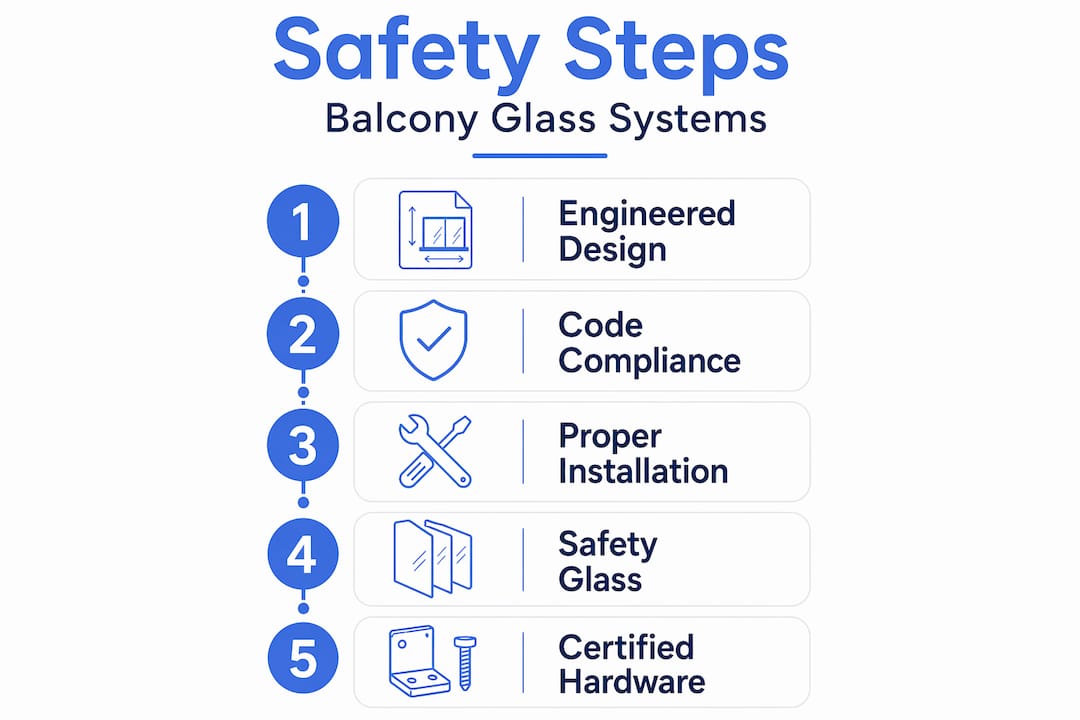
Now that you understand what these systems are and what they need to do, here’s how to make a smart purchasing decision. There’s no single right answer. The best system for a ground-level residential deck in Phoenix is probably different from the right system for a 15th-floor commercial terrace in Chicago.
Factors to evaluate before you buy:
- Location and height above grade: Higher elevations increase the consequences of failure and often trigger stricter code requirements
- Residential vs. commercial use: Commercial applications face higher load requirements and stricter inspection regimes
- Local climate: Coastal environments require marine-grade stainless steel hardware to resist corrosion; freeze-thaw cycles affect sealant performance
- Aesthetic goals: Frameless systems maximize views but require thicker, more expensive glass; framed systems can use thinner glass but are more visually prominent
- Budget: Account for glass, hardware, installation, and engineering documentation, not just the panel price
- Local building code: Always verify with your local building department before purchasing
The entire system must be engineered as a compliant unit. Buying code-compliant glass panels and pairing them with non-compliant posts or anchors doesn’t produce a compliant system. The whole assembly needs to work together.
Check the US glass railing code overview to understand what baseline requirements look like across jurisdictions before you start comparing products.
Questions to ask any supplier or installer:
- Can you provide engineering documentation for this system at my specific span and load requirements?
- Is your glass certified to ANSI Z97.1 or CPSC 16 CFR 1201?
- What hardware grade do you use for coastal or high-humidity environments?
- Can you pull permits on my behalf and manage inspections?
- Do you offer test reports for your glass panel assemblies?
Pro Tip: Always ask for installer credentials and check whether they have experience with permitted projects in your jurisdiction. An experienced installer knows the local inspectors and knows exactly what documentation they’ll need to pass the job.
Why Most Property Owners Underestimate Balcony Glass Safety and Compliance
We see this pattern constantly. A homeowner spends weeks picking out the perfect glass panel color, frameless vs. semi-frameless, the exact shade of hardware finish, and then spends about 20 minutes thinking about whether the system meets code. The aesthetic decision gets 90% of the attention. The safety decision gets the rest.
That imbalance is understandable. Glass is visual. You can see it. Compliance is invisible until it isn’t. And when it stops being invisible, it’s usually because something went wrong.
The real-world consequences of non-compliant or poorly installed balcony glass systems are not hypothetical. Panels installed without proper engineering calculations can pass casual inspection but fail under dynamic loads like a crowd leaning against a railing at a party. Glass that isn’t properly anchored at the base can develop stress fractures over time from thermal movement, quietly weakening until a minor impact causes sudden total failure. These aren’t rare worst-case scenarios. They’re documented failure modes that proper engineering is specifically designed to prevent.
There’s also a liability dimension that most homeowners don’t think about until they’re talking to a lawyer. If someone is injured on your property because of a non-compliant railing, your homeowner’s insurance may not cover the claim. Non-compliant construction is often treated as a policy exclusion. That means personal exposure to medical costs, legal fees, and potential judgments.
Our perspective, shaped by working with both homeowners and professional contractors on projects ranging from small residential decks to large commercial terraces, is that the conversation about balcony glass systems needs to start with safety and code, not style. Style comes after you’ve confirmed the system can do its job. When you understand glass railing codes upfront, the aesthetic choices become easier because you’re working within a defined, safe framework rather than retrofitting compliance onto a design that may not support it.
The good news: a properly engineered, code-compliant balcony glass system is also a beautiful one. Safety and aesthetics aren’t at odds. But safety has to come first.
Explore Certified, Code-Compliant Balcony Glass Solutions
Understanding the technical side of balcony glass systems is the first step. Finding a supplier who can actually deliver on those requirements is the next one.

At Glass Railing Store, every system we offer is built around safety glass, marine-grade hardware, and compliance with US building standards. Whether you’re navigating the permit process for the first time or specifying a system for a commercial terrace, our resources are designed to help you move from knowledge to action with confidence. Explore our full building code guide to understand what your jurisdiction requires, and review our engineering testing and compliance documentation to see how our systems are verified. If you’re ready to get specific, request a quote and our team will help you match the right system to your project’s exact requirements.
FAQs
1. What makes a glass system safe for balconies?
A safe balcony glass system uses an engineered guard/barrier assembly with specified safety glass types, designed to resist defined structural loads and function as a compliant fall barrier. Every component, including the glass, posts, hardware, and anchors, must work together as a tested and documented unit.
2. What is the difference between toughened and laminated glass?
Toughened glass breaks into small blunt fragments that fall away, while laminated glass stays in place because fragments bond to the interlayer, maintaining the barrier function even after breakage. For elevated balconies, laminated or laminated tempered glass is generally the safer choice.
3. Are there specific height or load standards for balcony glass railings?
Yes. Building codes require minimum guarding heights and load resistance for all balcony glass guard systems, verified through either engineering calculations or physical testing. Minimums vary by jurisdiction and occupancy type.
4. Is professional installation required for balcony glass systems?
Professional installation is strongly advised because compliance depends on correct anchoring, proper torque on fasteners, and accurate load path design, details that are easy to get wrong without hands-on experience. An improperly installed system can look perfect and still fail under load.
5. Can I retrofit an existing balcony with a glass system?
Retrofitting is possible, but it requires a structural assessment of the existing balcony framing and a thorough code review to confirm the substrate can handle the anchor loads the new glass system will generate. Skipping that step is one of the most common sources of costly installation failures.
Recommended
- Avoid these glass railing mistakes for a safe, stylish home – The Glass Railing Store
- Tempered glass advantages: enhance safety and design outdoors – The Glass Railing Store
- California Building Standards Code for Glass Railings – The Glass Railing Store
- Choosing safe and stylish glass thickness for railings – The Glass Railing Store