

How Much Does a Glass Railing Panel Weigh?
Most residential glass railing panels weigh between 5 and 7.5 pounds per square foot, depending on thickness. A typical 4-foot by 3-foot frameless panel in 1/2-inch tempered glass lands close to 80 pounds, which is roughly the point where you stop lifting by hand and start planning for two people or a vacuum lifter.
The numbers behind this trace back to one formula: glass weighs 2.5 kilograms per square meter for every millimeter of thickness. That figure, along with load guidance from the International Code Council, is what installers and engineers actually use to size hardware and plan a safe lift.
- 10mm tempered glass: about 5.3 lb/ft²
- 12mm laminated glass: about 6.7 lb/ft²
- Panels over 80 lb: plan for mechanical lifting or a two-person carry
Key Takeaways
Glass railing panel weight follows one formula, thickness times a fixed density factor, and that single number drives every safety and hardware decision downstream.
| Point | Details |
|---|---|
| Use the density formula | Weight (kg/m²) equals thickness in millimeters times 2.5; multiply by area for total weight. |
| Watch the 80-pound line | Panels approaching 80 lb typically need two people or a vacuum lifter, not a solo carry. |
| Laminated adds a little | PVB interlayers add under 0.5 kg/m², a minor adjustment unless you’re at a weight threshold. |
| Size hardware with a margin | Rate clamps and anchors for 20 to 25 percent over nominal panel weight to cover variance. |
| Confirm specs before ordering | Glassrailingstore’s tempered panel pages list exact dimensions to verify your weight math. |
Table of Contents
- Calculating Glass Railing Panel Weight: The Formula and Quick Conversions
- Glass Weight by Thickness: A Quick Reference Chart
- Does Tempered, Laminated, or Insulated Glass Weigh More?
- Safe Handling: When to Bring in a Second Person or a Lifter
- How Panel Weight Shapes Hardware and Fitting Choices
- When Panel Weight Calls for an Engineer or a Code Check
- Two Quick Worked Examples You Can Copy
- Order Tempered Panels and Rated Hardware Direct
- Frequently Asked Questions
- Sources
Calculating Glass Railing Panel Weight: The Formula and Quick Conversions
The math is simpler than most people expect. The metric version comes straight from glass density: weight (kg/m²) equals thickness (mm) times a constant factor. For example, a 10mm panel weighs about 25 kg/m², and a 12mm panel about 30 kg/m². Multiplying that by your panel’s area in square meters gives the total weight.
For imperial measurements, use a formula where weight (lb) roughly equals width (in) times height (in) times thickness (in) times a constant. That 0.0903 constant accounts for glass density converted into pounds per cubic inch.
Here’s how it plays out on a real panel:
- Measure the panel: say 36 inches wide by 48 inches tall, in 1/2-inch (0.5") tempered glass.
- Multiply: 36 × 48 × 0.5 × 0.0903 ≈ 78 lb.
- Cross-check with area-based figures: at roughly 6.5 lb/ft² for half-inch tempered glass, a 12 square foot panel comes out close to the same number.
Both methods should land within a few pounds of each other. If they don’t, recheck your thickness assumption. Online tools like the Glass Weight Calculator or Quattrolifts’ glass weight calculator will do this math instantly if you’d rather skip the arithmetic on a job site.
Glass Weight by Thickness: A Quick Reference Chart
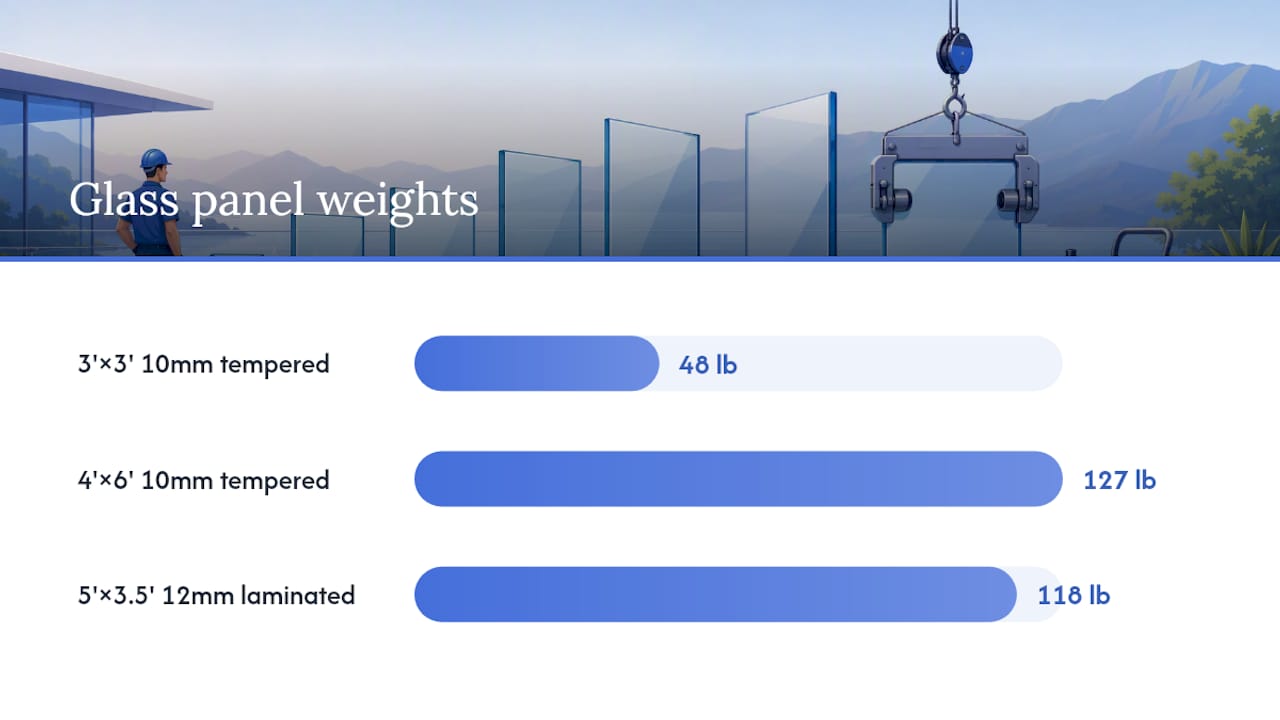
Once you know the per-area weight for your glass thickness, sizing any panel is just multiplication. Here’s how the common railing thicknesses stack up:
The 12mm and 13.5mm figures reflect laminated glass commonly used in frameless base-channel systems, which is why they run a bit heavier per millimeter than the raw glass density formula alone would suggest.
Applying those numbers to real panels:
- A 3’×3’ panel in 10mm tempered glass: about 48 lb
- A 4’×6’ panel in 10mm tempered glass: about 127 lb, solidly in mechanical-lift territory
- A 5’×3.5’ panel in 12mm laminated glass: about 118 lb
Pro Tip: Laminated glass includes a PVB interlayer that adds a small amount of extra mass, usually under half a kilogram per square meter. It won’t change your ballpark estimate much, but if you’re right at a lifting threshold, round up rather than down.
Does Tempered, Laminated, or Insulated Glass Weigh More?
Tempering doesn’t add weight. Toughened (tempered) glass and standard annealed glass have essentially identical mass per thickness because the heat-treatment process changes the internal stress profile, not the density of the material.
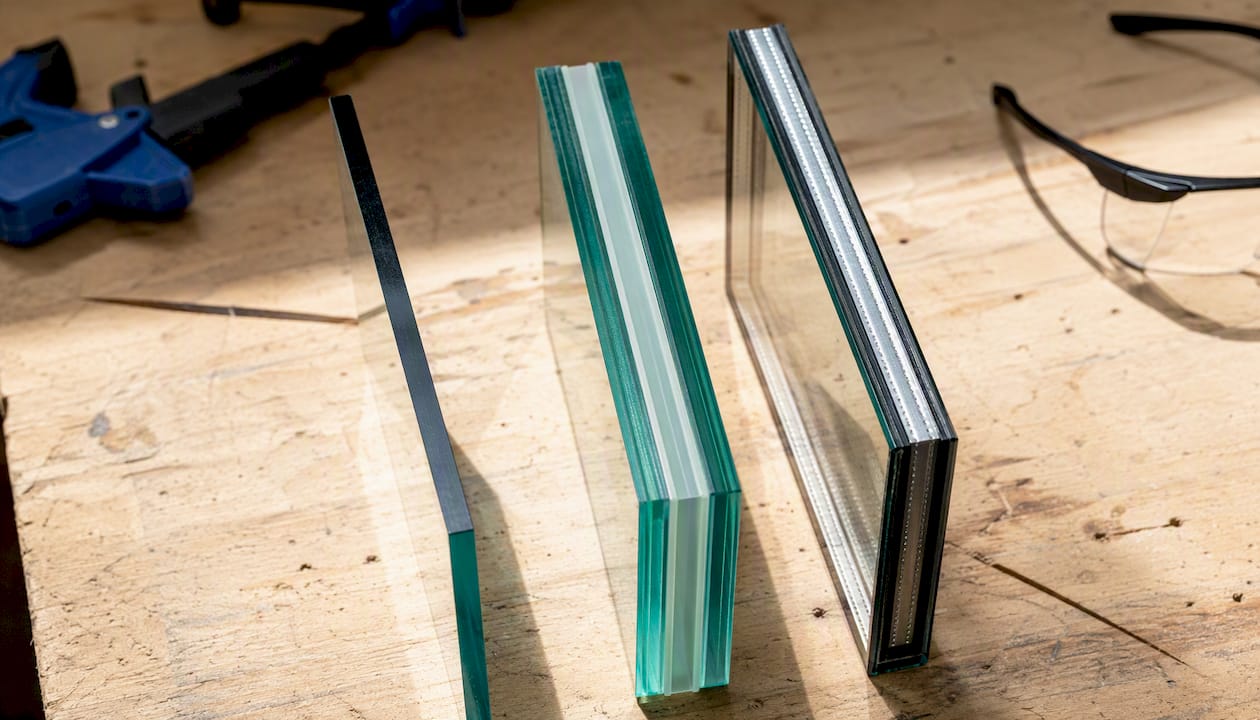
Laminated glass is a different story, though only slightly. The PVB interlayer bonding two panes together adds a small amount of extra weight, typically well under 0.5 kg/m². It’s a rounding error on most panels but worth including if you’re calculating right up against a lifting or hardware limit.
Insulated glass units (double-glazed panels) barely move the needle either. Most of an IGU’s weight comes from the glass panes themselves. The spacer and gas fill between them add negligible mass in nearly every calculator and engineering table you’ll find.
Safe Handling: When to Bring in a Second Person or a Lifter
Weight thresholds aren’t arbitrary. They’re based on what a human body can safely carry without risking a dropped panel, a strained back, or a bad cut from a broken edge.
- Under 40 lb: one person can typically handle a small panel alone with proper glove and grip technique.
- 40 to 80 lb: this is two-person territory. Panels in this range are awkward more than heavy, and a dropped edge is the real risk.
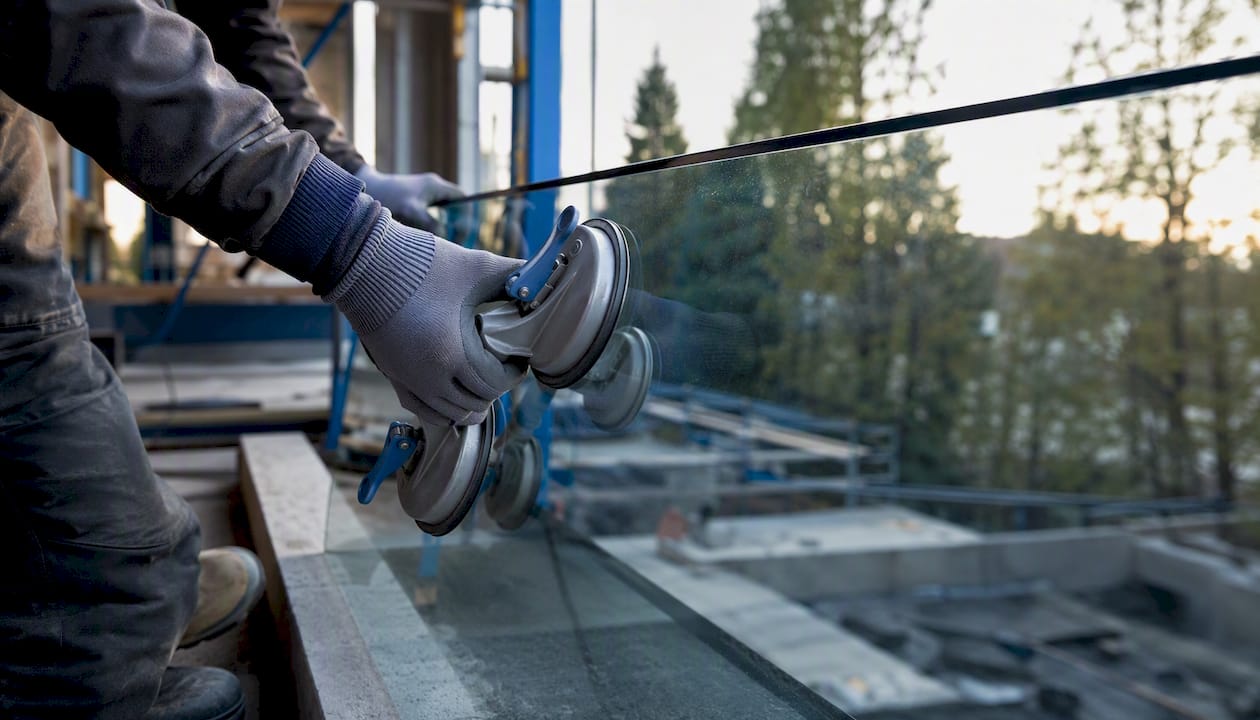
- Over 80 lb: installer guidance points to mechanical lifting at this threshold. Vacuum lifters or suction-pad carts become the standard tool, not an optional upgrade.
Before any lift, regardless of weight, run through a basic checklist: cut-resistant gloves, forearm protection, a clear and level path to the install point, and cribbing or a padded cart for temporary staging. Never lean a panel unsupported against a railing post while you grab hardware. Vacuum lifters speed up placement and cut injury risk on any job where panels are consistently pushing past that 80-pound mark, and most equipment rental yards carry them for a day-rate that’s far cheaper than an ER visit.
Pro Tip: If you’re ordering panels for a multi-day install, rent the vacuum lifter for the whole job rather than per-panel. The setup and breakdown time adds up fast if you’re renting piecemeal.
How Panel Weight Shapes Hardware and Fitting Choices
Frameless systems using base channels concentrate the entire panel’s weight onto anchors spaced along the deck or slab. Framed systems with posts and caprail spread that same load across multiple connection points. The math is the same, but the practical risk to your substrate is not.
- Heavier panels need clamps, spigots, and channel anchors with load ratings that match or exceed calculated weight, not just visual “looks sturdy enough” judgment.
- Fastener type and substrate condition matter as much as the hardware rating. A rated spigot bolted into deteriorated decking is still a failure point.
- Frameless base-channel anchors concentrate load at close spacing, so a total system weight that looks fine per linear foot can still overload individual anchor points.
A reasonable safety margin is to size hardware for at least 20 to 25 percent over your nominal calculated weight. That buffer covers minor thickness variation, laminated interlayer mass, and installation error. If you’re working with heavier laminated panels, our guide on choosing glass panel thickness walks through how thickness choice interacts with hardware selection in more detail.
Pro Tip: Check the wall connector or channel anchor’s rated load against your worst-case panel weight, not the average one, before you finalize an order.
When Panel Weight Calls for an Engineer or a Code Check
Most residential railing jobs don’t need a structural engineer. Some do, and knowing the difference upfront saves a failed inspection later.
- Larger panels or systems with higher loads merit review by a qualified installer or engineer.
- Frameless base-channel systems installed on older deck framing of unknown condition are a common red flag, since concentrated anchor loads can exceed what aging joists were designed to carry.
- Coastal or high-wind exposure changes the load equation entirely. Our wind load guide for U.S. projects covers what changes when you’re building near open water.
ICC and IBC guardrail provisions set the baseline loads your system needs to resist, including a 200 lb concentrated top-rail load and a 25 psf uniform panel load. Local permit offices often want your weight calculations documented alongside your hardware specs, so keep your math on paper before you submit.
Two Quick Worked Examples You Can Copy
Metric example: A 900mm × 1000mm panel in 10mm tempered glass. Weight per area is 25 kg/m² (10 × 2.5). Area is 0.9 m², so total weight is about 22.5 kg, roughly 50 lb.
Imperial example: A 42-inch by 72-inch tall balcony panel in 1/2-inch (0.5") tempered glass. Using the formula: 42 × 72 × 0.5 × 0.0903 ≈ 137 lb, well into two-person or lifter territory.
For a fast double-check on either method, Quattrolifts’ glass weight calculator gives instant results in both units. When you’re ready to order, confirm exact panel dimensions against Glassrailingstore’s 46-inch tempered glass panel specs before you finalize your hardware list.
A Practical Note on Margins
Round your weight estimates up, not down, and always check the number against the manufacturer’s spec sheet before you order hardware or plan a lift.
Order Tempered Panels and Rated Hardware Direct
Glassrailingstore sells tempered glass panels in standard heights alongside marine-grade stainless steel and aluminum hardware rated for exactly the loads this guide walks through, so you’re not guessing whether a connector matches your calculated panel weight.

If you’ve run the numbers above and landed on a panel size, the 46-inch tempered glass panel page lists exact specs to confirm your weight calculation before checkout. Need corner hardware rated for a heavier laminated panel? The 90-degree connector and wall connector pages list load-relevant specs for framed and wall-mounted setups. Glassrailingstore’s team can also help verify panel weight and hardware fit before you order, so a quick measurement check now saves a mismatched fitting later. Browse the panel and hardware catalog to size your next order.
FAQs
1. How much does a standard glass railing panel weigh?
A typical 36-inch by 48-inch panel in half-inch tempered glass weighs around 78 to 80 pounds, based on the imperial weight formula and confirmed by online calculators like Quattrolifts.
2. What’s the formula for glass railing panel weight?
Metric: weight (kg/m²) equals thickness in millimeters times 2.5. Imperial: weight (lb) roughly equals width times height times thickness (all in inches) times 0.0903.
3. At what weight do I need two people to lift a glass panel?
Panels between 40 and 80 pounds generally call for two people. Above roughly 80 pounds, mechanical lifting equipment like a vacuum lifter becomes the safer standard.
4. Does laminated glass weigh more than tempered glass?
Slightly. The PVB interlayer in laminated glass adds a small amount of mass, typically under half a kilogram per square meter, which rarely changes your handling plan.
5. When do I need an engineer to review my glass railing weight?
Consult an engineer for panels over about 15 square feet, frameless base-channel systems on older deck framing, or any installation in a high-wind or coastal zone where code review is likely required.
Sources
- Glass Weight Calculator: Free, Instant, lb + kg
- Glass Railing Calculator — Framed vs Frameless + Cost | DeckMath
- Glass Weight Calculator: Free, Instant, lb + kg | Quattrolifts
- ICC — International Code Council