

5 Minute Fix for Parents: 4 Code Checks for Child Safe Glass Railings
Yes, glass railings can be entirely child safe glass railings for homes with young children, but only when four things line up: safety glazing (tempered or laminated), correct guardrail height, no gaps a small child could slip through, and secure, well-maintained anchoring. Check those four boxes and a glass railing is arguably safer than a wood rail with wide balusters that a toddler can climb. If your current railing fails any check, retrofit fixes exist and don’t require ripping the whole thing out.
TL;DR:
- Ensuring a glass railing meets safety standards involves checking for tempered or laminated glass, correct height, no large gaps, and secure anchoring.
- Glass thickness and type should match the specific location, with certificates explicitly stating compliance with safety standards.
- Routine home checks should measure guardrail height, test gaps with a small ball, and assess climbability around the railing for potential hazards.
- Simple retrofits like infill panels or temporary mesh screens can close safety gaps without full replacement, but permanent fixes are preferable for exterior use.
- Proper hardware selection and professional installation are critical, with regular inspections for corrosion, wobbling, or chips to maintain long-term safety.
Table of Contents
- Why glass can be safer than other rails: tempered vs. laminated glass
- Design rules parents must check: height, gaps, and climbability
- Retrofit and quick childproofing options for existing railings
- Installation and hardware: what keeps a mounted glass railing secure
- Maintenance and inspection checklist parents should follow
- Publisher expertise: how Glassrailingstore supports safe installations
- A parent’s priority order for glass railing safety
- Ready to upgrade? What Glassrailingstore offers for childproofing
- Sources
Why Glass Can Be Safer Than Other Rails: Tempered vs. Laminated Glass
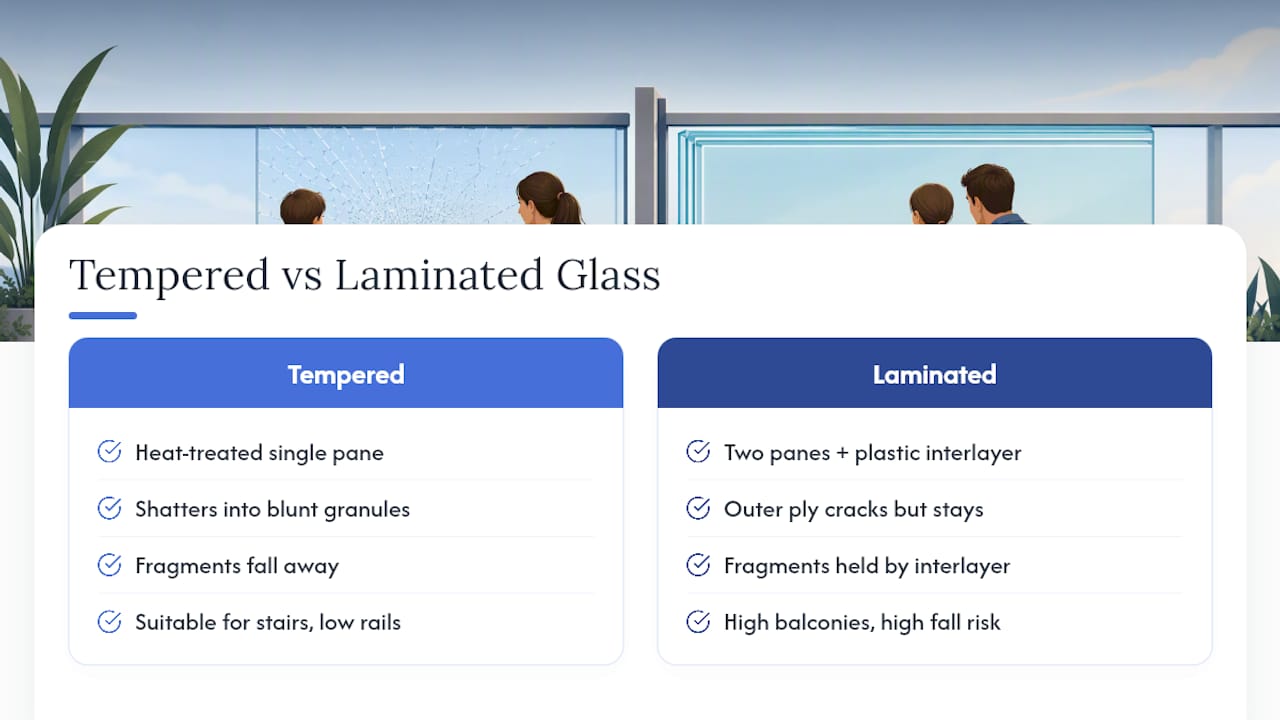
Most residential glass railings use tempered safety glass, heat-treated so it’s several times stronger than ordinary annealed glass and engineered to shatter into small, blunt granules rather than sharp shards if it ever breaks. That shatter pattern is the whole point. A wine glass shatters into blades; tempered glass crumbles into pieces closer to gravel.
Laminated glass takes this further by sandwiching a plastic interlayer between two glass sheets. If the outer ply cracks, the interlayer holds the fragments in place instead of letting them fall, which is why laminated-tempered combinations show up on high balconies and anywhere a fall from height compounds the risk of a break.
Thickness and glazing type should match the location. A stair rail on the second floor of a house carries different load and fall-height stakes than a pool fence or a fourth-floor balcony. Ask any supplier for the glazing certificate before you buy, not after installation. It should specify tempered or laminated, thickness, and the testing standard it meets. Reputable sellers, including the building code guidance published by Glassrailingstore, spell this out clearly rather than burying it in fine print.
Design Rules Parents Must Check: Height, Gaps, and Climbability
Codes and best practice converge on a few hard numbers, and you don’t need a contractor to check them.
Height. Most residential codes set a minimum guardrail height commonly around three feet, measured from the finished floor to the top of the rail. Higher-risk spots, elevated decks, and pool enclosures typically require a taller guardrail. Measure with a tape from the actual floor surface, not the subfloor, and don’t guess based on how the rail looks.
Gaps. The standard test is whether a 100 mm sphere, roughly the size of a small child’s head, can pass through any opening in the railing. That’s about 4 inches. Measure at the tightest point of any gap, including the space under the bottom rail and between panels.
Climbability. Horizontal rails, mid-rails, and decorative ledges turn a railing into a ladder. Full-height continuous glass panels avoid this entirely because there’s nothing for small feet to grip. Keep planters, chairs, and toy boxes away from the railing line too. Furniture next to a rail defeats the height requirement instantly.
A five-minute home check covers it, as detailed in the scaffolding inspection protocols that emphasize routine safety checks.
- Measure floor-to-rail-top height with a tape measure
- Test every gap with a ball or round object about 4 inches across
- Walk the perimeter looking for anything climbable within arm’s reach of the rail
- Push on the top rail and each panel edge to feel for movement
Retrofit and Quick Childproofing Options for Existing Railings
You don’t need a full replacement to close a safety gap. Clear polycarbonate or added glass infill panels can fill wide baluster gaps on an existing rail, keeping the view intact while removing both the pass-through risk and the foothold. For a rail that’s a few inches short of code height, a top-up glass extension or a framed add-on panel raises the guard without touching the structural anchoring below.
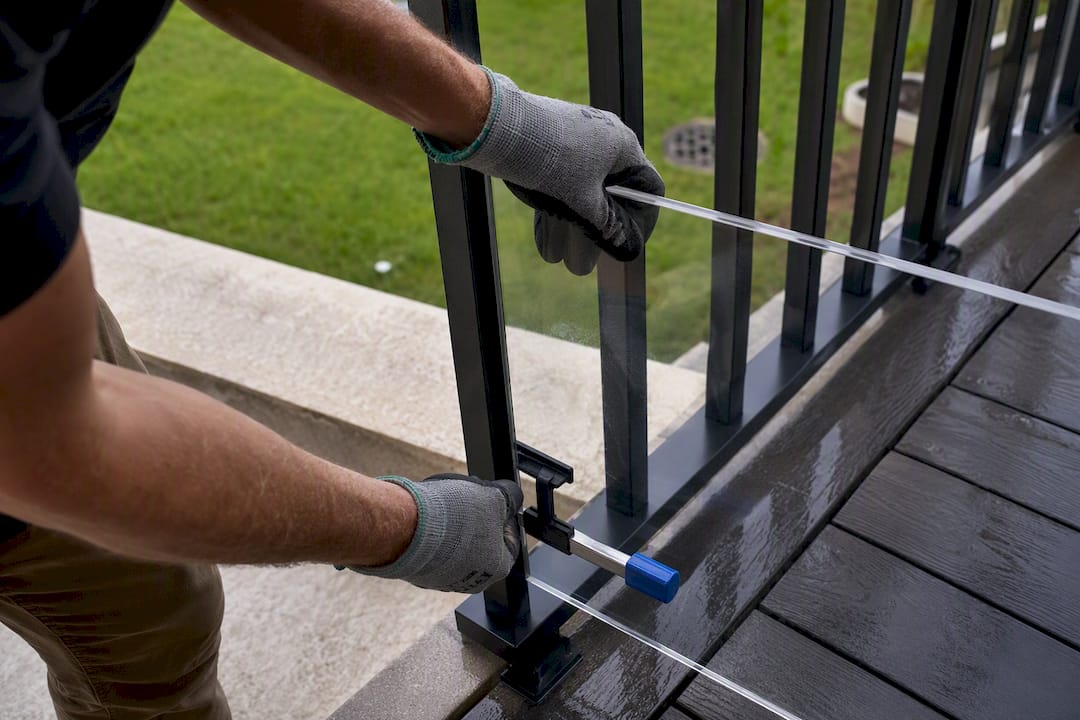
Temporary interior mesh screens or clear acrylic sheets zip-tied or clamped to an existing rail work as a stopgap, but they’re just that. Wind exposure, UV degradation, and weak attachment points mean they shouldn’t be your permanent answer on an exterior deck or balcony.
Pro Tip: Before you buy anything, do the free fixes first. Move furniture and planters away from every railing, lock doors leading to balconies above the second floor, and keep the sphere test handy for when new furniture or a play structure gets added near an edge.
Quick wins to deploy today:
- Slide any climbable furniture at least 3 feet from the railing line
- Add a door lock or alarm on balcony or upper-deck access points
- Fill obvious gaps with temporary rigid panels while you plan a permanent fix
- Photograph problem areas so you can show a contractor exactly what needs solving
Installation and Hardware: What Keeps a Mounted Glass Railing Secure
A glass panel is only as child safe glass railings as what’s holding it up. Posts and connectors need to anchor into real structure, concrete, a rim joist, solid framing, not just decking boards or thin trim. Loose base plates, visible gaps between post and surface, or rust streaks around fasteners are all warning signs that anchoring has failed or was never done right.
Hardware grade matters more outdoors than most homeowners assume. Marine grade stainless steel resists corrosion far longer than standard coated steel, and corroded fasteners are one of the more common causes of a railing loosening over years, not months. Frameless systems in particular depend on precise clamp or standoff hardware, so choosing the right connector type for the application matters as much as the glass itself. A caprail finish over the top edge adds rigidity and gives small hands something rounded to hold instead of a raw glass edge.
For any exterior installation, insist on a licensed installer and ask for documentation showing anchor spacing and load testing.
Maintenance and Inspection Checklist Parents Should Follow
Glass railings need routine attention, not constant worry. A simple schedule catches problems while they’re still cheap to fix:
- Weekly: Walk the railing line and look for chips, cracks, or cloudy spots in the glass.
- Quarterly: Check every visible fastener and connector for looseness or rust, and gently push each panel to feel for wobble.
- Annually: Have a professional inspect exterior systems, since freeze-thaw cycles and sun exposure stress hardware in ways a visual check misses.
If a panel shows a chip near an edge or you find a loose post, treat it as urgent: rope off the area and call for repair or replacement rather than waiting. A wobbling rail or a spider-cracked panel means replace, not patch.
Publisher Expertise: How Glassrailingstore Supports Safe Installations
Glassrailingstore maintains detailed building code guidance and an inspection checklist that map directly onto the height, gap, and hardware checks above. Product pages list panel thickness and glazing type up front, and measurement guides help you match panel size to your opening before you order connectors or caprail hardware.
A Parent’s Priority Order for Child Safe Glass Railings
If you’re staring at a railing wondering where to start, don’t try to fix everything at once. Pull climbable furniture away from the edge first, that’s free and takes five minutes. Add temporary infill or a lock on access doors next. Then plan the permanent upgrade, new panels, a top-up extension, or a full professional install, on your own timeline. Do a monthly walk-around, and when a panel looks off or a post wobbles, call a professional instead of guessing. Good design and real child safety aren’t a trade-off here.
— Fuanne
Ready to Upgrade? What Glassrailingstore Offers for Childproofing
If your checklist turned up a gap that’s too wide or a rail that’s a few inches short, Glassrailingstore carries the parts to fix it without a full teardown. The 46 inch tempered glass panel works well for raising a low guard to a safer height, and 90 degree connectors and square caprail connectors let you finish corners and top edges cleanly, whether a contractor is installing or you’re handling it yourself.

Start by measuring your opening height and widest gap, the same checks covered above, then request a quote through the product pages for the panel size and hardware you need. Glassrailingstore ships parts for both DIY installs and contractor jobs, so whether you’re closing one gap or replacing an entire railing run, you can order exactly the pieces the job calls for and get moving on the fix this weekend.
Sources
- Glass tables: an overlooked safety threat — Harvard Gazette
- Are glass deck railings child-proof? — Life-Style Metal blog